THROW-OFF MECHANISM FOR FISHING-REELS
Meisselbach's snap-action free-spool: no half-engaged gears, by design
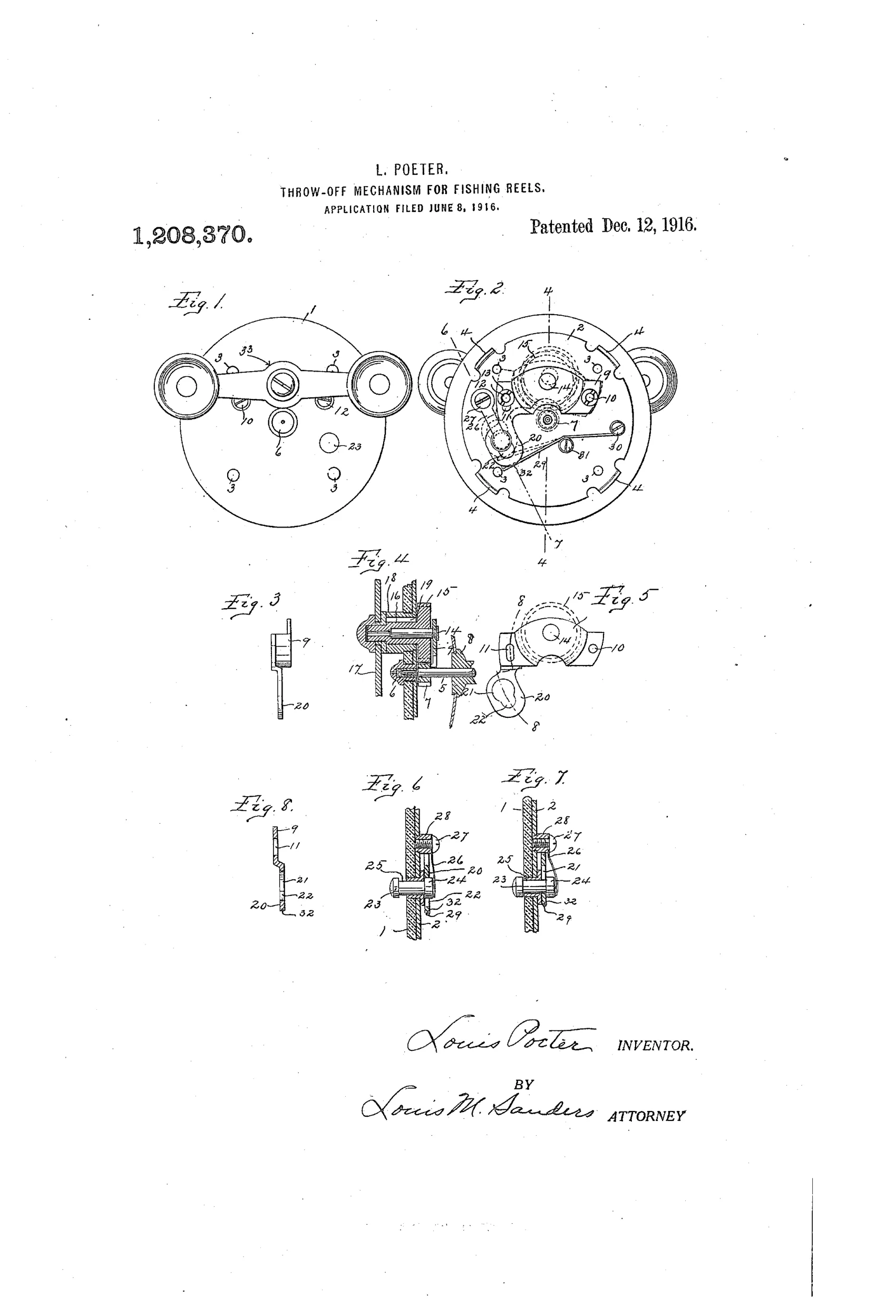
Free-spool throw-off mechanism for bait-casting fishing reels.
↻ How it works
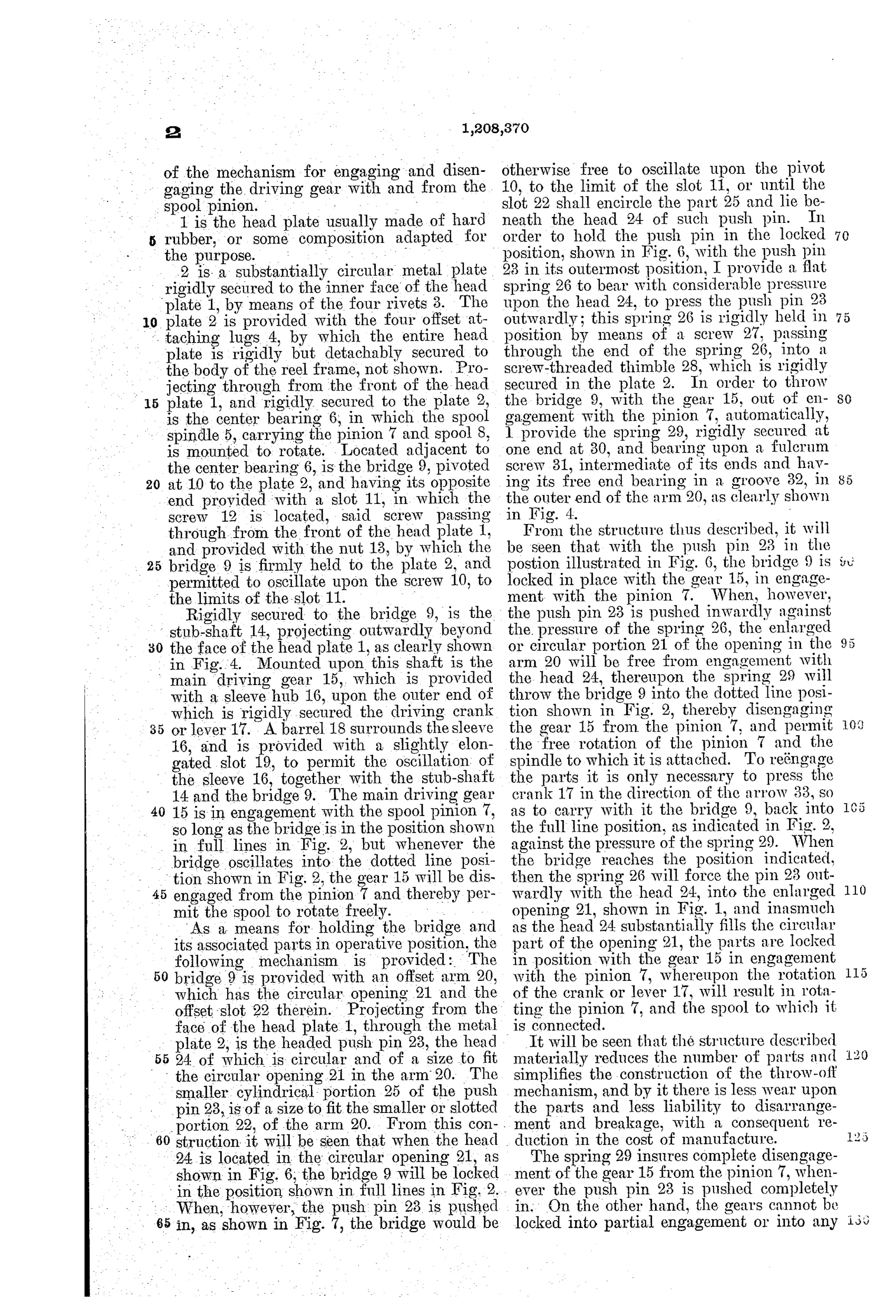
A pivoted bridge carries the main driving gear and can oscillate to engage or disengage it from the spool pinion. A push pin projecting through the head plate, held outward by a flat spring, locks the bridge's offset arm in gear-engaged position by seating its head in a circular opening. Pressing the pin inward releases the arm from the pin head, allowing a separate spring bearing on a groove in the bridge's arm to snap the bridge into the disengaged, free-spool position. Pressing the crank forward re-engages the gear train by forcing the bridge back until the push pin snaps outward into the locking opening again, with no intermediate partially-engaged position possible.
↻ What was claimed
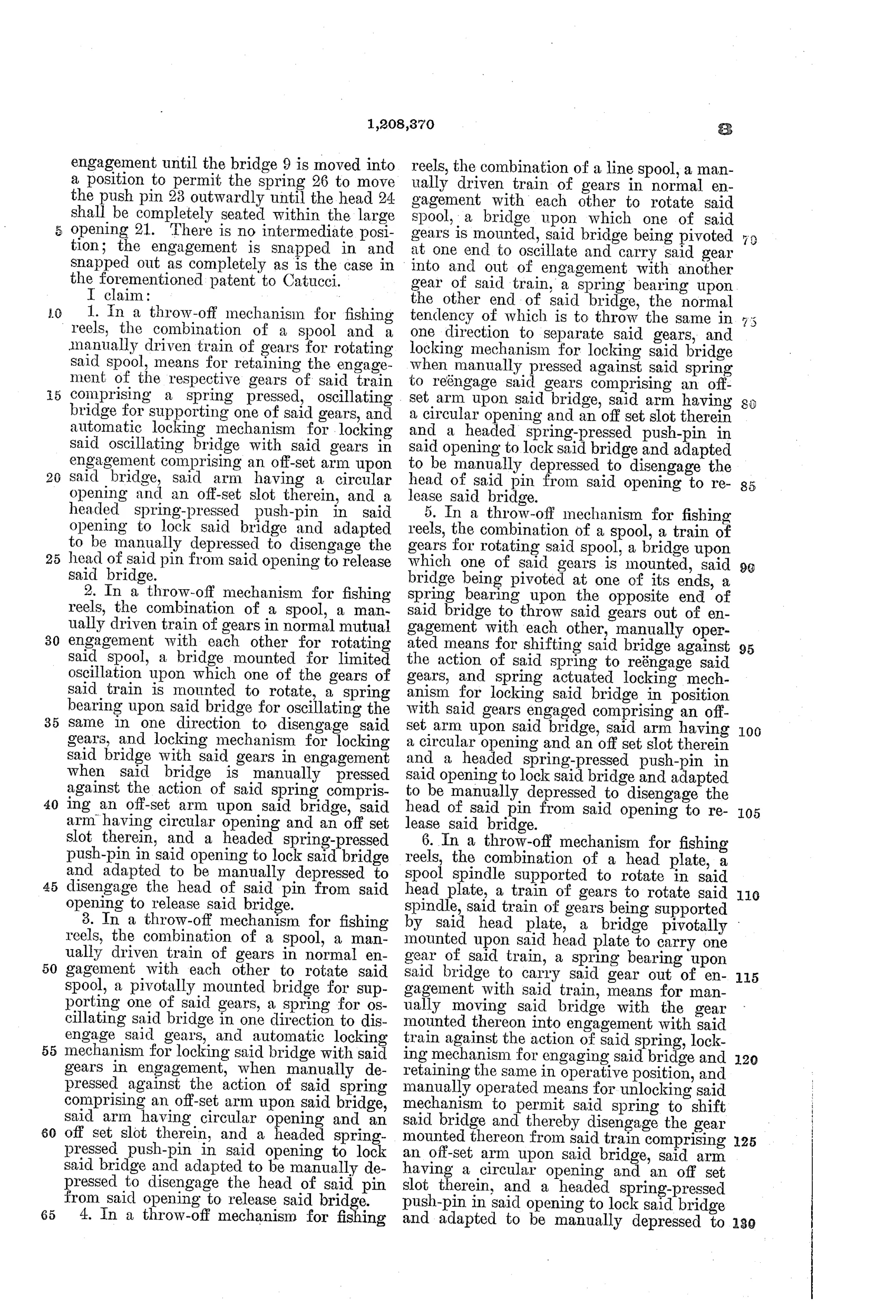
“1. In a throw-off mechanism for fishing reels, the combination of a spool and a manually driven train of gears for rotating said spool, means for retaining the engagement of the respective gears of said train comprising a spring pressed, oscillating bridge for supporting one of said gears, and automatic locking mechanism for locking said oscillating bridge with said gears in engagement comprising an off-set arm upon said bridge, said arm having a circular opening and an off-set slot therein, and a headed spring-pressed push-pin in said opening to lock said bridge and adapted to be manually depressed to disengage the head of said pin from said opening to release said bridge.”
In plain English: A fishing reel gear train is held engaged by a spring-loaded pivoting bridge that locks in place via a push-pin fitting into a hole in an offset arm, and pressing the pin releases the bridge so the spool can spin freely.
↻ In the inventor’s words
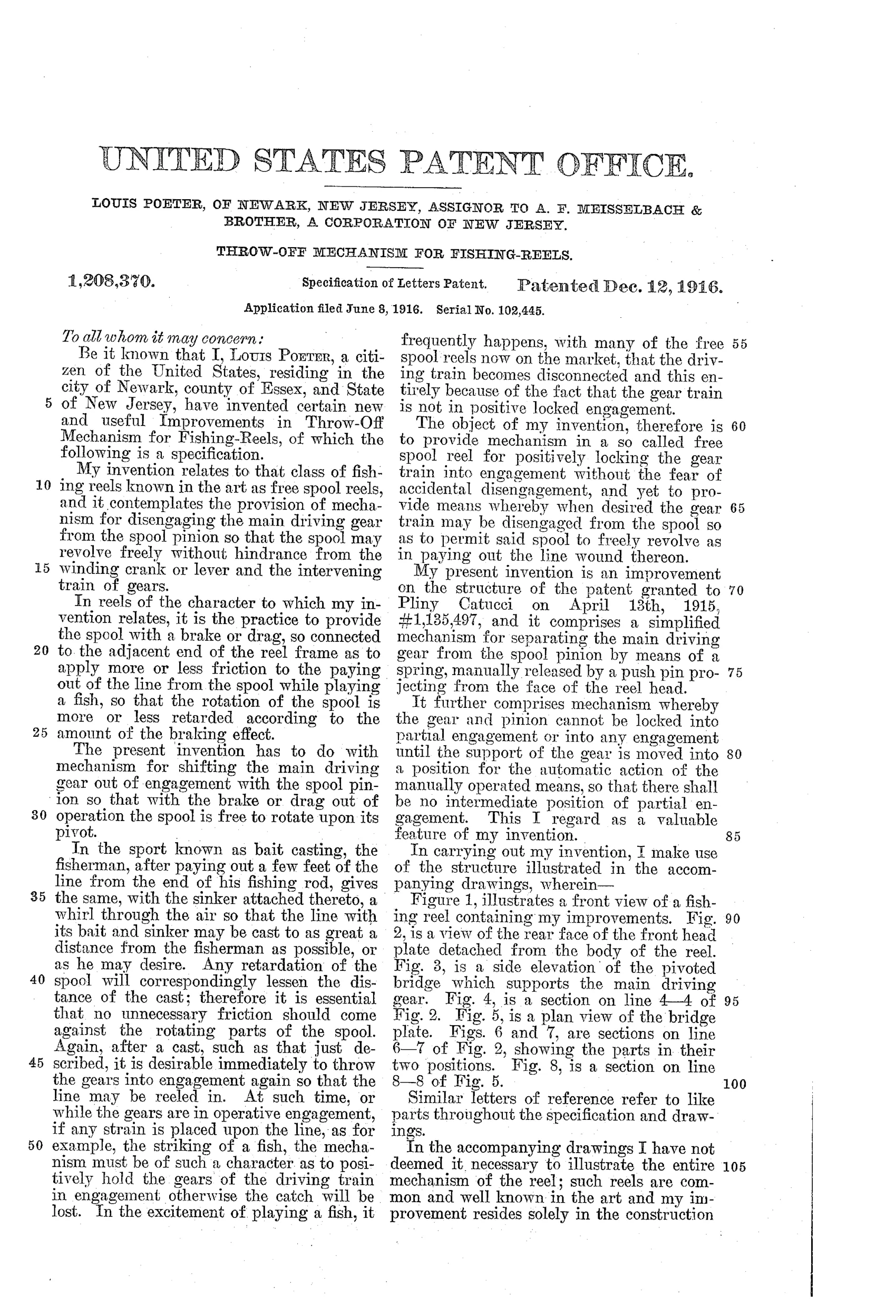
“There is no intermediate position; the engagement is snapped in and snapped out as completely as is the case in the aforementioned patent to Catucci.”— Louis Poeter, from the specification
Manufactured and sold
Meisselbach was a major Newark reel maker and sold free-spool casting reels in this era; the corporate assignment marks this as production engineering rather than paper speculation.
↻ Commentary
Free-spool was one of the two great obsessions of casting-reel design in the 1910s (the other being anti-backlash), and this Poeter patent, assigned to A. F. Meisselbach & Brother of Newark, is a serious factory answer rather than a garage dream. The problem it attacks is subtle: it's easy to make a gear train that disengages, but hard to make one that can't sit half-engaged, grinding tooth tips when the angler cranks. Poeter's solution is to make the pivoted bridge bistable. A spring snaps it fully out of mesh when you press the pin; the pin's head snapping into the circular opening locks it fully in. His own specification says it plainly: 'there is no intermediate position.'
Fig. 2 is the one to study. The main gear rides on the oscillating bridge, and the offset arm with its circular opening and offset slot is the whole trick — the pin head acts as a positive latch, not a friction detent. Re-engagement is equally clever: you don't hunt for a lever, you just push the crank forward and the bridge cams back until the pin snaps home. That's the kind of one-handed operation a tournament caster in 1916 actually wanted.
As mechanism it's a refinement, not a first — the text itself acknowledges the earlier Catucci work — but it's the refinement a production shop makes when it intends to build the thing at scale.
Commentary by Claude, The Fishing Reel Patent Archive’s resident enthusiast