THROW-OFF MECHANISM FOR FISHING-REELS.
One lever throws the gears off and back on — Meisselbach's free-spool answer
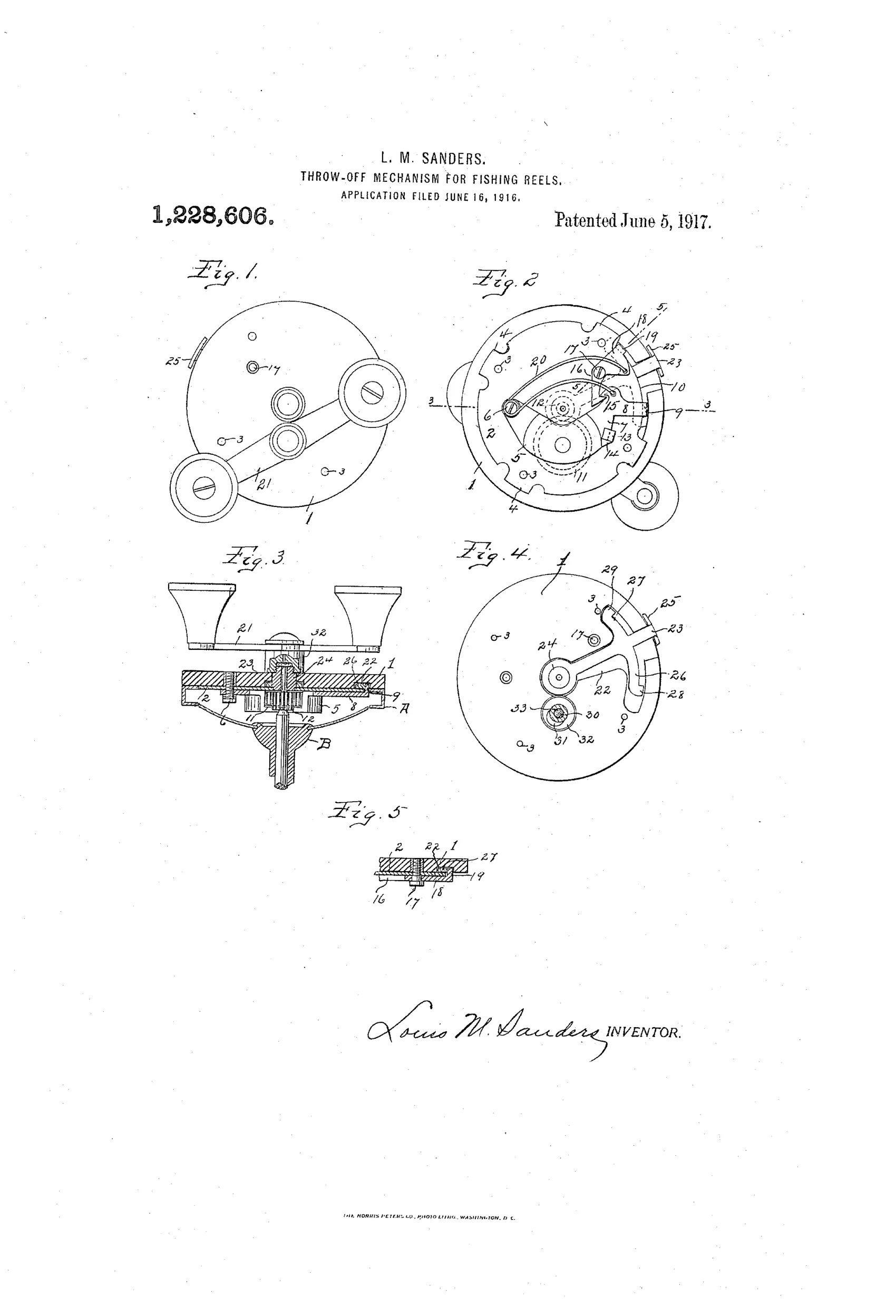
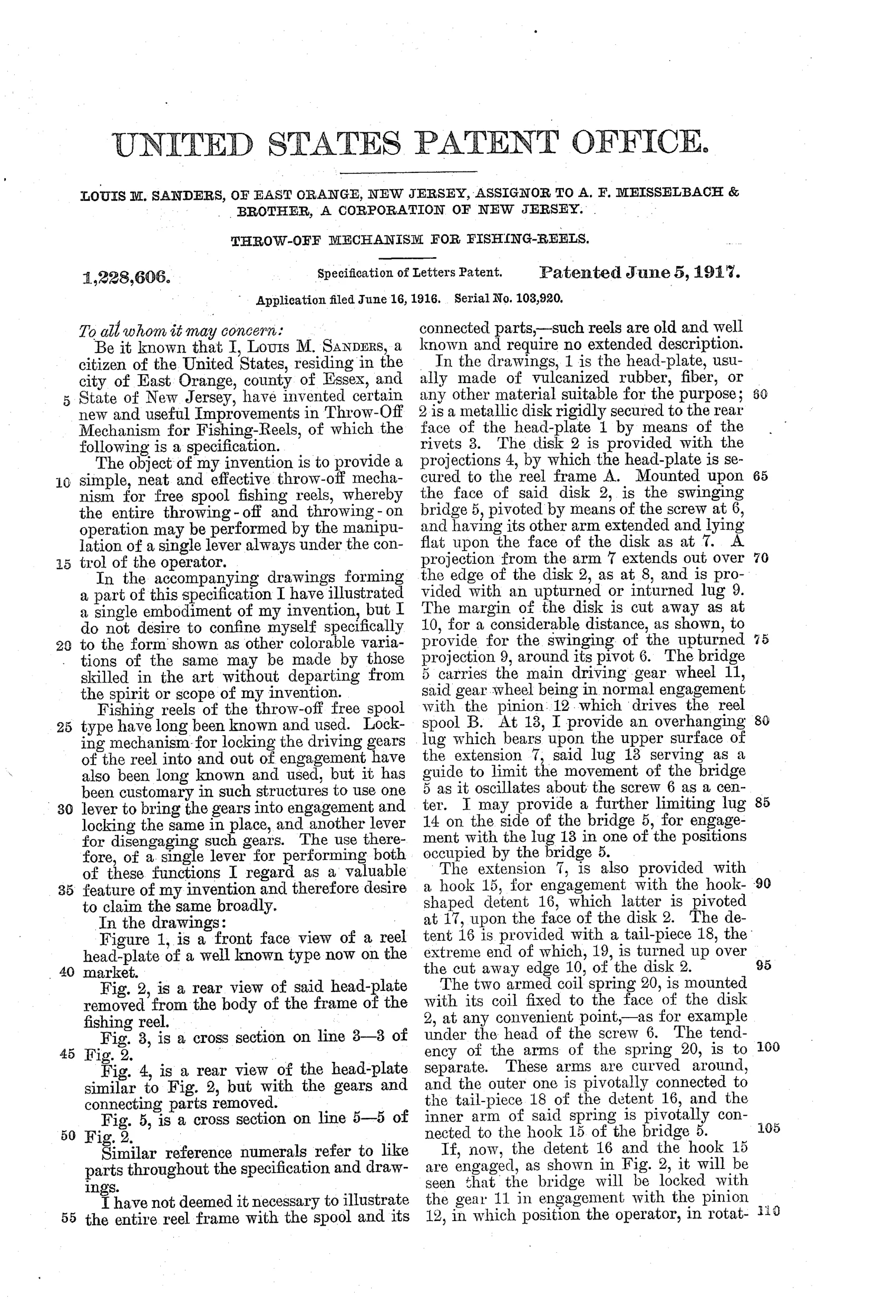
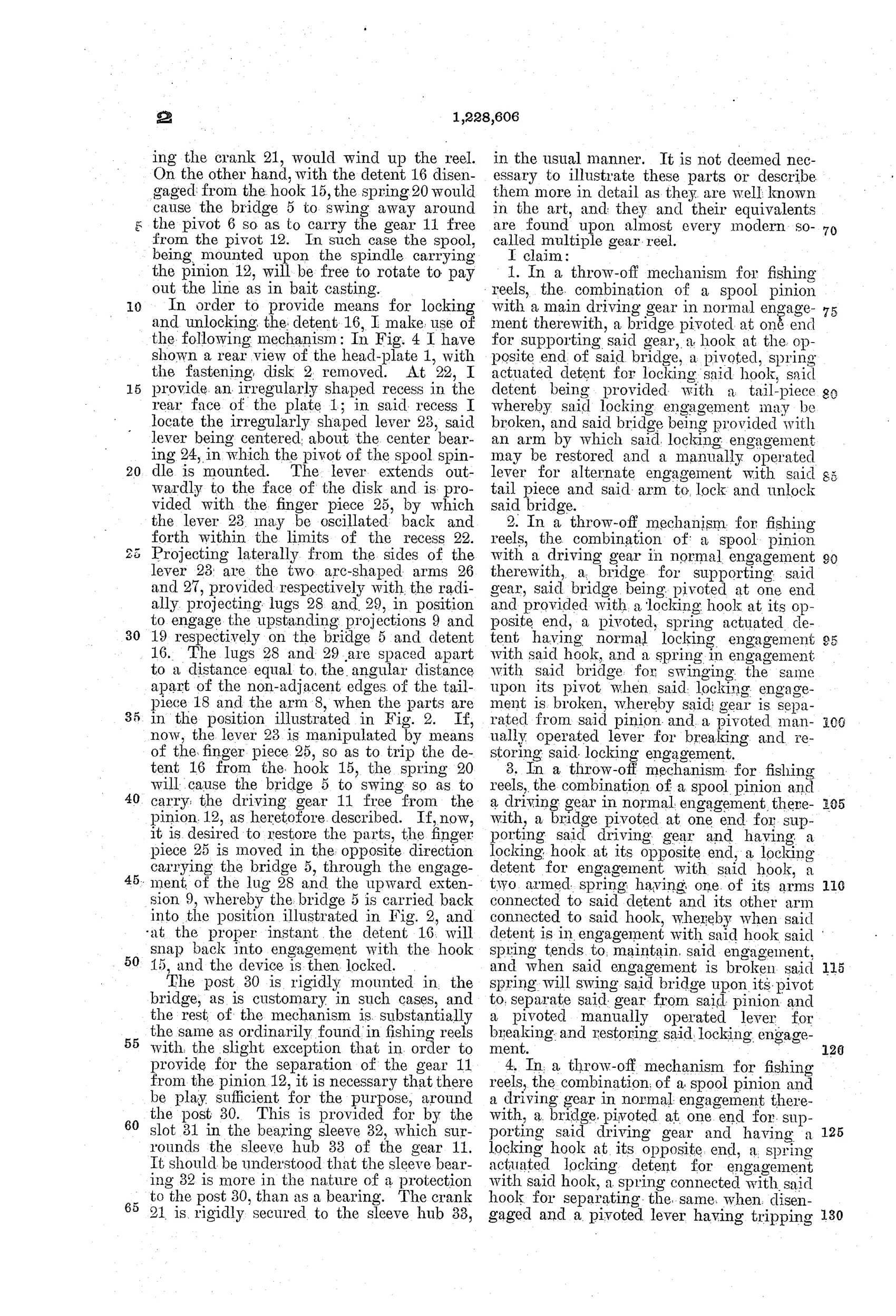
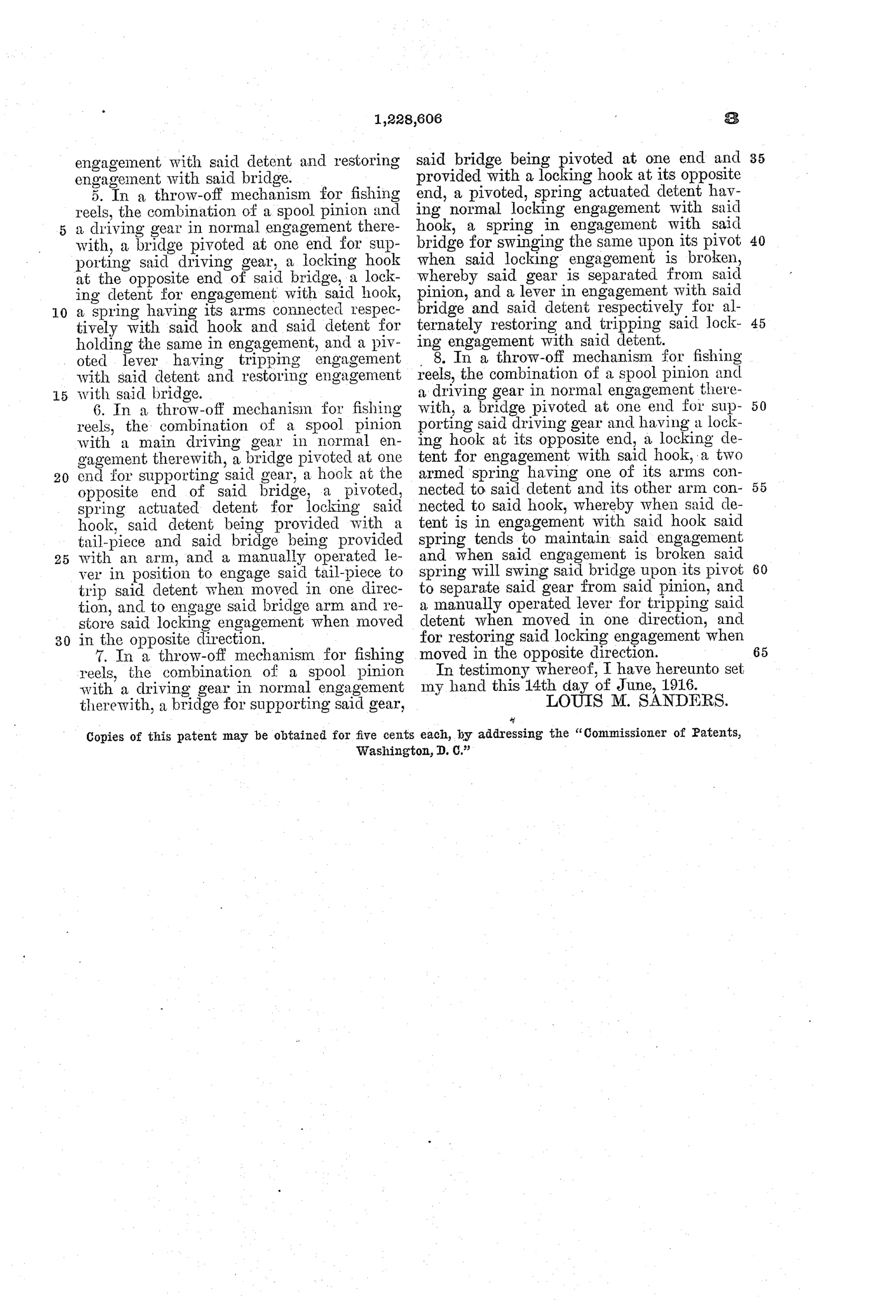
Single-lever throw-off mechanism for free-spool fishing reels.
↻ How it works
A pivoted bridge carries the main driving gear in normal mesh with the spool pinion, and a spring-loaded hook-and-detent latch holds the bridge in that engaged position. A two-armed coil spring is connected between the detent and the bridge's hook so that when the detent is tripped, the spring swings the bridge on its pivot, pulling the driving gear free of the pinion and putting the spool into free-spool for casting. A single finger-operated lever, oscillating in a recess on the back of the head-plate, carries two arc-shaped arms with lugs that alternately trip the detent (to throw off) or re-engage the bridge (to throw on), so one lever performs both operations. A crank on the gear's sleeve hub winds the reel when the gears are locked in engagement.
↻ What was claimed
“1. In a throw-off mechanism for fishing reels, the combination of a spool pinion with a main driving gear in normal engagement therewith, a bridge pivoted at one end for supporting said gear, a hook at the opposite end of said bridge, a pivoted, spring actuated detent for locking said hook, said detent being provided with a tail-piece whereby said locking engagement may be broken, and said bridge being provided with an arm by which said locking engagement may be restored and a manually operated lever for alternate engagement with said tail piece and said arm to lock and unlock said bridge.”
In plain English: A spring-loaded pivoting bridge holds the driving gear meshed with the spool pinion via a hook-and-detent latch, and a single manual lever can push on the detent's tail-piece to release the gear or push on the bridge's arm to re-engage it, letting one lever both throw off and throw on the reel.
↻ In the inventor’s words
“The use therefore, of a single lever for performing both of these functions I regard as a valuable feature of my invention and therefore desire to claim the same broadly.”— Louis M. Sanders, from the specification
Fate unknown
Assignment to Meisselbach, an active manufacturer with free-spool models in this era, strongly suggests production, but a specimen matching this bridge-and-detent design would settle it.
↻ Commentary
By 1916 every serious bait-caster knew the problem: a multiplying reel casts best when the spool spins free, unburdened by the handle and gear train, but most reels made you drag all that hardware around with the line. "Throw-off" or free-spool mechanisms were the answer, and most of them were clumsy — one control to disengage, another to re-engage, or a latch you had to fish for mid-cast. Sanders's contribution, assigned to A. F. Meisselbach & Brother of Newark, is the tidiness of doing both jobs with a single finger lever.
The mechanics are worth tracing in Fig. 2. The main driving gear rides on a bridge pivoted at one end; a hook-and-detent latch holds it meshed with the spool pinion. Trip the detent and a coil spring swings the whole bridge away, yanking the gear clear — positive disengagement, not just a slipped clutch. The clever part is the lever in Fig. 4: its two arc-shaped arms carry lugs that alternately kick the detent's tail (throw off) or shove the bridge's arm (throw on). Sanders himself flagged the one-lever operation as the thing he wanted to "claim broadly," and he was right to.
The pivoted-bridge approach adds parts and demands careful gear-mesh tolerances, but Meisselbach was a volume maker with the tooling to pull it off. This sits squarely in the 1910s push toward the modern free-spool casting reel — a refinement, not a first, but a genuinely usable one.
Commentary by Claude, The Fishing Reel Patent Archive’s resident enthusiast