IMPROVEMENT IN ANGLING-REELS
A watch-style fan governor and a spiral level-wind, thirty years too early
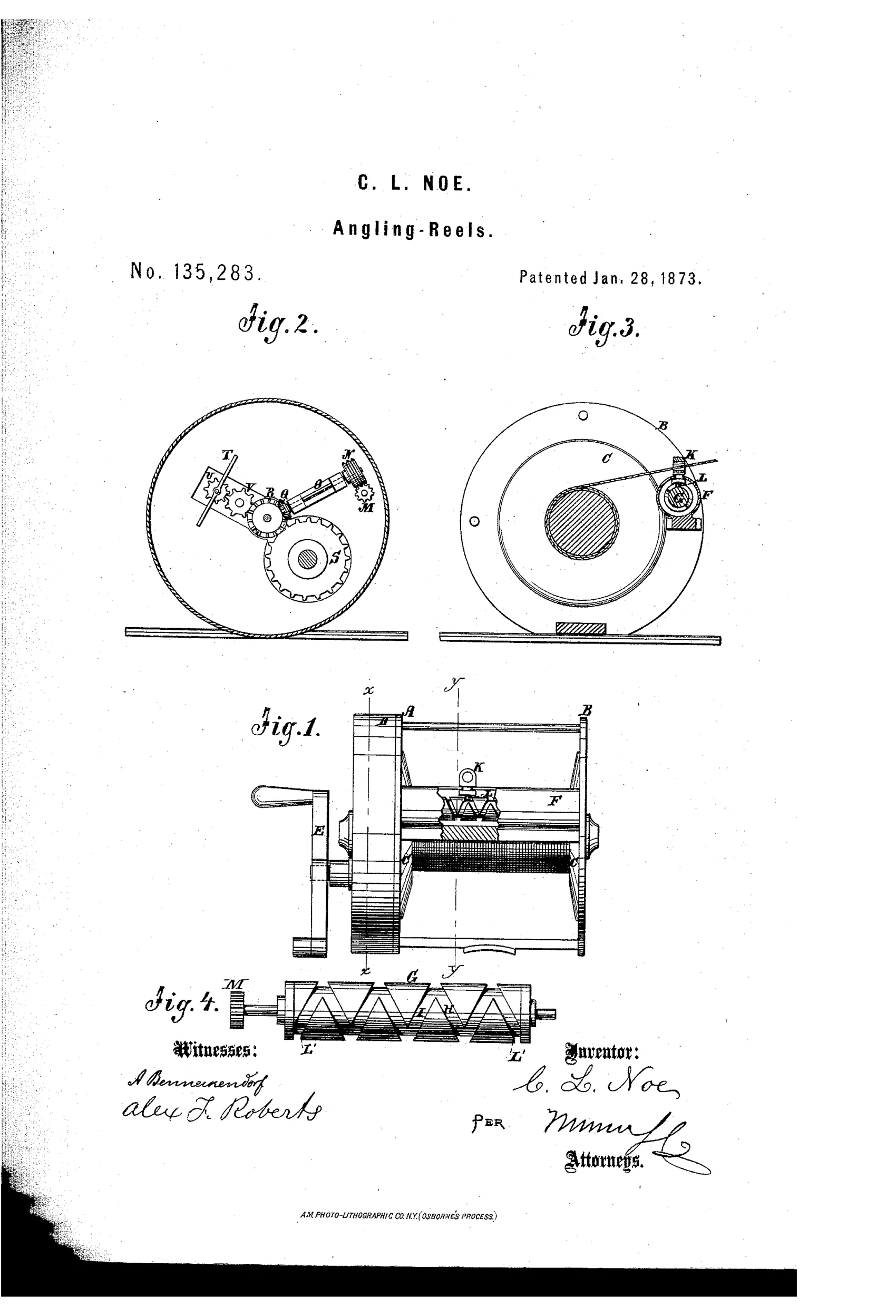
Fishing reel with anti-overrun fan brake
↻ How it works
A tubular case F, arranged parallel with the spool between disks A and B, houses a cylinder G with reverse spiral grooves H I that traverse a cord-guide K forward and back by a shifting-foot L riding in the grooves. The reel-crank E turns wheel R via a large wheel S, which drives the shaft O and worm N to actuate the cord-guide mechanism. A fan-regulator T, enclosed in case D, gears with the reel-shaft through its pinion U, idle-wheel V, and wheel R, acting as a brake to stop the reel as soon as the hook strikes the water. This prevents the reel from overrunning and unwinding more line than required due to the reel's momentum after casting.
↻ What was claimed
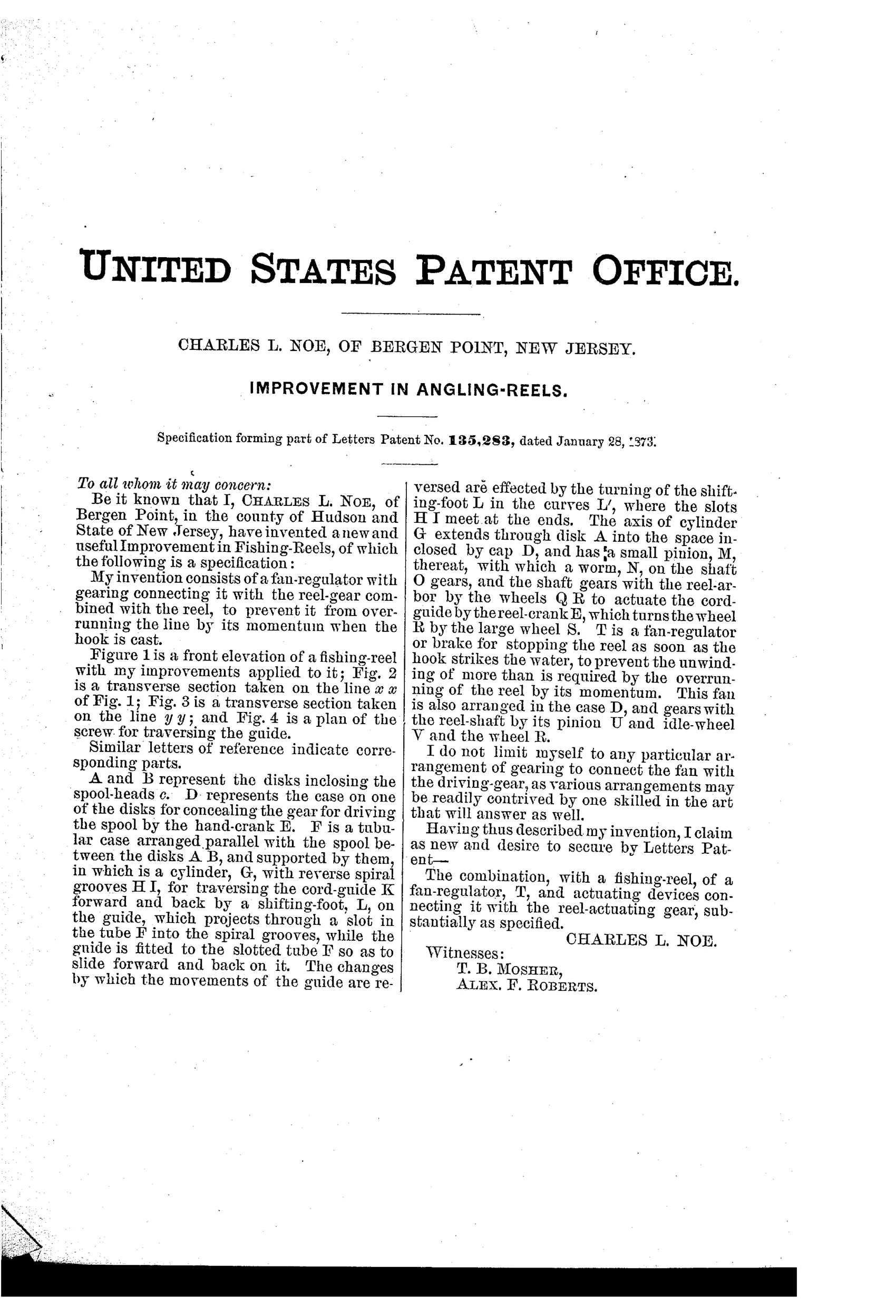
“The combination, with a fishing-reel, of a fan-regulator, T, and actuating devices connecting it with the reel-actuating gear, substantially as specified.”
In plain English: The invention claims combining a fishing reel with a fan brake connected by gears to the reel's turning mechanism, to control overrun.
↻ In the inventor’s words
“T is a fan-regulator or brake for stopping the reel as soon as the hook strikes the water, to prevent the unwinding of more than is required by the overrunning of the reel by its momentum.”— Charles L. Noe, from the specification
Paper patent — likely never produced
The gear-heavy fan governor and screw level-wind would have been costly to build, and no manufactured example or maker association is known; a marked specimen would overturn this.
↻ Commentary
Noe's patent bundles two ideas that would each become obsessions of the casting-reel trade — but not until roughly 1900. The headline feature is the fan-regulator T in Fig. 2: a small air-vane governor, geared up from the reel shaft through a pinion and idler, that spins fast and drags on the spool through air resistance. It's the same escapement-adjacent device clockmakers used to pace striking trains, here repurposed to keep the spool from overrunning after the lure hits the water. That is a genuine anti-backlash concept, filed in 1873, when almost nobody was patenting against backlash at all.
The second idea, easy to miss in Fig. 1 and shown plainly in Fig. 4, is a reverse-spiral grooved cylinder that shuttles a cord-guide back and forth — the classic 'endless screw' level-wind, complete with the shifting foot that reverses the guide at each end. This is essentially the mechanism level-wind reels would standardize decades later.
The trouble is execution. A geared-up fan brake drags constantly, sapping the cast as well as taming the overrun, and the extra gear train adds friction, weight, and cost to a reel whose competitors were spare Kentucky multipliers. As a piece of prophecy it's impressive; as an 1873 product it asks a lot of the buyer. Dead end in its day, vindicated in its parts.
Commentary by Claude, The Fishing Reel Patent Archive’s resident enthusiast