IMPROVEMENT IN FISHING-REELS
In 1875 Baltimore, a line paying off a stationary spool — spinning-reel thinking early
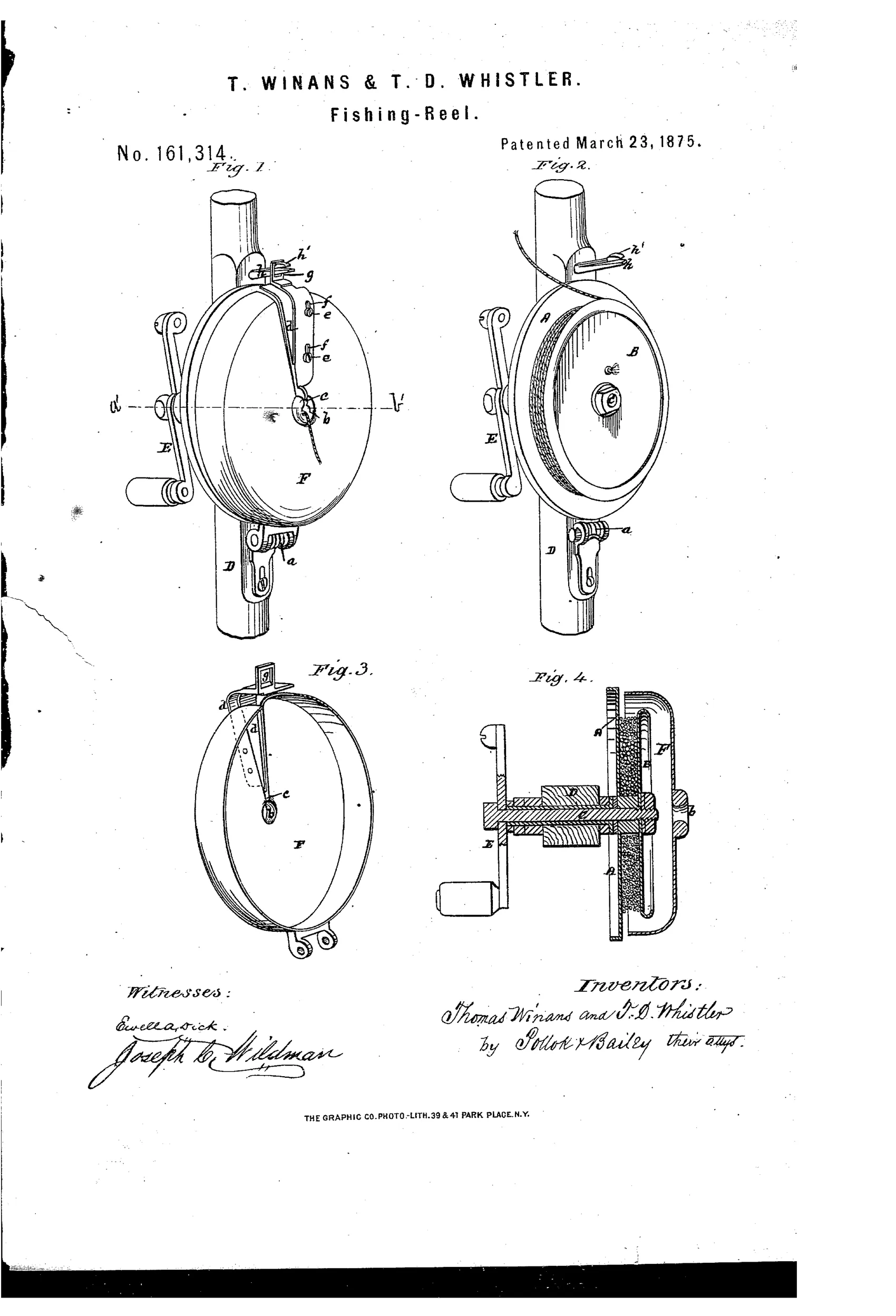
Fishing reel with anti-overrun line guide and cover
↻ How it works
The reel consists of two disks fixed on a central shaft mounted through the pole butt, with a crank handle on the opposite end. A hinged cover, held open by a spring, can be pressed shut against the larger disk to enclose the line-carrying portion during casting, while a guide eye set on the axis prolongation lets line run out freely without turning the reel. A sliding wedge-shaped gate, moved by a loop riding on an inclined arm, opens or closes a tapered slit so the line can be threaded into or withdrawn from the eye. The periphery of the larger disk is exposed to serve as a thumb-operated braking surface when the cover is open.
↻ What was claimed
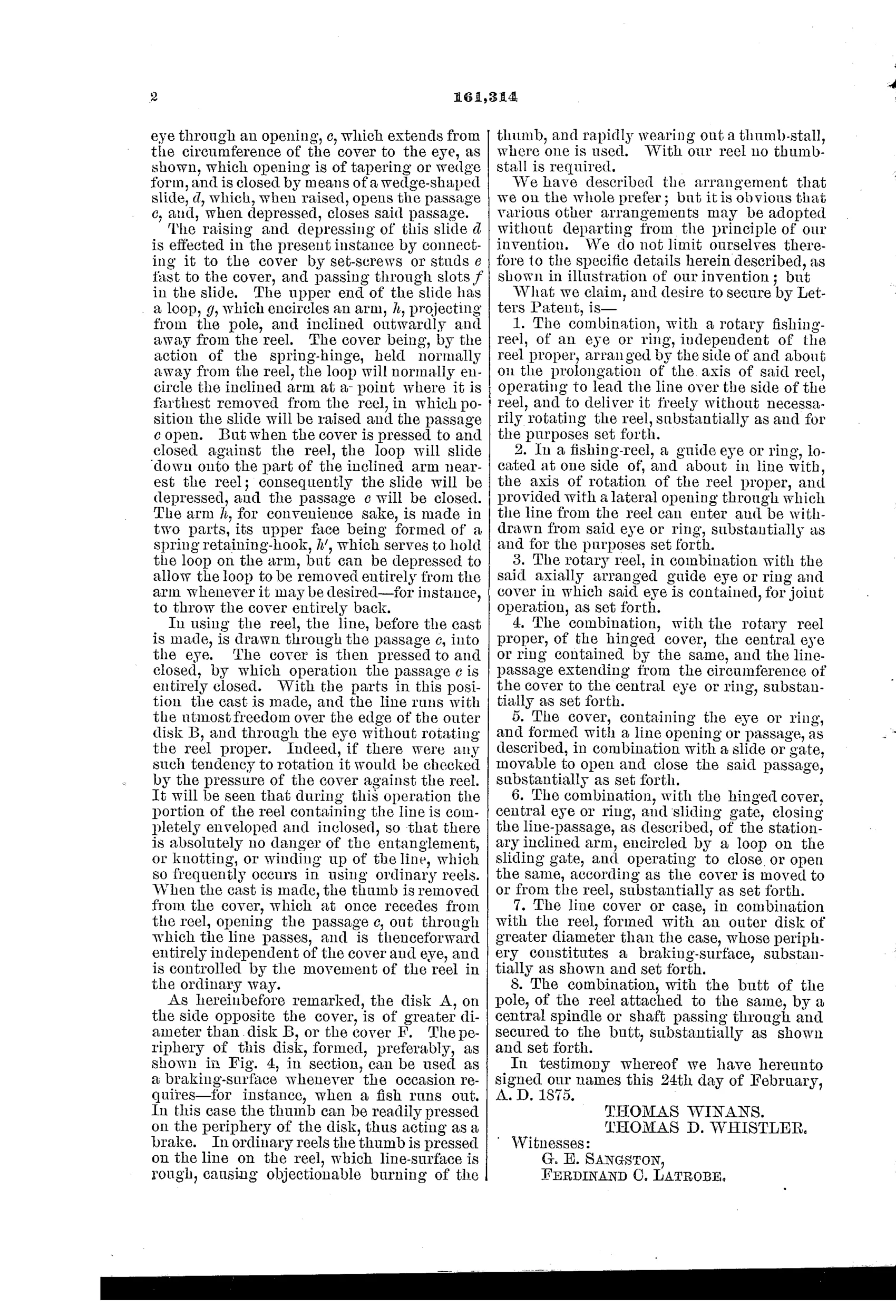
“The combination, with a rotary fishing-reel, of an eye or ring, independent of the reel proper, arranged by the side of and about on the prolongation of the axis of said reel, operating to lead the line over the side of the reel, and to deliver it freely without necessarily rotating the reel, substantially as and for the purposes set forth.”
In plain English: A line guide positioned along the reel's axis lets the line pay out freely during a cast without having to spin the reel itself.
↻ In the inventor’s words
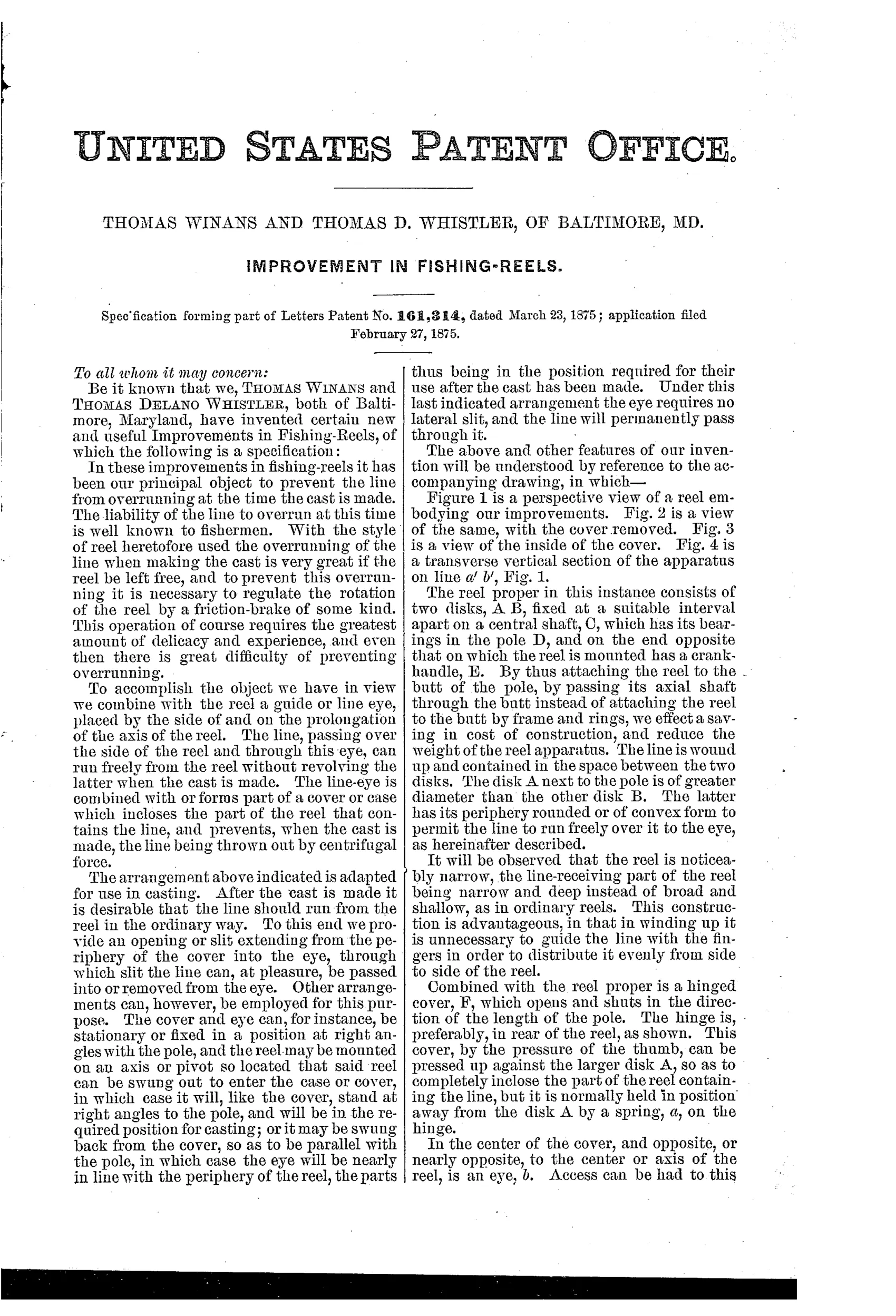
“The liability of the line to overrun at this time is well known to fishermen.”— Thomas Winans and Thomas D. Whistler, from the specification
Paper patent — likely never produced
The through-the-butt mounting and gated cover are impractical for production, and no manufactured example is known; a surviving specimen would be a genuine surprise.
↻ Commentary
The claim here is worth reading twice. Winans and Whistler put a guide eye "about on the prolongation of the axis" of the reel so the line spills over the side of the disk during a cast without turning the reel at all. That is, functionally, the fixed-spool principle — the core idea of the spinning reel that Alfred Holden Illingworth would patent in England thirty years later and that would eventually conquer the tackle world. These two got there in 1875, framed not as a new species of reel but as a cure for overrun on a rotary one.
The execution is more baroque than the insight. The reel mounts on a shaft driven clear through the rod butt, crank on the far side — an old and awkward arrangement even then. A spring-loaded hinged cover snaps shut over the line-carrying disk for casting, and a wedge-shaped sliding gate opens a tapered slit so you can thread the line into the axial eye. Fig. 3 shows how fussy that gate is. The exposed disk rim doubles as a thumb brake when the cover is open, which is a nice economy.
Thomas Winans was the Baltimore railroad millionaire and inveterate tinkerer, which explains both the ambition and the disregard for manufacturability. As a product it was a dead end; as an idea, it was decades early, and the patent's own line — the liability to overrun "is well known to fishermen" — names the obsession that would drive the next fifty years.
Commentary by Claude, The Fishing Reel Patent Archive’s resident enthusiast