IMPROVEMENT IN REELS FOR FISHING-LINES
The Leonard raised-pillar fly reel begins here, three years after Orvis
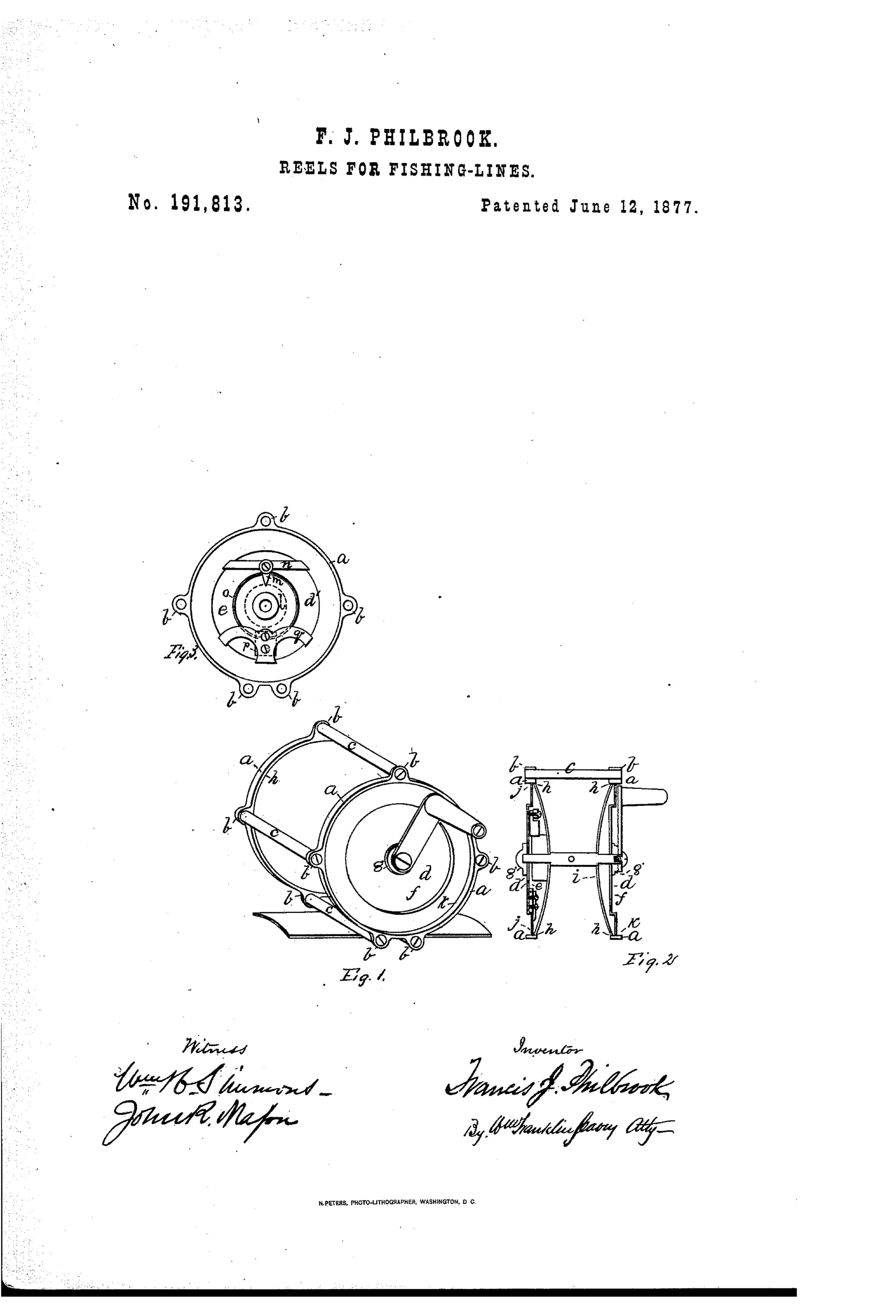
Lightweight fishing reel with click mechanism
↻ How it works
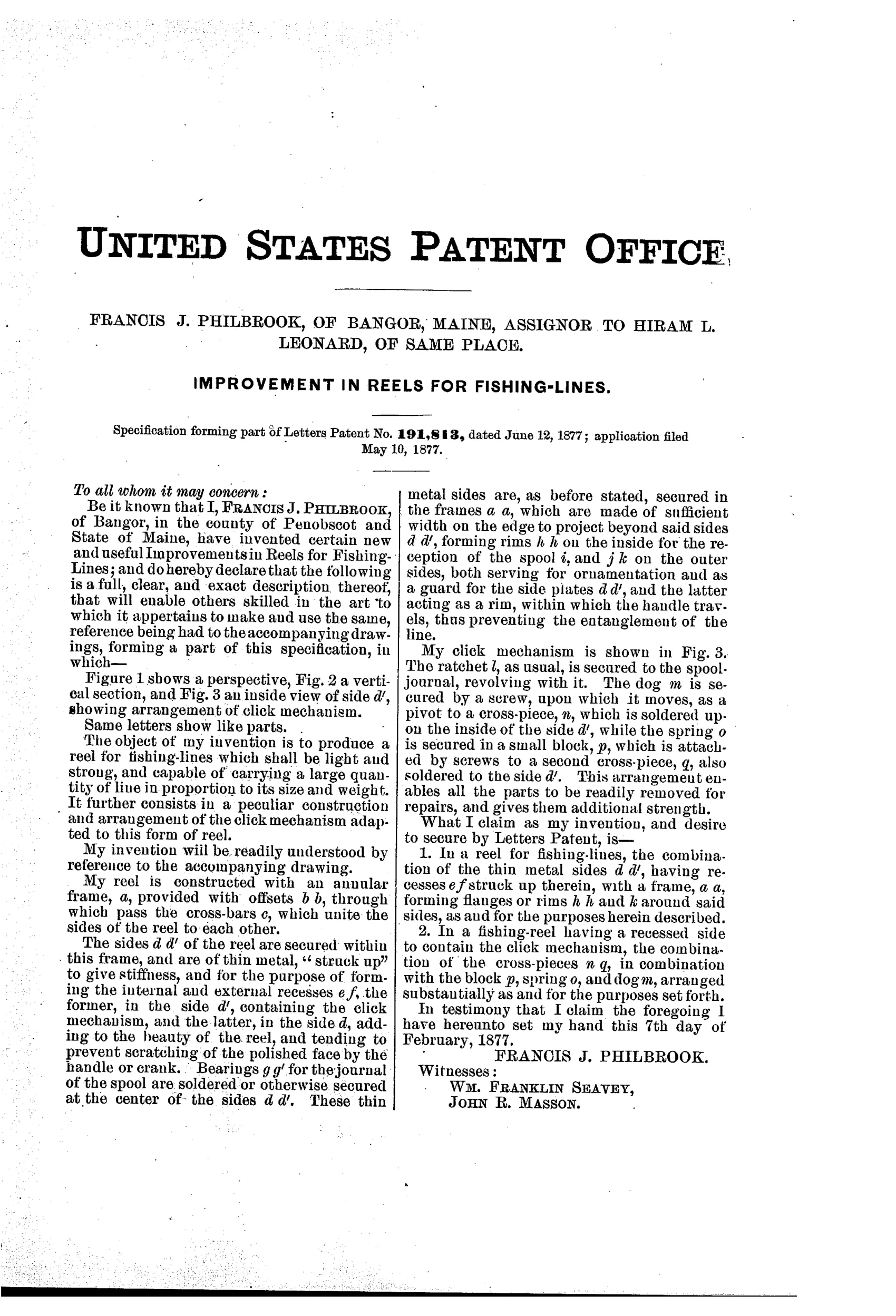
The reel has an annular frame with offsets through which cross-bars pass to unite the two thin metal sides, giving strength while keeping weight low. Each side is struck up to form internal and external recesses, one housing the click mechanism and the other for ornamentation and protection of the polished face. Bearings for the spool journal are soldered at the center of the sides, and the frame's rims guard the outer edges and confine the crank handle to prevent line entanglement. The click mechanism consists of a ratchet secured to the spool journal, a pivoting dog mounted on a cross-piece, and a spring held in a block attached to a second cross-piece, all soldered or screwed to the recessed side for easy removal and repair.
↻ What was claimed
“In a reel for fishing-lines, the combination of the thin metal sides d d', having recesses e f struck up therein, with a frame, a a, forming flanges or rims h h and k around said sides, as and for the purposes herein described.”
In plain English: The reel combines thin stamped metal sides with recessed areas and a surrounding frame that forms protective rims, all working together as described.
↻ In the inventor’s words
“The object of my invention is to produce a reel for fishing-lines which shall be light and strong, and capable of carrying a large quantity of line in proportion to its size and weight.”— Francis J. Philbrook, from the specification
Manufactured and sold
Philbrook & Payne built these reels for Hiram Leonard, and surviving marked examples of the raised-pillar design are well documented among collectors.
↻ Commentary
The name to notice isn't Philbrook's — it's the assignee. Francis Philbrook worked for Hiram L. Leonard of Bangor, already the most celebrated rod maker in America, and this patent is the mechanical foundation of the Leonard raised-pillar reel, one of the most imitated fly reel architectures of the next half century. The offsets in the annular frame that carry the cross-bars — visible in Fig. 2 as those little jogs where the pillars meet the rim — are exactly the 'raised pillar' silhouette collectors still use as an identifier.
The engineering logic is honest weight-saving, not gadgetry. Instead of thick turned plates, Philbrook uses thin stamped sides stiffened by struck-up recesses — the same trick that makes a corrugated can rigid. One recess houses the click works; the other, on the show side, doubles as ornament and protects the polished face from scuffing on rocks and boat bottoms. The rims formed by the frame guard the crank so the line can't foul it. Every gram trimmed serves the stated goal: maximum line capacity per ounce, which is precisely what a fly angler carrying a long bamboo rod wanted.
Where Orvis's 1874 patent attacked weight with perforations, Philbrook attacked it with stamped structure. Both approaches won: this design, executed by Philbrook & Payne for Leonard, became a genuinely produced and long-lived reel, not a paper curiosity.
Commentary by Claude, The Fishing Reel Patent Archive’s resident enthusiast