IMPROVEMENT IN FISHING-RODS
A Milwaukee inventor hides the whole reel inside the rod itself
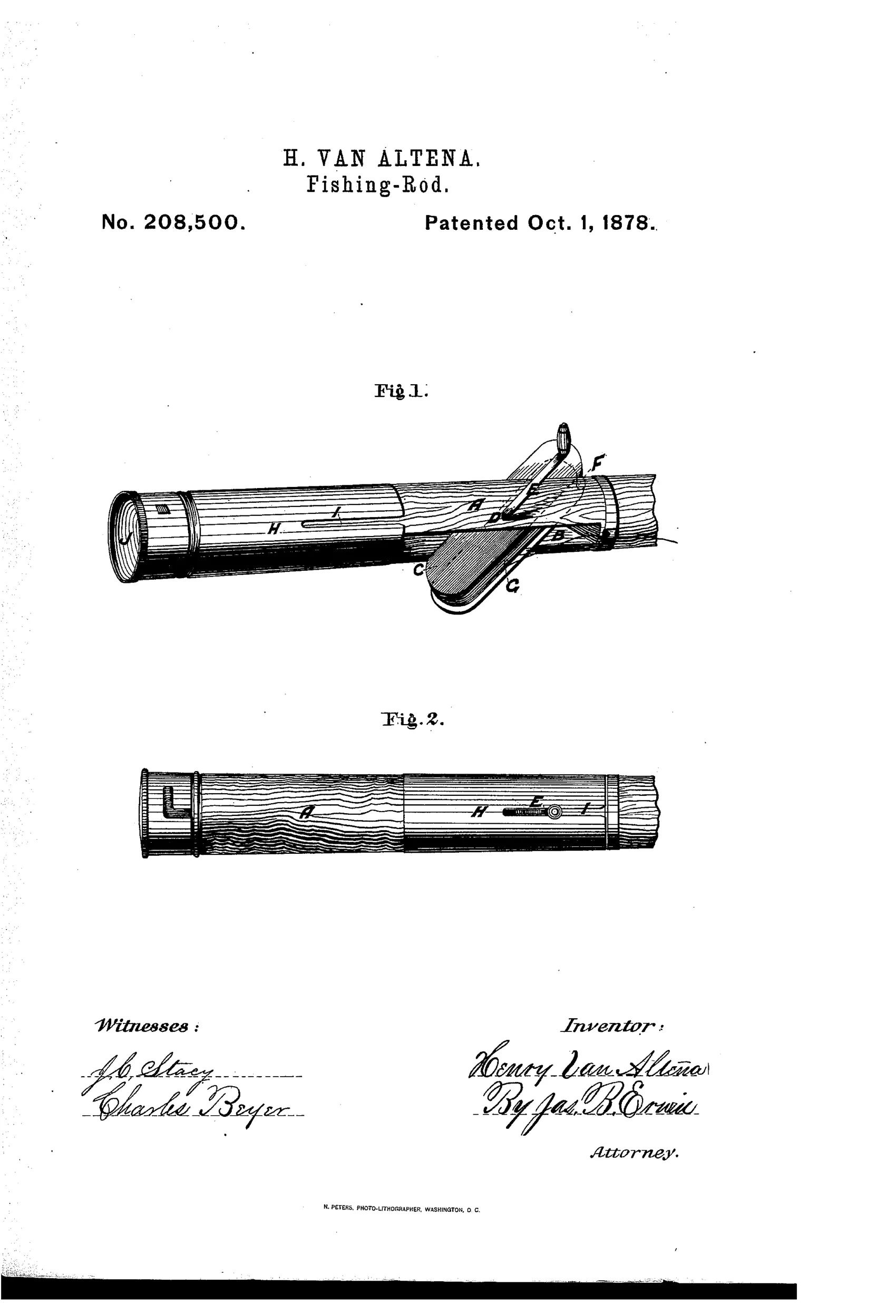
A fishing rod with built-in line-winding reel bar.
↻ How it works
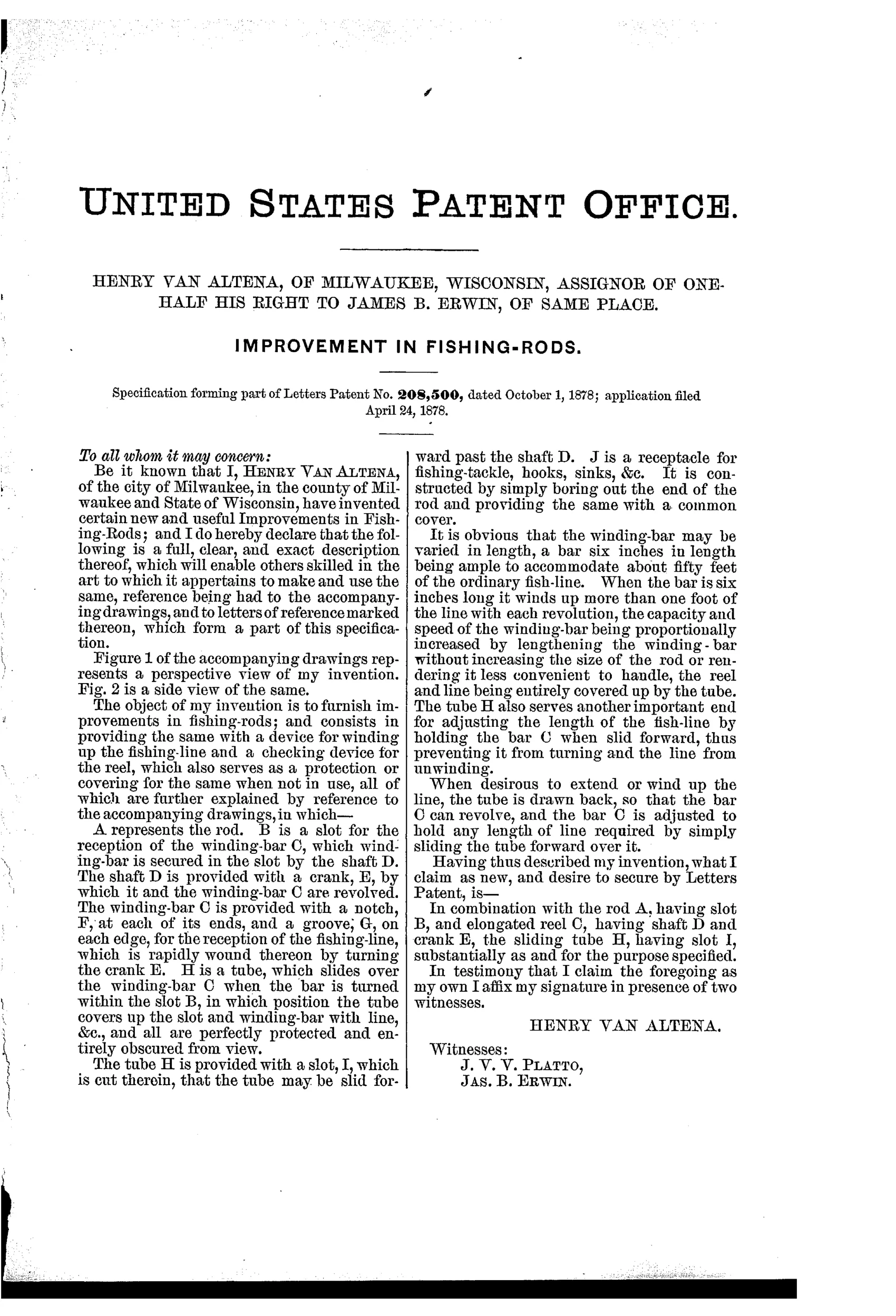
A slot in the rod holds an elongated winding-bar mounted on a shaft with a crank, and turning the crank winds the fish-line onto grooves cut in the bar. A sliding tube fits over the winding-bar and slot, covering and protecting the line and reel when not in use. The tube also has a slot allowing it to slide forward past the shaft to hold the winding-bar stationary, which prevents it from turning and the line from unwinding, thus adjusting the length of line let out. A separate bored-out receptacle in the rod's end, with a common cover, stores hooks, sinks, and tackle.
↻ What was claimed
“In combination with the rod A, having slot B, and elongated reel C, having shaft D and crank E, the sliding tube H, having slot I, substantially as and for the purpose specified.”
In plain English: The patent covers the combination of the slotted rod, the crank-turned winding-bar reel, and the slotted sliding cover tube that protects the line and locks the bar to control line length.
↻ In the inventor’s words
“When the bar is six inches long it winds up more than one foot of the line with each revolution, the capacity and speed of the winding-bar being proportionally increased by lengthening the winding-bar without increasing the size of the rod or rendering it less convenient to handle, the reel and line being entirely covered up by the tube.”— Henry Van Altena, from the specification
Fate unknown
No production example is documented; a surviving slotted rod with this winding-bar would settle it, but rod-integrated reels rarely left the patent office.
↻ Commentary
Henry Van Altena's answer to the fishing reel was to get rid of it. Instead of a spool hung below the grip, he cut a slot into the rod and set an elongated winding-bar inside it, turned by a small crank. His arithmetic is the charm of the patent: a six-inch bar takes up more than a foot of line per revolution, so the thing multiplies retrieve speed by geometry alone — no gears, no jeweled bearings, none of the watchmaker's craft the Kentucky makers were selling. The sliding tube does double duty, covering the line for travel and sliding forward to lock the bar so the line can't pay out, which serves as both drag and line-length adjustment. He even bored out the butt for a tackle compartment.
Look closely at Fig. 1 and you see the catch a casual reader misses: line wound on a long flat bar comes off in loops and half-hitches, and the slot puts the winding right where your hand wants to grip. There is no free-spool for casting; this is a still-fishing rig, a cane pole with storage, at the exact moment American anglers were paying for multiplying casting reels.
It sits in the record as a genuine dead end — an honest one, aimed at the traveling pond fisherman rather than the bass caster, and superseded by the telescoping rods and cheap stamped reels that solved the same portability problem better.
Commentary by Claude, The Fishing Reel Patent Archive’s resident enthusiast