FISHING-REEL.
The birdcage reel: America's first fly reel patent, from a Rochester gunsmith
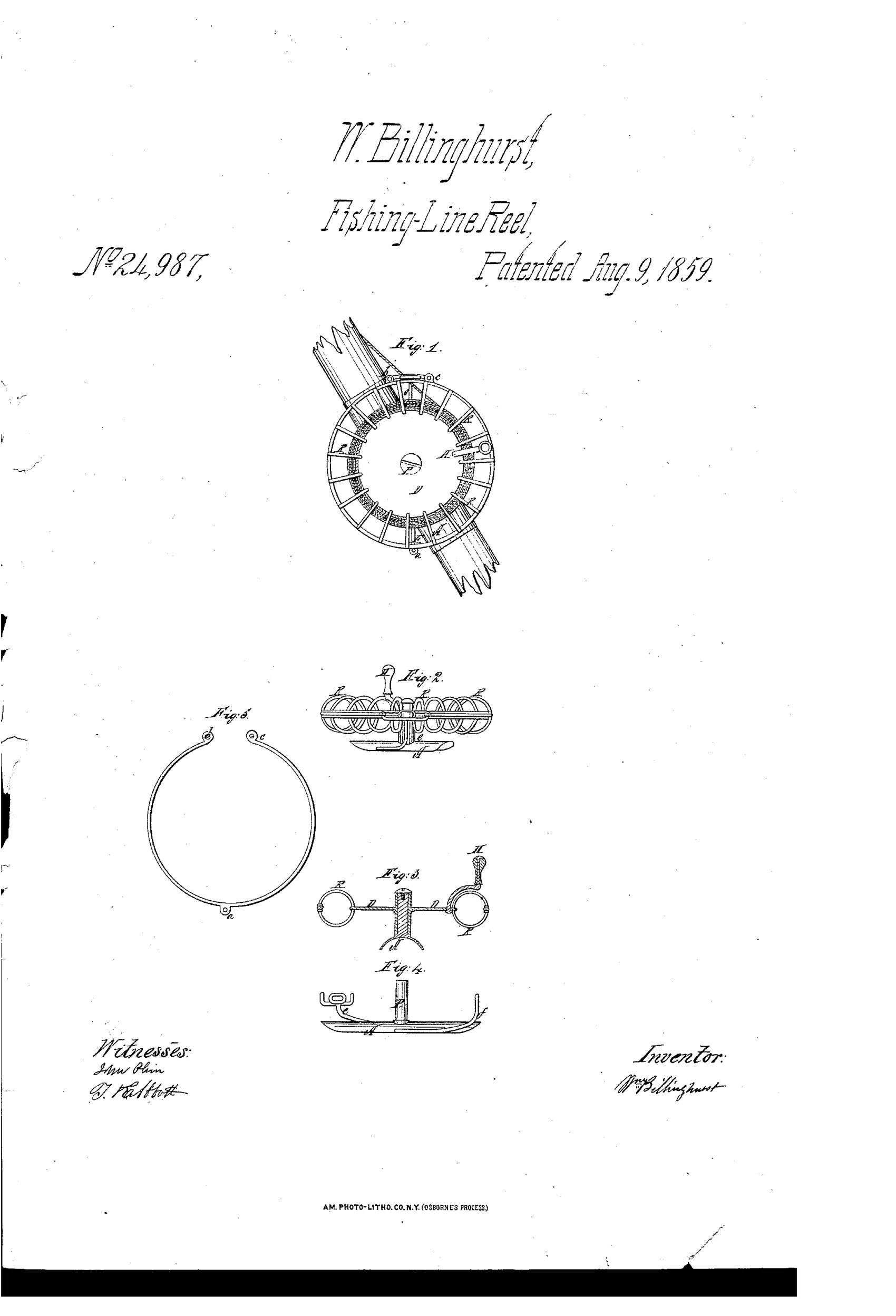
Fishing reel that winds line into a ring
↻ How it works
The reel's plate A attaches to the fishing rod and holds a fixed stud P. A disk D rotates on this stud and carries divided rings R R R on its periphery that form the skeleton of a tubular ring. As the disk rotates via handle H, line is admitted into the tubular ring through the openings left by the divided rings, coiling the line into a ring shape rather than a cylinder for better drying and faster winding.
↻ What was claimed
“The combination of the skeleton ring R R with the other parts of the reel, the whole being arranged in the manner and for the purpose substantially as set forth.”
In plain English: The claim covers combining the divided skeleton ring with the reel's other parts, arranged to wind fishing line into a ring shape as described.
↻ In the inventor’s words
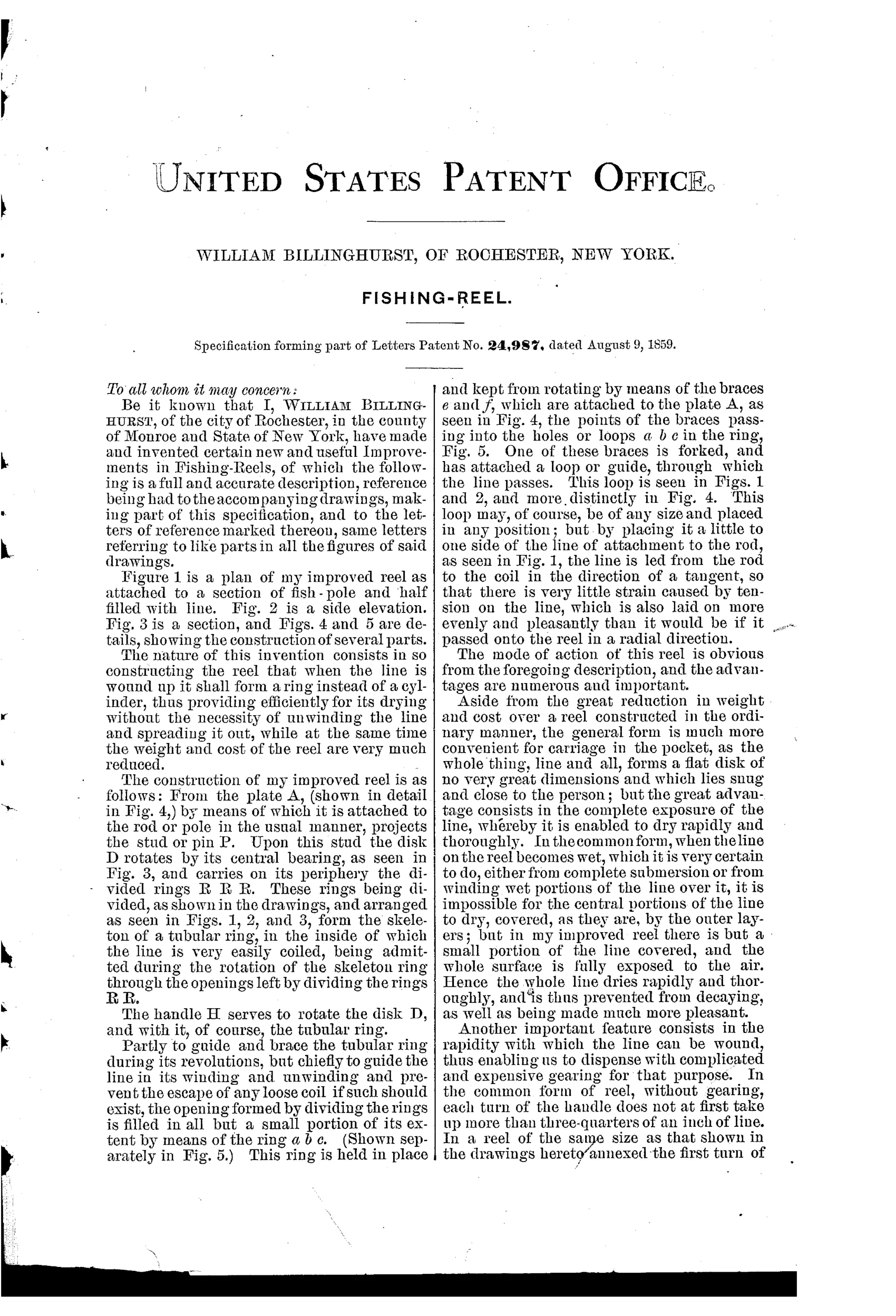
“The nature of this invention consists in so constructing the reel that when the line is wound up it shall form a ring instead of a cylinder, thus providing efficiently for its drying without the necessity of unwinding the line and spreading it out, while at the same time the weight and cost of the reel are very much reduced.”— William Billinghurst, from the specification
Manufactured and sold
Billinghurst birdcage reels were produced in Rochester and survive in collections, often bearing the August 9, 1859 patent date.
↻ Commentary
This is the famous Billinghurst "birdcage" reel — widely regarded as the first American fly reel patent — and the drawing shows exactly why it earned the nickname. Instead of a spool between solid side plates, Billinghurst built a skeleton: a rotating disk carrying divided rings at its rim, so the line coils into an open tubular ring rather than a packed cylinder. Fig. 5 shows one of those split rings on its own, which is the whole trick — the gaps between the ring halves are where the line enters as the disk turns.
The stated purpose is worth taking seriously. In 1859, lines were braided silk or linen that rotted if stored wet. Winding the line into a large-diameter, fully ventilated ring meant it dried on the reel, no unspooling required. The large coil diameter also meant faster retrieve per crank without any multiplying gears, and the skeleton frame made the reel remarkably light for a brass fitting of the era — all three claims in one honest geometric idea.
Billinghurst was a Rochester gunmaker, and the workmanship shows in how spare the design is: a fixed stud, one rotating disk, a side handle. It sits at the very start of the American fly reel story, a genuinely different answer from the Kentucky multiplier tradition, and it worked well enough to be manufactured for decades and imitated by others.
Commentary by Claude, The Fishing Reel Patent Archive’s resident enthusiast