CRANK
A crank that swallows itself whole — fishing reels only an afterthought
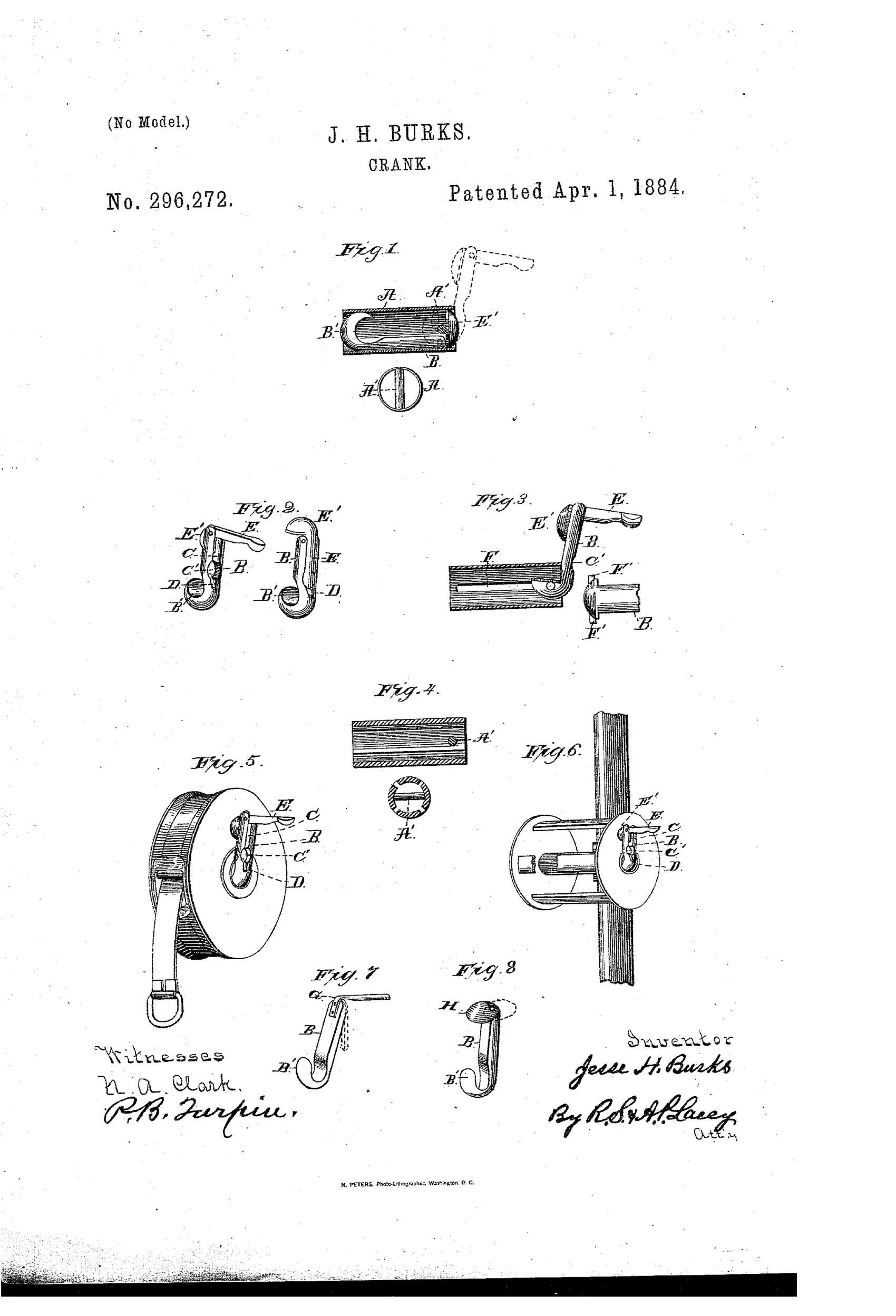
Foldable, retractable crank stored inside a hollow casing.
↻ How it works
A casing carries a transverse rod near one end and a hinged arm terminating in a hook that engages the rod. A handle is pivoted to the outer end of the arm and folds down into a groove along the arm's side, with a spring in a mortise pressing the folded parts against the casing wall to hold them in place. When not needed, the arm and handle fold flat and slide entirely inside the casing, closed at both ends by the hook and a head fitted to the casing's diameter; a slight push on the hook end forces the parts out to be unfolded and used to revolve the casing.
↻ What was claimed
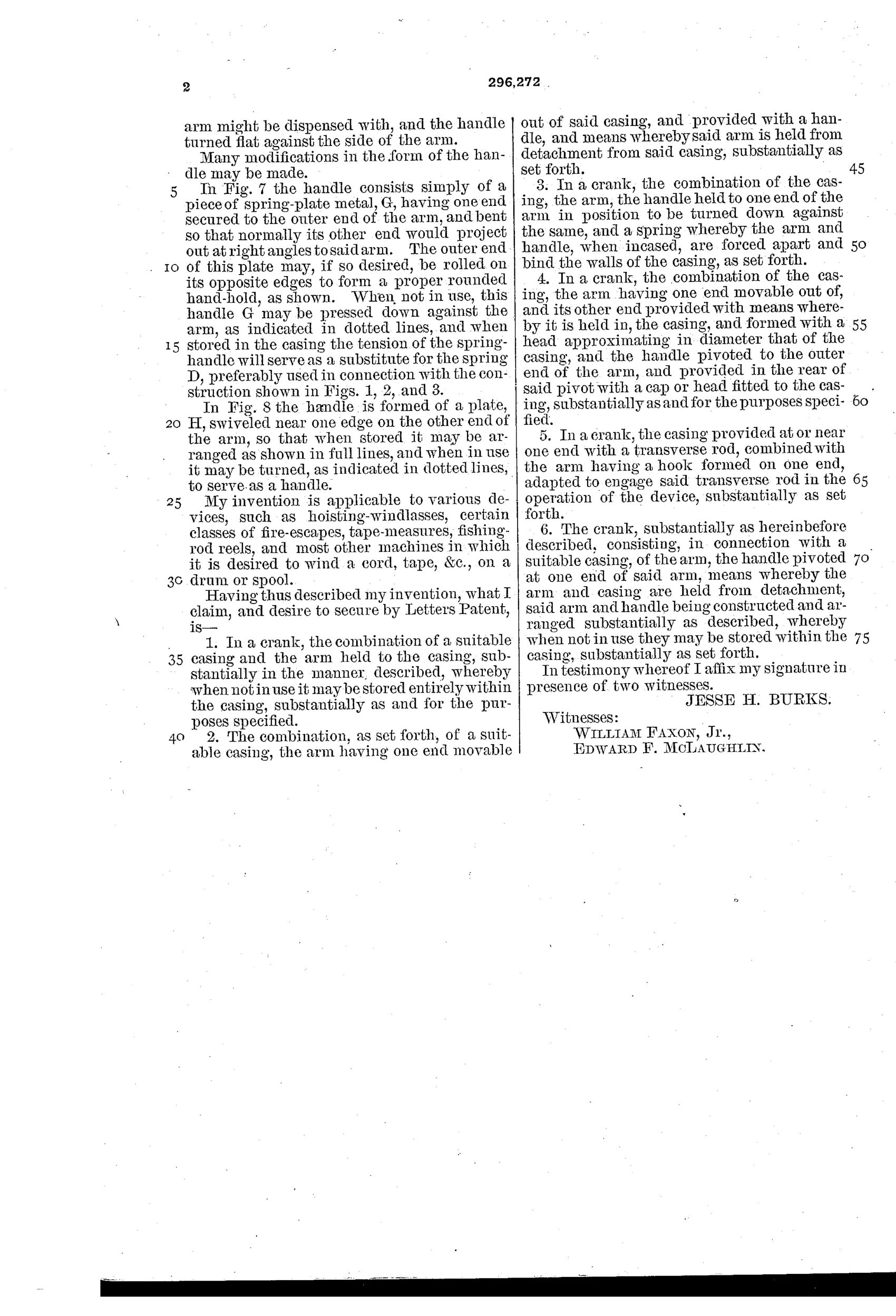
“1. In a crank, the combination of a suitable casing and the arm held to the casing, substantially in the manner described, whereby when not in use it may be stored entirely within the casing, substantially as and for the purposes specified.”
In plain English: A crank whose arm attaches to a casing so that it can be completely folded and stored inside the casing when not being used.
↻ In the inventor’s words
“For light use—such as tape-measures—it will be appreciated.”— Jesse H. Burks, from the specification
Fate unknown
No reel with this retractable crank is documented among known makers; a marked specimen or trade listing would settle it, and none is known to me.
↻ Commentary
Jesse Burks of Los Angeles wasn't really a reel man. He patented a crank — any crank — whose arm and handle fold flat and slide entirely inside a hollow casing, held there by a spring until a push on the hooked end pops it back out. The fishing reel in Fig. 6 is one of several suggested homes, alongside the tape-line reel of Fig. 5, and his own specification tips his hand: 'For light use—such as tape-measures—it will be appreciated.'
The mechanics are neat in a pocket-knife way. The handle pivots into a groove along the arm's side, the arm hinges to a transverse rod via a hook, and when folded the whole assembly becomes a plug that closes the casing at both ends. Figs. 2, 7, and 8 show him worrying at the handle joint — studs and slots, spring-plate metal, a swiveled plate — which is where a folding crank always fails first, so he was thinking about the right weak point.
For a fishing reel, though, it answers a question few anglers were asking. A casting reel's handle needs rigidity and instant grip, and a crank that must be poked out, unfolded, and locked before each use adds slop at every joint. The idea's real descendants are stowable winch and jack handles, not reels. As a reel patent it's a dead end — but an honest, carefully drawn one.
Commentary by Claude, The Fishing Reel Patent Archive’s resident enthusiast