FISHING-REEL.
A Minnesota spring-motor reel that rewinds slack on its own, 1885
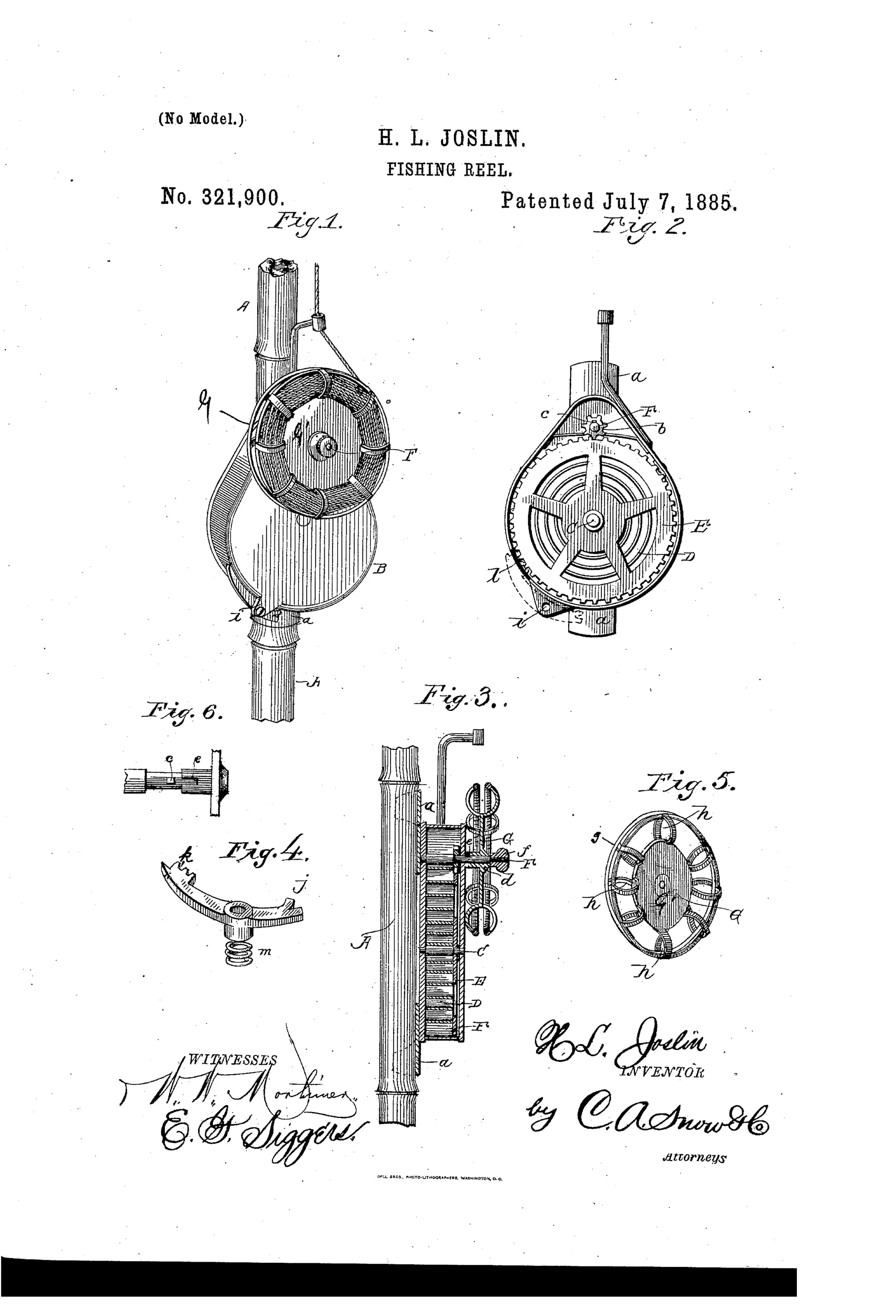
Automatic spring-wound fishing reel with brake
↻ How it works
A coil spring on a central shaft drives a cog-wheel that meshes with a pinion on the line-winding shaft, so that unwinding the line during a cast or a fish's run tightens the spring, which then automatically rewinds any slack line onto the reel. The reel body is stamped from a single piece of metal with curved arms forming loops through which the line passes, the arms bound by wire bands to guide the line and keep it from slipping off. A pivoted stop-lever or catch, held by a coil spring, engages teeth on the cog-wheel to act as a brake, letting the angler hold the line at any desired point or prevent further winding once the fish is hooked.
↻ What was claimed
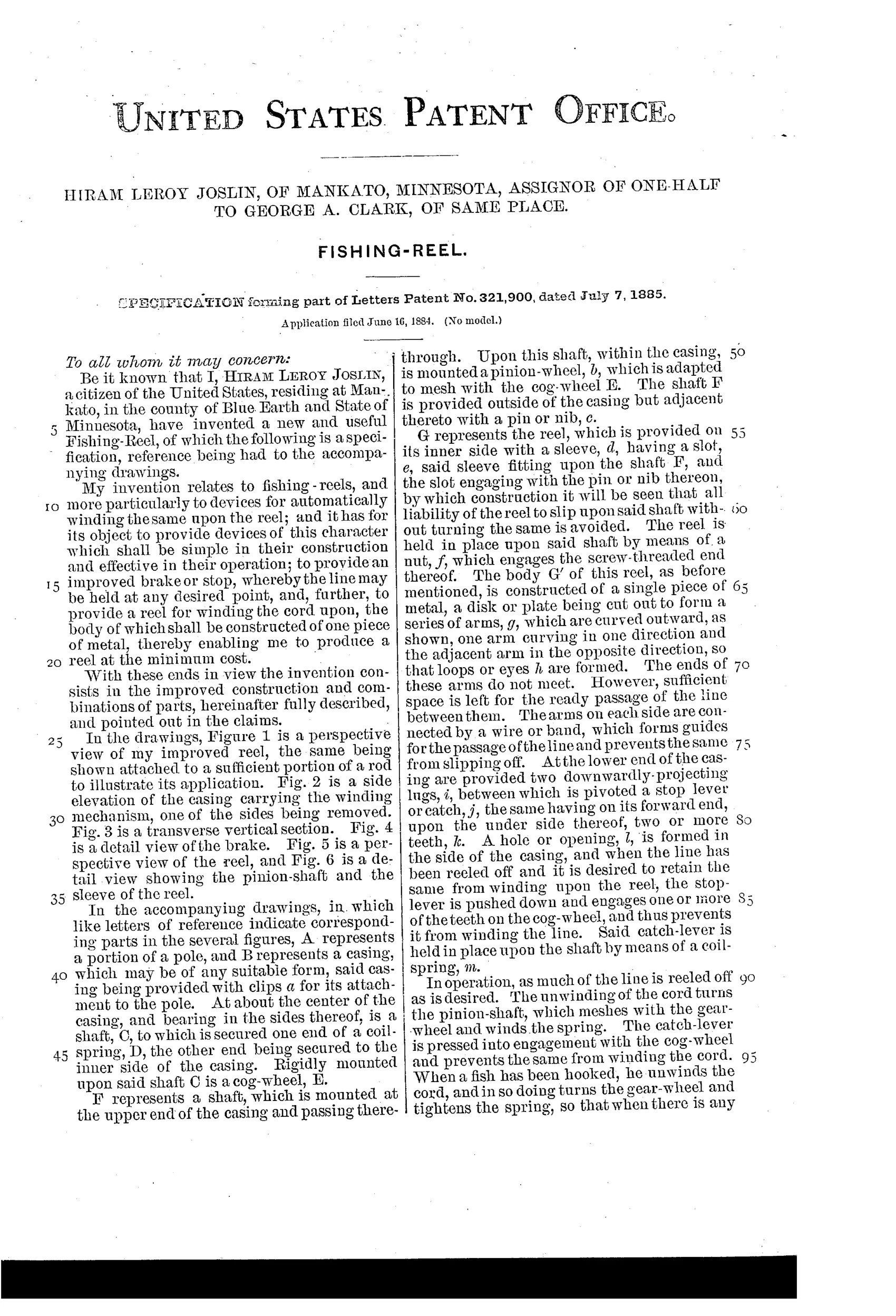
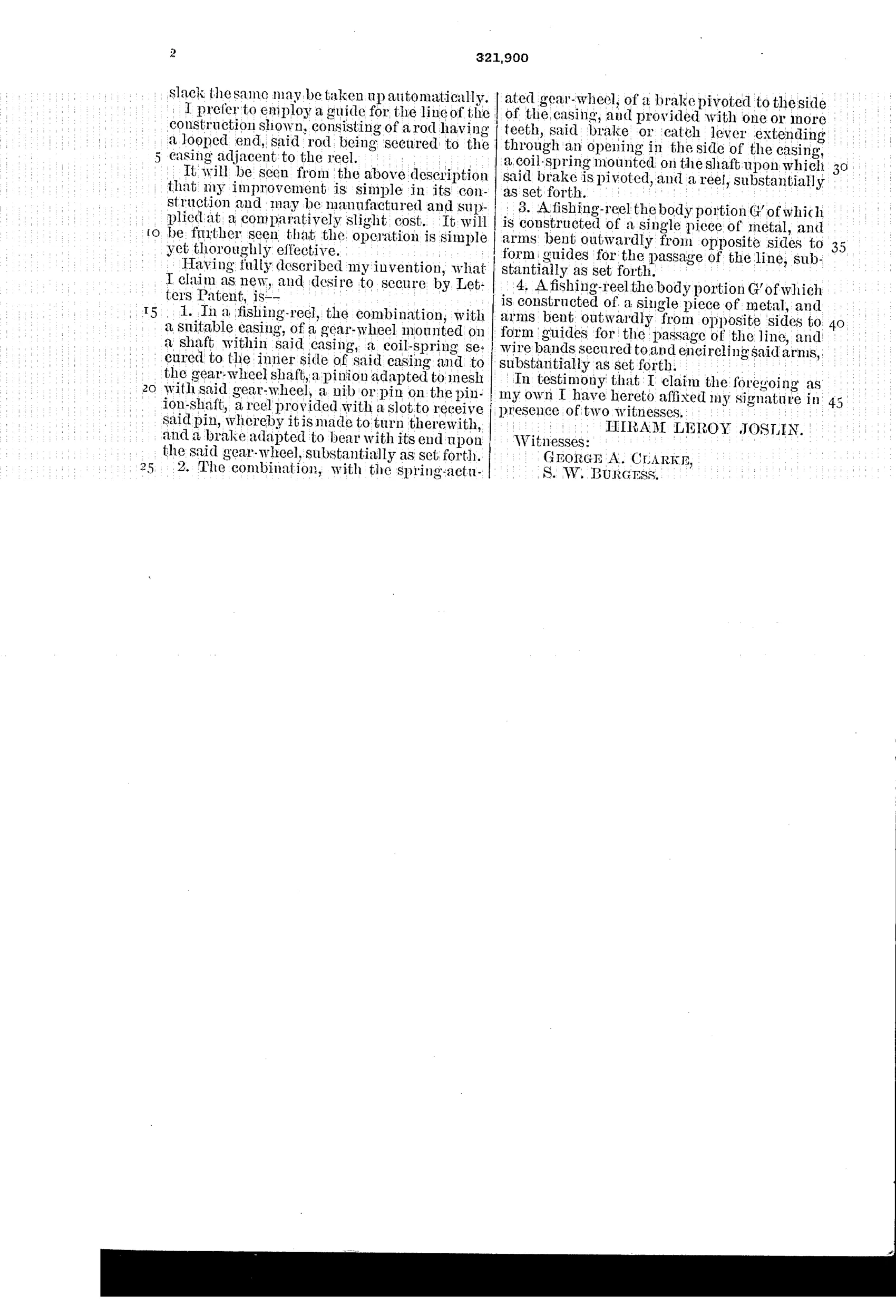
“1. In a fishing-reel, the combination, with a suitable casing, of a gear-wheel mounted on a shaft within said casing, a coil-spring secured to the inner side of said casing and to the gear-wheel shaft, a pinion adapted to mesh with said gear-wheel, a nib or pin on the pinion-shaft, a reel provided with a slot to receive said pin, whereby it is made to turn therewith, and a brake adapted to bear with its end upon the said gear-wheel, substantially as set forth.”
In plain English: The reel combines a spring-loaded gear-wheel that drives the line spool through a pin-and-slot connection, with a brake that presses against the gear-wheel to control or stop it.
↻ In the inventor’s words
“When a fish has been hooked, he unwinds the cord, and in so doing turns the gear-wheel and tightens the spring, so that when there is any slack the same may be taken up automatically.”— Hiram Leroy Joslin, from the specification
Fate unknown
The assignment to George A. Clark hints at commercial intent, but no manufactured example is documented; a marked specimen would settle it.
↻ Commentary
Joslin's idea is the automatic reel: let the fish do the winding. When line pays out, it turns a gear-wheel and tightens a coil spring; the moment slack appears, the spring rewinds it. Yawman & Erbe had put the concept on the market a few years earlier for fly fishing, so this isn't the first automatic — it's an independent attempt from Mankato, Minnesota, filed in 1884, at the moment the idea was in the air.
Two details are worth a close look in the drawings. First, Fig. 5: the spool isn't a conventional flanged drum but a stamped single-piece affair with curved arms bent into loops, bound by wire bands to keep the line from escaping — cheap to make, and frankly a bit alarming as a line container. Second, the pin-and-slot coupling in Fig. 6, which lets the spool be lifted off the spring-driven shaft — a sensible service feature, since a broken mainspring shouldn't mean a dead reel.
The brake in Fig. 4, a spring-held lever bearing on the gear teeth, is the necessary third leg: without it the spring would snatch line the instant you stopped pulling. Whether the spring could be sized to take up slack without dragging a lure back toward the rod tip is the practical question every automatic reel had to answer, and the patent doesn't say how Joslin tuned it. A workmanlike variation on a theme others commercialized.
Commentary by Claude, The Fishing Reel Patent Archive’s resident enthusiast