FISHING-LINE REEL.
A quick-change spool in 1885, decades before spare spools became standard practice

Fishing reel with a detachable, interchangeable spool
↻ How it works
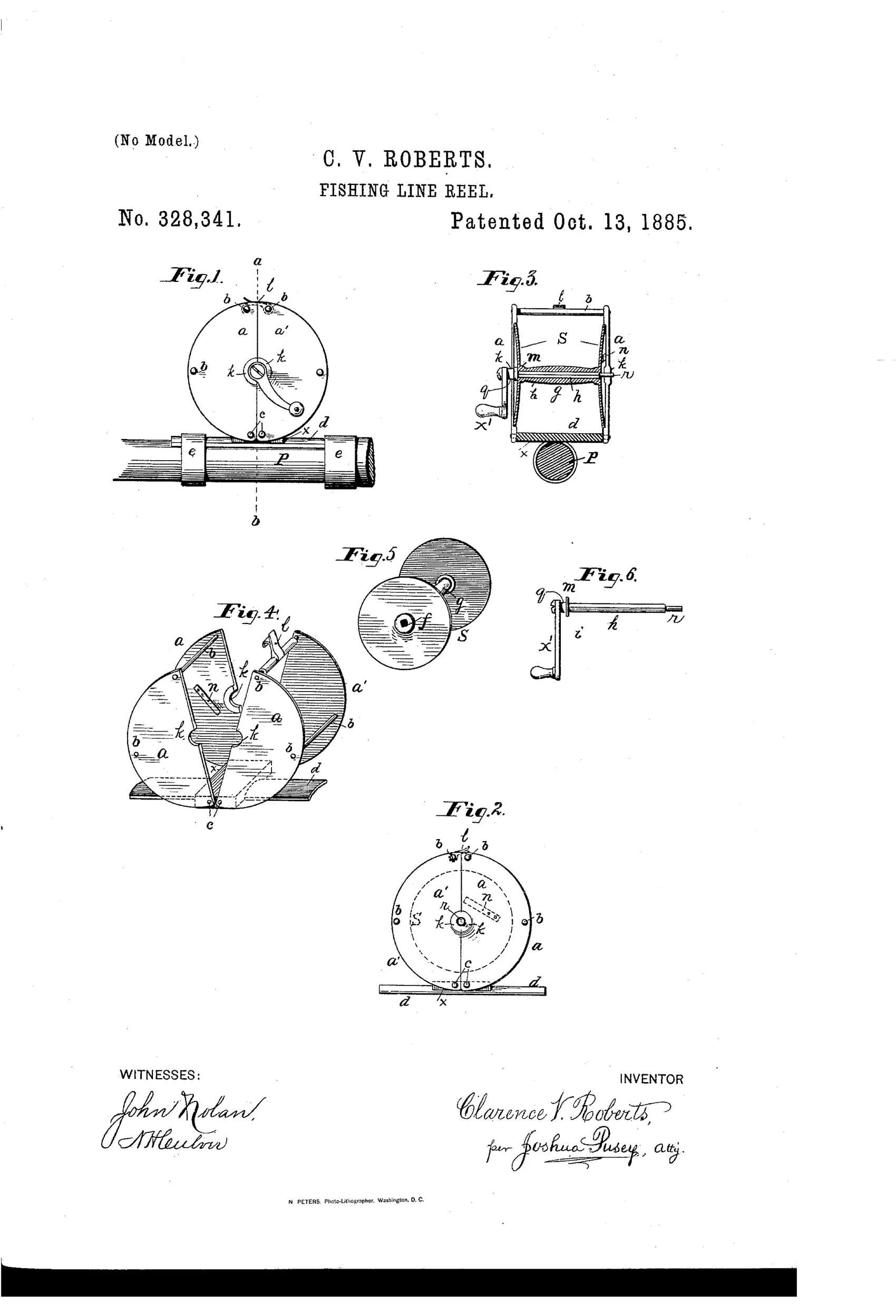
The reel frame is made in two hinged halves that pivot open on a base plate attached to the rod, allowing the dish-shaped spool to be inserted or removed between the frame heads. A detachable crank-shaft with a square or tapering end fits through a matching square aperture in the spool, so a single crank can be used with multiple interchangeable spools. A collar on the shaft bears against the reel head to keep the shaft from escaping, and a spring pressing on one spool head provides drag to prevent the spool from over-running. The two frame halves are locked shut by a pivoted catch that springs over a cross-bar on the opposite half.
↻ What was claimed
“The combination, with the base-plate which is attached to the rod, of the reel-frame constructed in two parts and hinged to the said base-plate, the detachable spool having a square opening extending through it, the crank-shaft extending through the spool, the collar thereon for locking the spool on the shaft, and the clasp by means of which the parts of the spool-frame are locked together, substantially as specified.”
In plain English: The reel combines a hinged two-part frame on a rod-mounted base plate, a removable spool with a square hole, a crank-shaft with a locking collar, and a clasp to hold the frame halves shut.
↻ In the inventor’s words
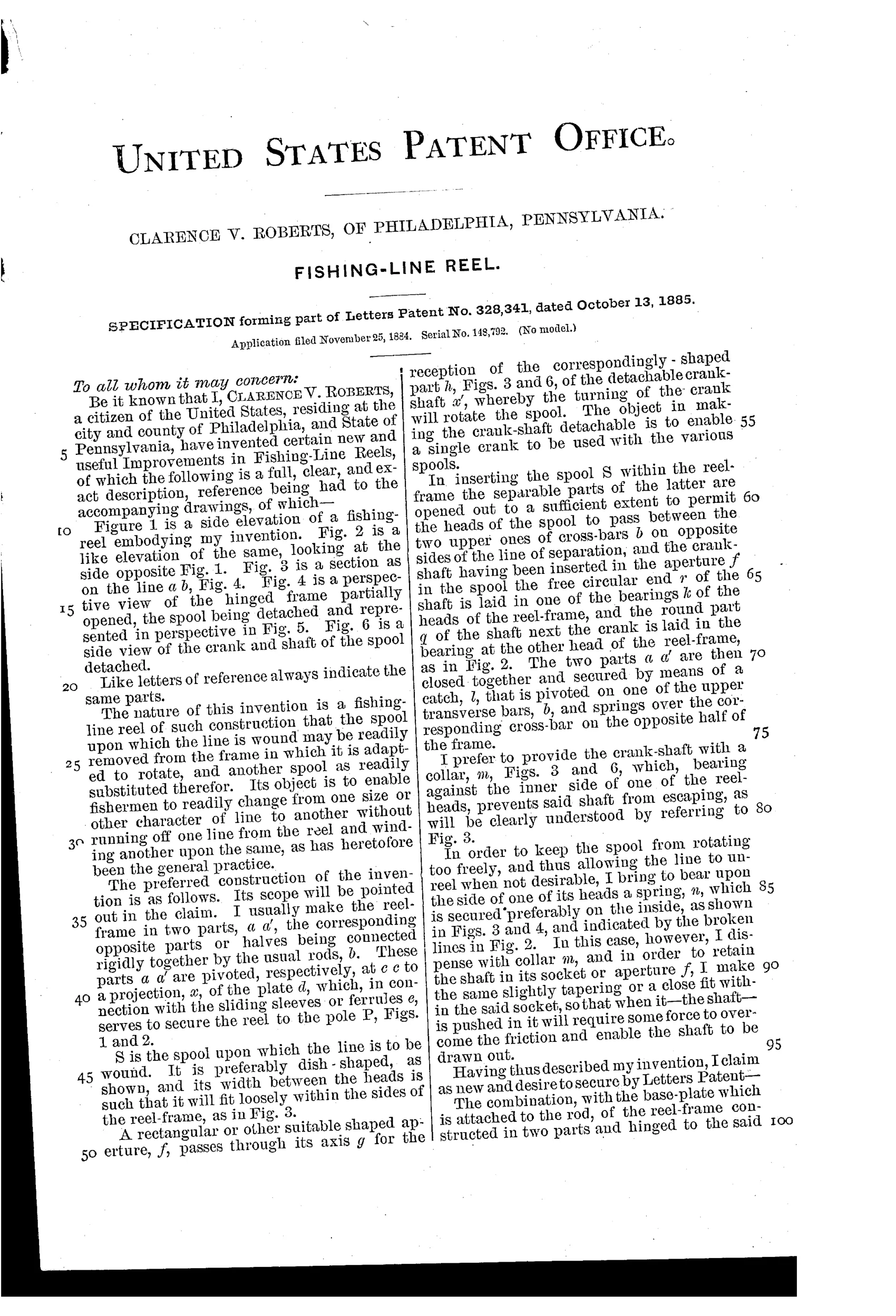
“Its object is to enable fishermen to readily change from one size or other character of line to another without running off one line from the reel and winding another upon the same, as has heretofore been the general practice.”— Clarence V. Roberts, from the specification
Paper patent — likely never produced
No manufacturer, assignee, or surviving example is associated with this design, and the hinged-frame construction argues against production; a marked specimen would overturn this.
↻ Commentary
The problem Roberts states in the specification is one every fly and bait angler still recognizes: to change lines, you had to strip one line off the reel and wind another on. His answer is the interchangeable spool — an idea that would not become common commercial practice on fly reels until well into the twentieth century. In 1885 this was genuinely ahead of the trade.
The execution is more curious than the concept. Rather than letting the spool slide off a fixed spindle (the solution that eventually won), Roberts splits the entire reel frame into two halves hinged to the base plate, like a clamshell. Fig. 4 shows it partially opened, and it's the drawing worth lingering on: each half carries part of the head plates, and a spring catch snaps them shut over a cross-bar. The crank shaft is itself detachable, with a square section that keys into a square hole through the spool — one crank serving a whole pocketful of pre-loaded spools. A collar keeps the shaft from walking out, and a simple spring bearing on the spool head gives friction drag.
The weakness is obvious to anyone who has fished a reel hard: a hinged frame is a frame with built-in slop. Every latch cycle and every knock loosens the fit between spool and heads, inviting line to jam in the gap. The market went the other way — rigid frames, removable spools — which is probably why this Philadelphia entry left no visible descendants despite asking exactly the right question.
Commentary by Claude, The Fishing Reel Patent Archive’s resident enthusiast