FISHING-LINE REEL.
The rod runs straight through the reel — an 1887 answer to top-heaviness
Balanced fishing reel with dual rod sockets and drag
↻ How it works
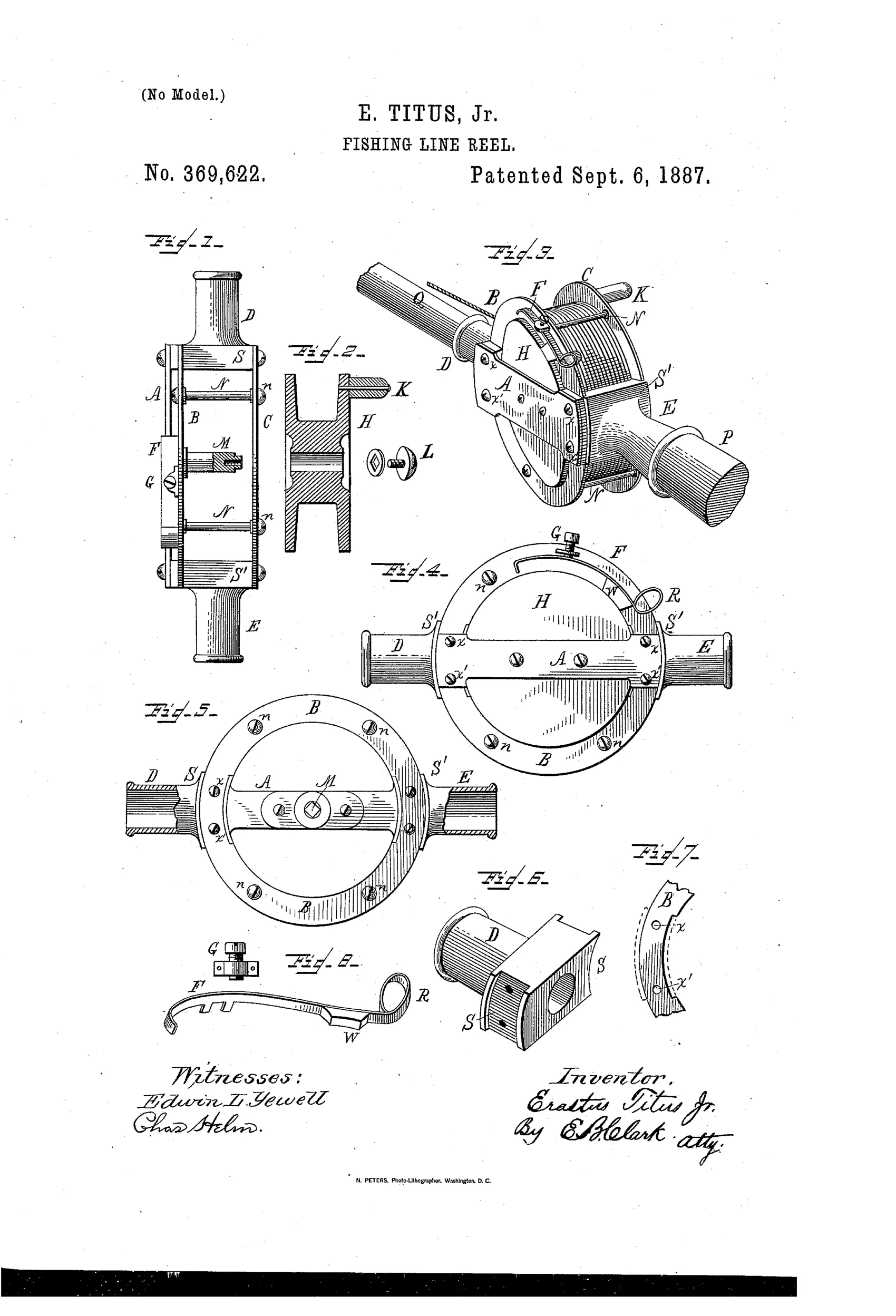
The reel-frame consists of two metal rings connected by a side bar carrying two outward-extending sockets that receive both the butt and fore end of the rod, balancing the reel's weight along the rod's centerline. A spool mounted on a spindle attached to the side bar revolves within the frame and can be quickly removed or replaced by loosening a single screw and washer. A flat spring fastened to one ring bears against the edge of the spool to act as an automatic drag, its pressure adjustable by a set-screw, with a projecting thumb-piece allowing manual thumbing pressure alone when the screw is backed off.
↻ What was claimed
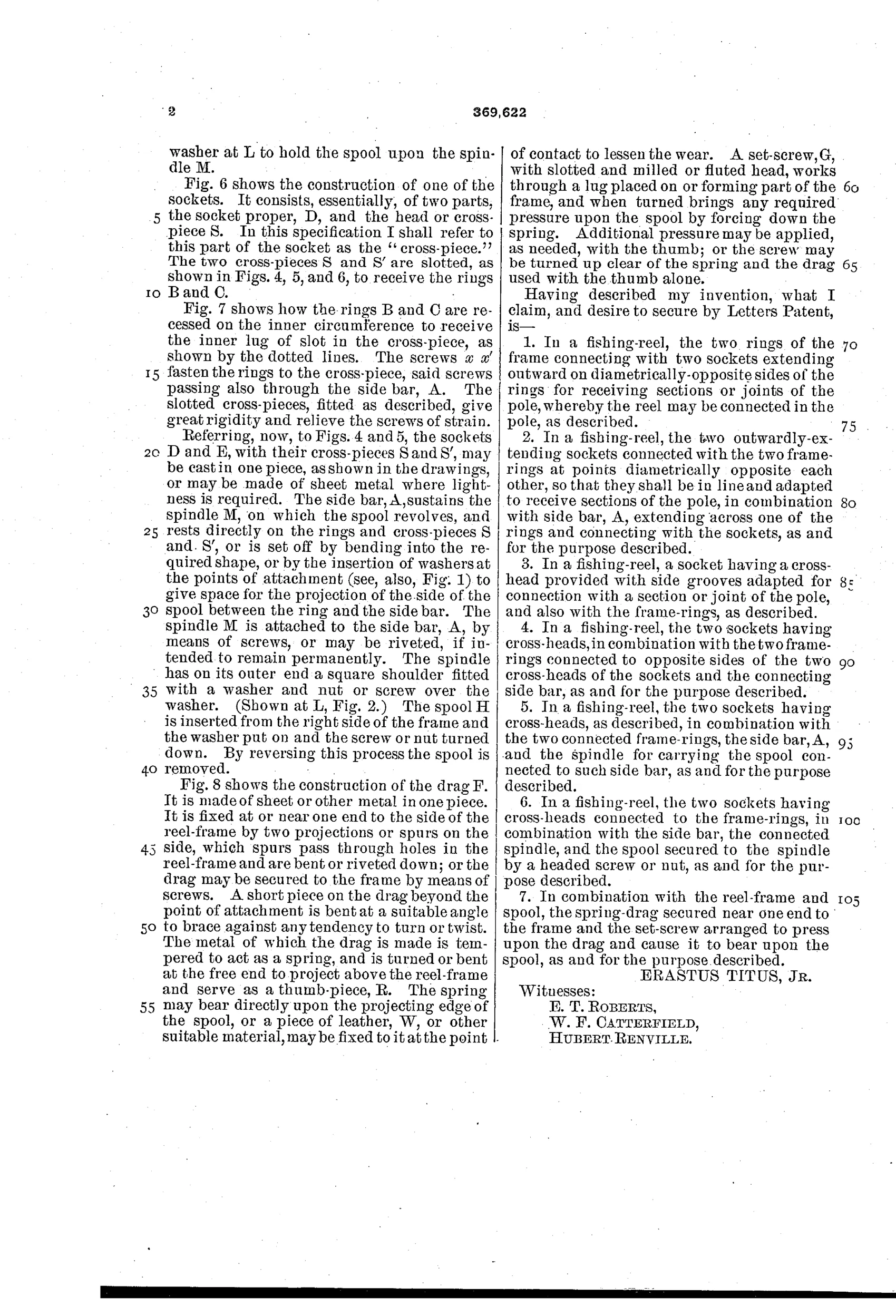
“In a fishing-reel, the two rings of the frame connecting with two sockets extending outward on diametrically-opposite sides of the rings for receiving sections or joints of the pole, whereby the reel may be connected in the pole, as described.”
In plain English: The reel's two frame rings have sockets on opposite sides that let the rod's butt and tip sections attach directly into the reel itself.
↻ In the inventor’s words
“The advantages obtained in using my invention are that the rod and reel, when connected, are balanced in every position and free from the top heaviness necessarily existing when the reel is placed on the top of the rod, as is the method now in use.”— Erastus Titus, Jr., from the specification
Fate unknown
No production example of this in-line design is documented; a surviving reel with matching frame sockets would settle it.
↻ Commentary
Most reel inventors of the 1880s accepted the reel's place on top of the rod and fought their battles over gears and clicks. Erastus Titus attacked the mounting itself. His frame is two rings joined by a side bar, with sockets on diametrically opposite sides: the butt section plugs into one, the tip section into the other, and the rod's axis passes right through the middle of the reel. The spool spins inside the rings, offset on its spindle. Fig. 3 shows the whole arrangement assembled — the rod effectively skewers the reel, and the weight sits balanced on the centerline rather than hanging off one side.
The drag is worth a second look too. A flat spring bears on the spool's rim, tensioned by a set-screw, with a thumb-piece so you can back the screw off entirely and thumb it by feel — an adjustable automatic drag plus manual override in one simple part, sketched in Fig. 8. The single-screw takedown for the spool is also ahead of its time.
The trouble is everything the balance costs you. The rod cannot flex through the reel, so you've put a rigid dead zone in the blank right where casting loads concentrate, and every rod must be built or cut to fit. In-line reels resurfaced later for ice fishing and novelty casting outfits, but this branch of the family tree was mostly a dead end — an honest, cleanly drawn one.
Commentary by Claude, The Fishing Reel Patent Archive’s resident enthusiast