FISHING-REEL.
Vermont's rod-making giant tries a bow-spring drag and a switchable click
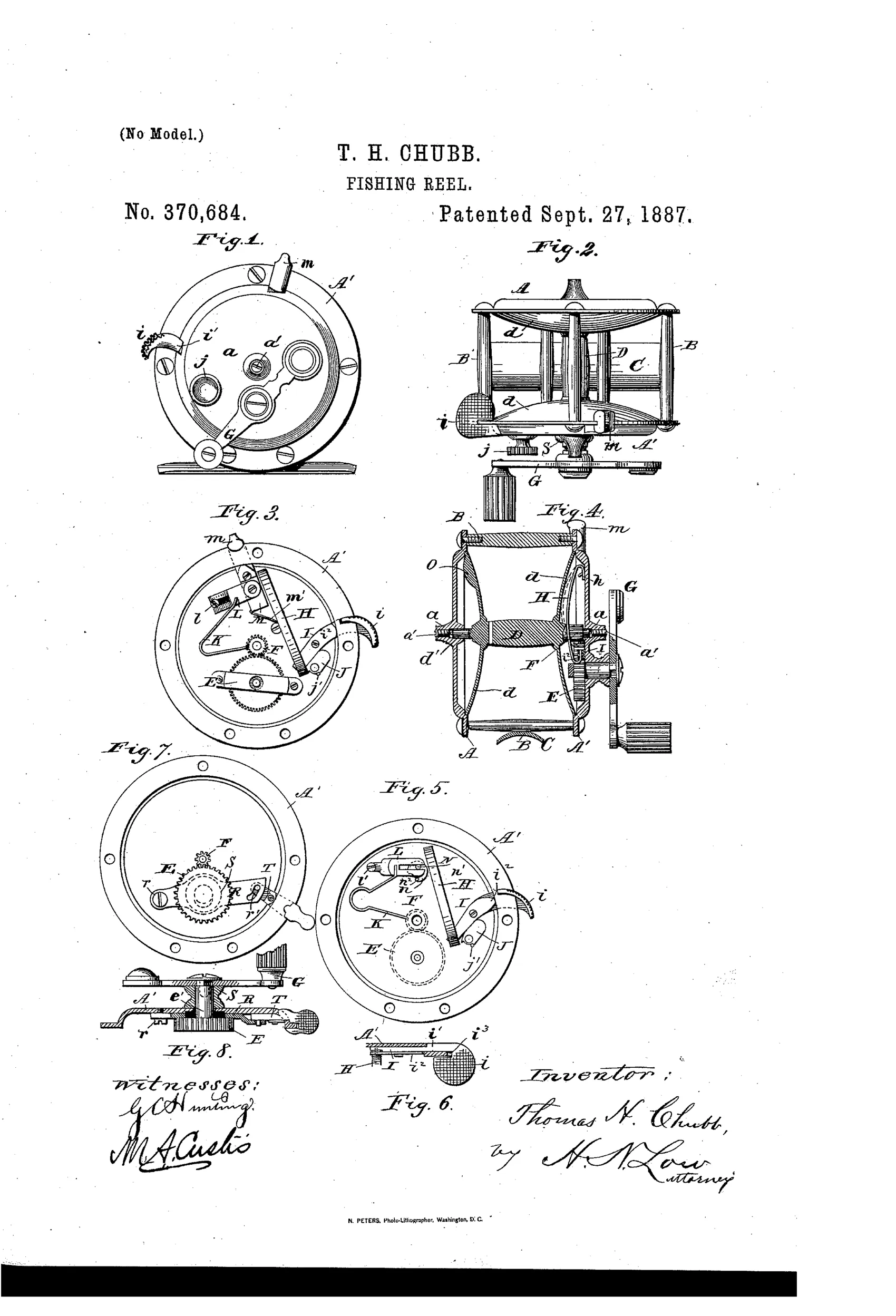
Multiplying fishing reel with adjustable drag and click
↻ How it works
The reel proper, mounted on conical journals adjustable by screws, is turned by a hand-crank driving a gear-wheel that meshes with a pinion on the reel axis to multiply revolutions per crank turn. A bow-spring drag lever, operated by a thumb-piece, presses against a reel-disk to check or brake the spool's rotation, and can be locked in a compressed position by a cam. A separate click-spring lever engages a ratchet or gear tooth to produce an audible click, and can be slid or pivoted into or out of engagement at will, converting the reel between silent and click modes. A pin-and-slot lever arrangement also allows the multiplying gear to be thrown into or out of mesh with the pinion.
↻ What was claimed
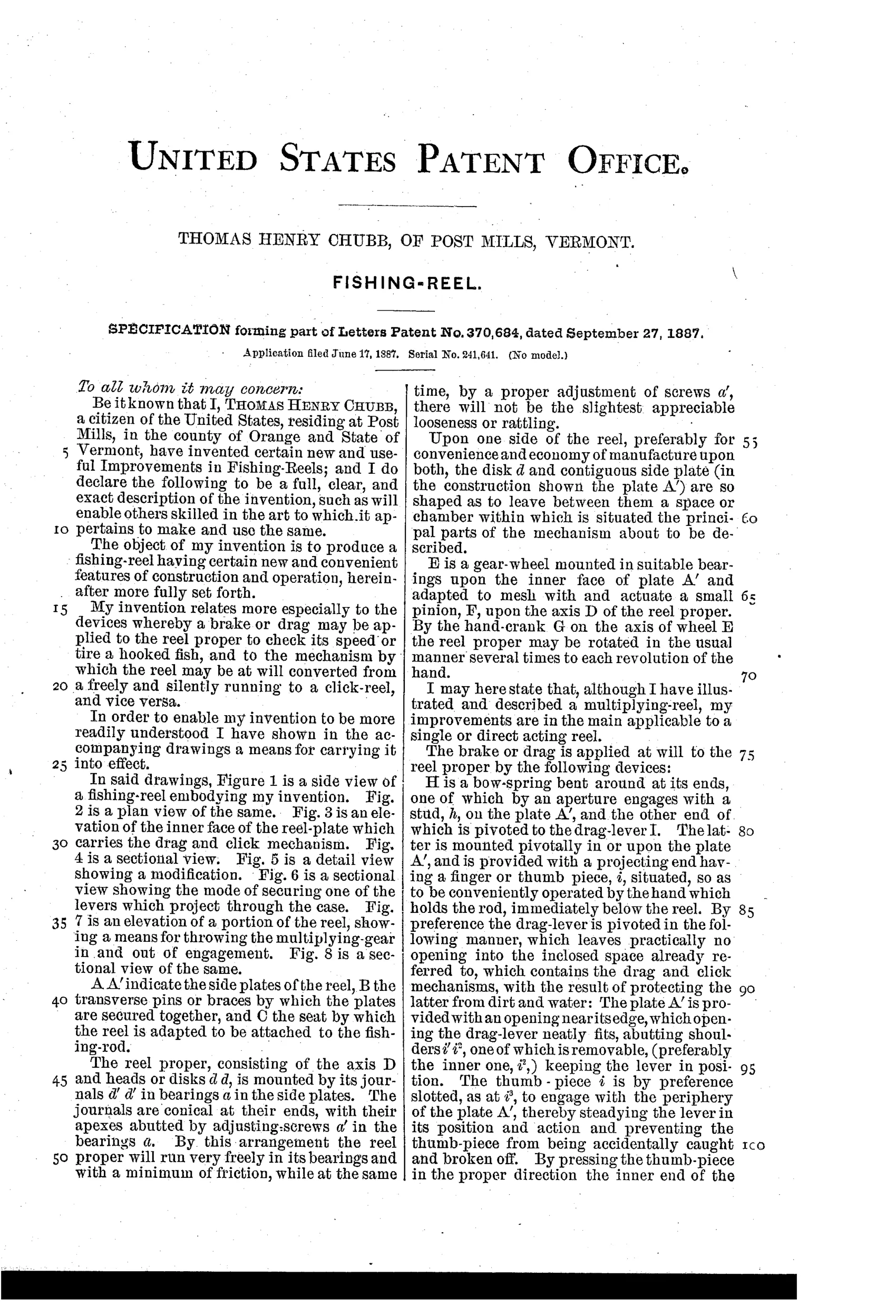
“In a fishing-reel, the combination, with the reel-plate and the reel proper, of a bow-spring situated between said parts, secured at one end to the reel-plate, and having its convex surface turned toward and adapted to engage the reel, and devices, substantially as described, connected with the other end of the spring, for compressing the same, as and for the purpose set forth.”
In plain English: The reel uses a bow-shaped spring mounted between the plate and the reel that can be squeezed to press against and brake the spool.
↻ In the inventor’s words
“My invention relates more especially to the devices whereby a brake or drag may be applied to the reel proper to check its speed or tire a hooked fish, and to the mechanism by which the reel may be at will converted from a freely and silently running to a click-reel, and vice versa.”— Thomas Henry Chubb, from the specification
Fate unknown
Chubb was a major manufacturer and marketed reels, but no documented example of this specific bow-spring drag reel is known to me; a marked specimen or catalog listing would settle it.
↻ Commentary
Thomas H. Chubb is a name tackle historians know well — his Post Mills, Vermont works was one of the largest rod-making operations in America in the 1880s, shipping fly and bait rods by the thousands. Here he turns his shop's attention to the reel, and the result is a sensible multiplier with two features worth a close look: a bow-spring drag and a click that can be thrown in and out at will.
The drag is the heart of the patent. Instead of a friction pad or leather washer, Chubb uses a bowed leaf spring set between the back plate and the reel disk, convex side toward the spool. Squeeze the spring's free end with the thumb-piece and its arch flattens against the disk, braking the spool with a pressure the angler can modulate — and a cam locks it compressed for a set drag. Fig. 3 shows how much is packed onto that inner plate: drag lever, separate click-spring on its own pivot, and in Figs. 7-8 a pin-and-slot lever that lets you unmesh the main gear entirely, converting the multiplier to a free-running spool.
That last trick — disengaging the gearing — anticipates a feature that would matter enormously once casting from the reel became standard practice. Nothing here is a dead end; it's a thoughtful mid-1880s consolidation of drag, click, and free-spool ideas by a man who actually ran a factory, which is more than most patentees of the era could say.
Commentary by Claude, The Fishing Reel Patent Archive’s resident enthusiast