FISHING-REEL
A free-spool casting reel in 1887 — thirteen years before the mania began
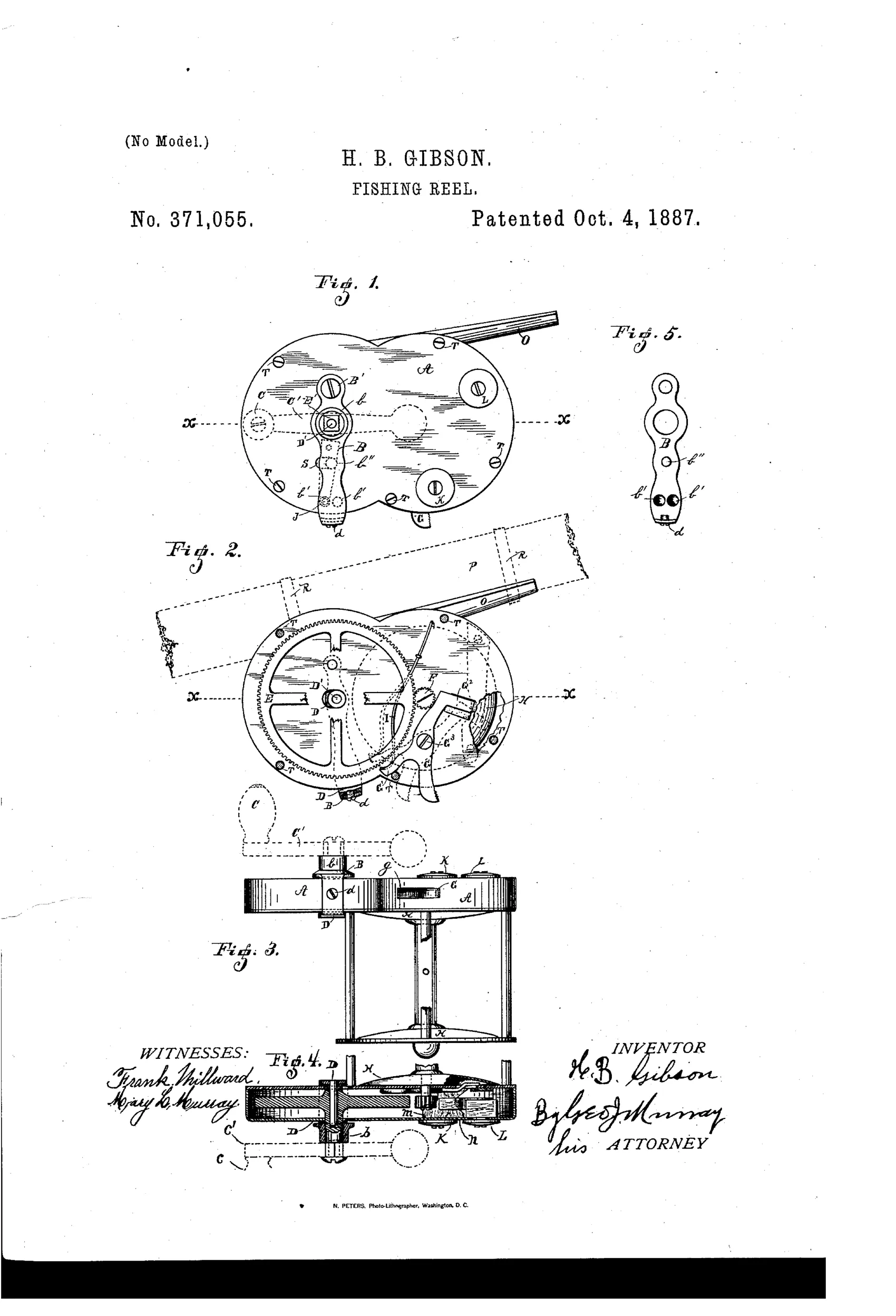
Free-spool fishing reel with cast-stopping brake
↻ How it works
A sheet-metal shell A encases the driving mechanism, with a swinging yoke B pivoted on bolts B' that carries the driving-wheel E and can throw it into or out of engagement with the pinion F on the spool shaft H, allowing the spool to run free for casting. A spring-latch retains the yoke in either the connected or disconnected position. A pivoted stop-lever G, with an angular arm G2 projecting through a slot in the case rim, can be pressed by the angler's finger to instantly brake the spool end and prevent backlash or line tangling the moment the bait strikes the water, being released again by spring I.
↻ What was claimed
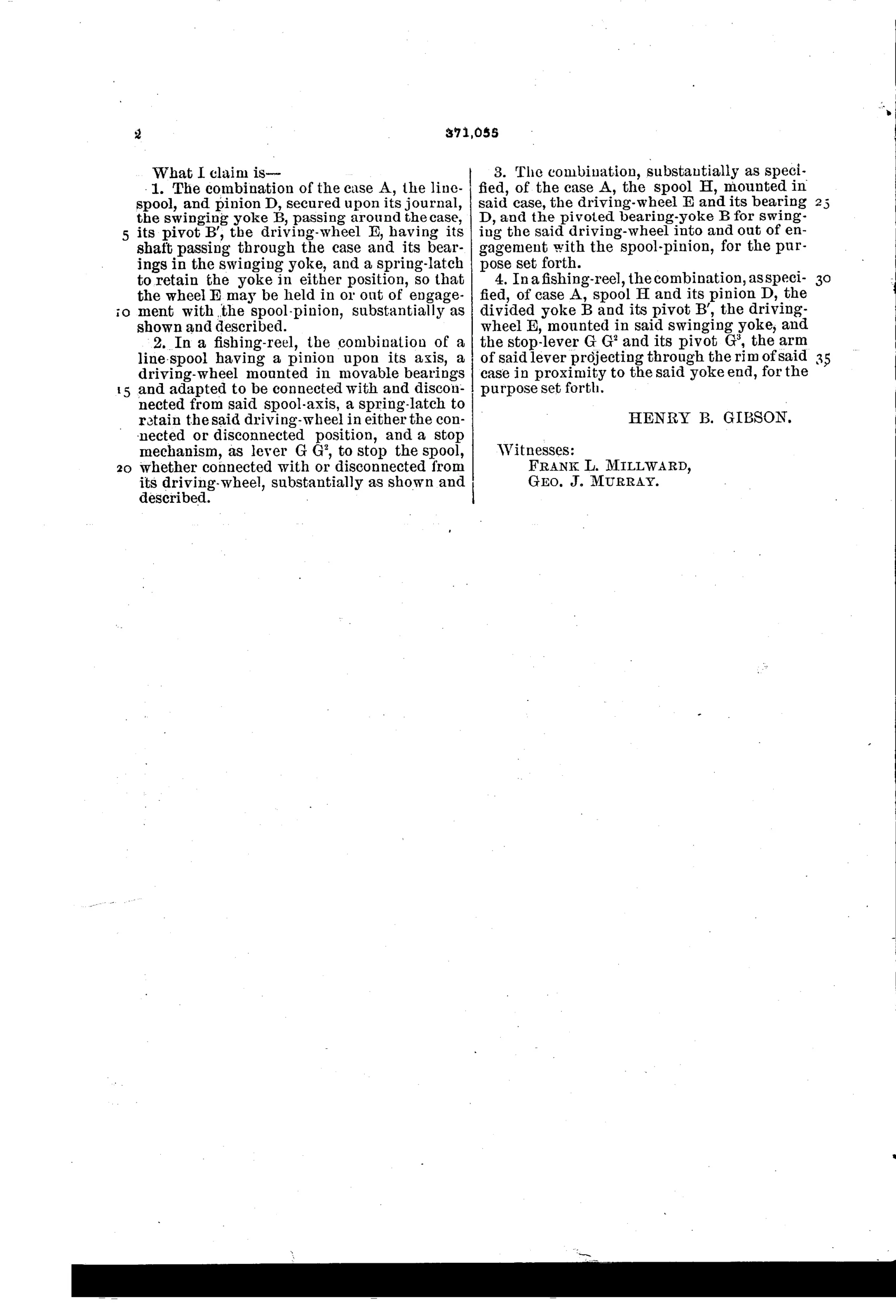
“1. The combination of the case A, the line-spool, and pinion D, secured upon its journal, the swinging yoke B, passing around the case, its pivot B', the driving-wheel E, having its shaft passing through the case and its bearings in the swinging yoke, and a spring-latch to retain the yoke in either position, so that the wheel E may be held in or out of engagement with the spool-pinion, substantially as shown and described.”
In plain English: The reel combines a case, a line spool with a pinion, and a swinging yoke holding a driving wheel that can be pivoted into or out of gear with the spool pinion and locked in either position by a spring latch, so the spool can spin freely for casting or be re-engaged for reeling in.
↻ In the inventor’s words
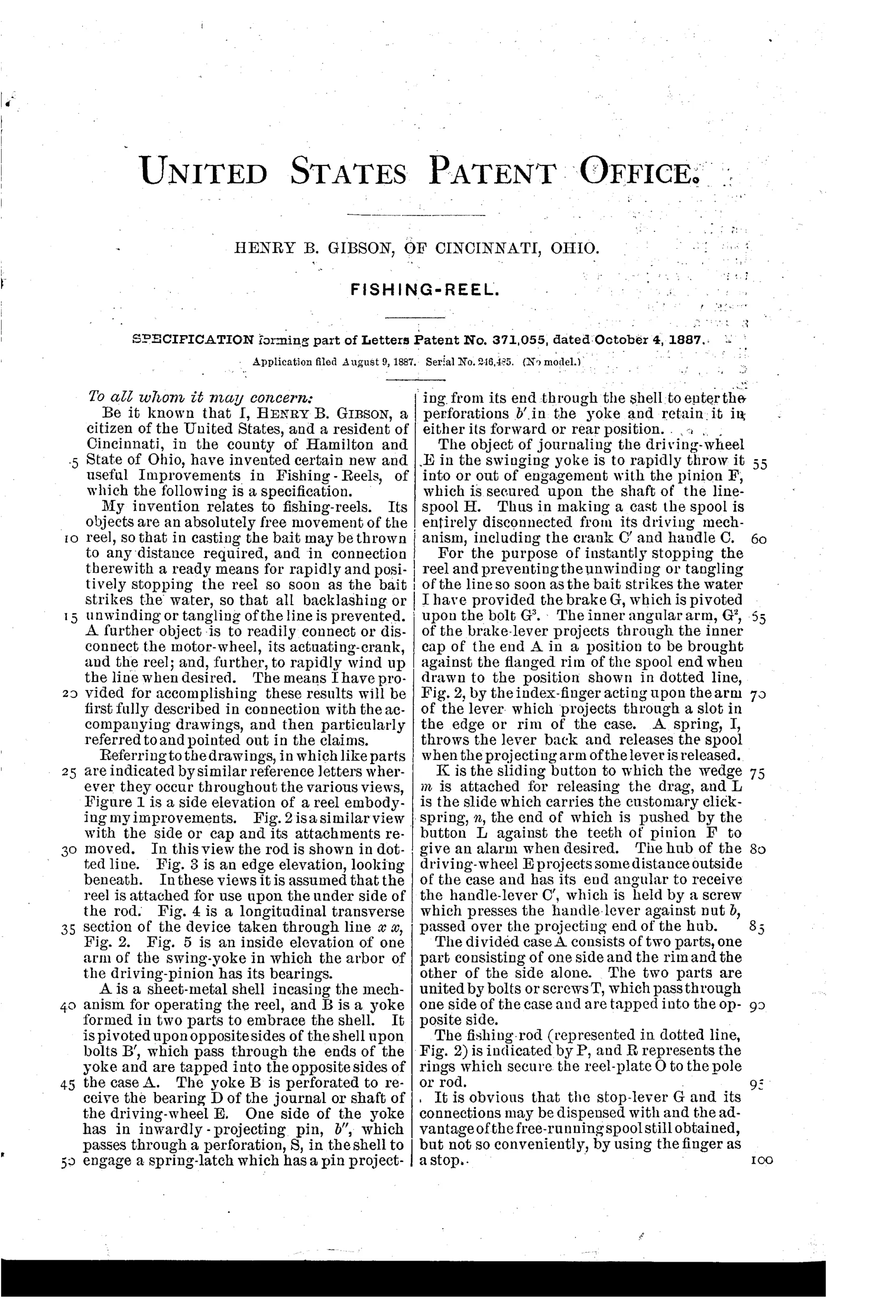
“Its objects are an absolutely free movement of the reel, so that in casting the bait may be thrown to any distance required, and in connection therewith a ready means for rapidly and positively stopping the reel so soon as the bait strikes the water, so that all backlashing or unwinding or tangling of the line is prevented.”— Henry B. Gibson, from the specification
Fate unknown
No production Gibson reel of this design is documented in the collecting record; a marked specimen would settle it.
↻ Commentary
Gibson is chasing the problem that would consume reel designers for the next thirty years: the backlash. His answer is remarkably direct. Instead of leaving the crank gearing permanently meshed — so the angler's cast has to drag the handle, gears, and all their inertia along with the line — he mounts the driving wheel in a swinging yoke that pivots the whole gear train out of engagement. Throw the latch, and the spool spins alone. That is a genuine free-spool mechanism, and 1887 is early for it; most casting reels of the era simply let the handle whirl.
The second half is the honest part. A free spool overruns even worse than a geared one once the bait hits the water, so Gibson adds the stop-lever G with its arm poking through a slot in the rim — a thumb brake, essentially, formalized as a lever. Fig. 2 shows how tight the packaging is: the big internal gear, the yoke pivots at B', and the brake all crowded inside a sheet-metal shell. That shell is worth noting too — stamped construction rather than the machined brass of the Kentucky school, which suggests he was thinking about cost.
The weak point is the yoke itself. A gear train that swings in and out of mesh on pivot bolts is a gear train whose alignment depends on a spring latch, and under a heavy fish that engagement would be tested hard. Educated thumbs on the spool flange solved the same problem with fewer parts, which is likely why history went that way.
Commentary by Claude, The Fishing Reel Patent Archive’s resident enthusiast