FISHING-REEL.
A slipping-clutch drag in 1888, a quarter century before the star drag
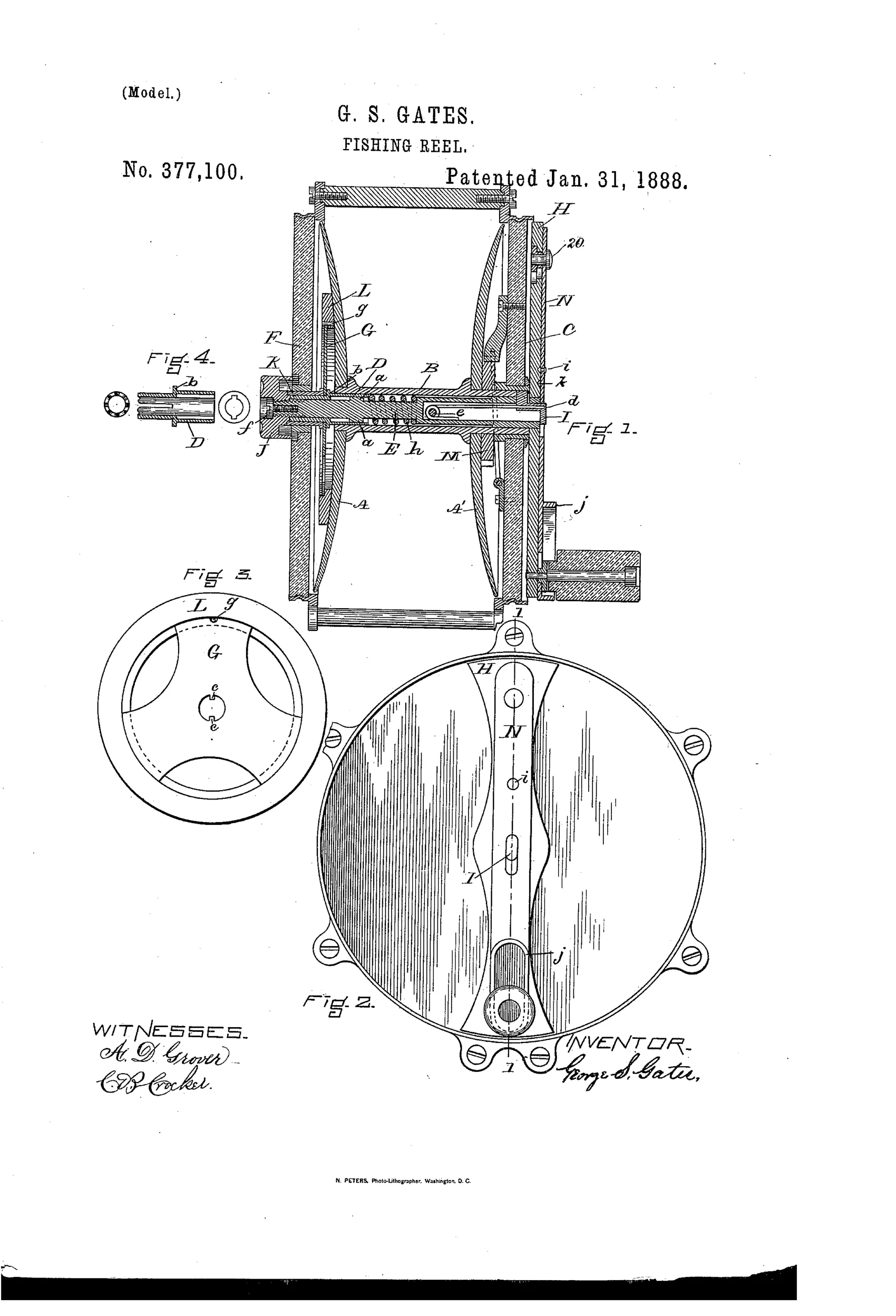
Friction-tension fishing reel with automatic drag mechanism
↻ How it works
The spool is loosely mounted on a shaft so that a friction device—comprising a tension spring or plate and a hard-rubber-faced friction ring—adjustably connects the shaft to the spool. Turning the tension nut compresses the spring, pressing the friction ring against the spool flange with a force proportional to the line strain, so the spool slips and pays out line when the fish's pull exceeds the friction, but winds in when the handle drives it. A positive locking device, actuated by a slotted spring-strip on the handle, can lock the spool solidly to the shaft for ordinary non-multiplying reeling. Corrugated surfaces on the sleeve and adjusting nut act as a friction lock to keep the tension setting from slipping.
↻ What was claimed
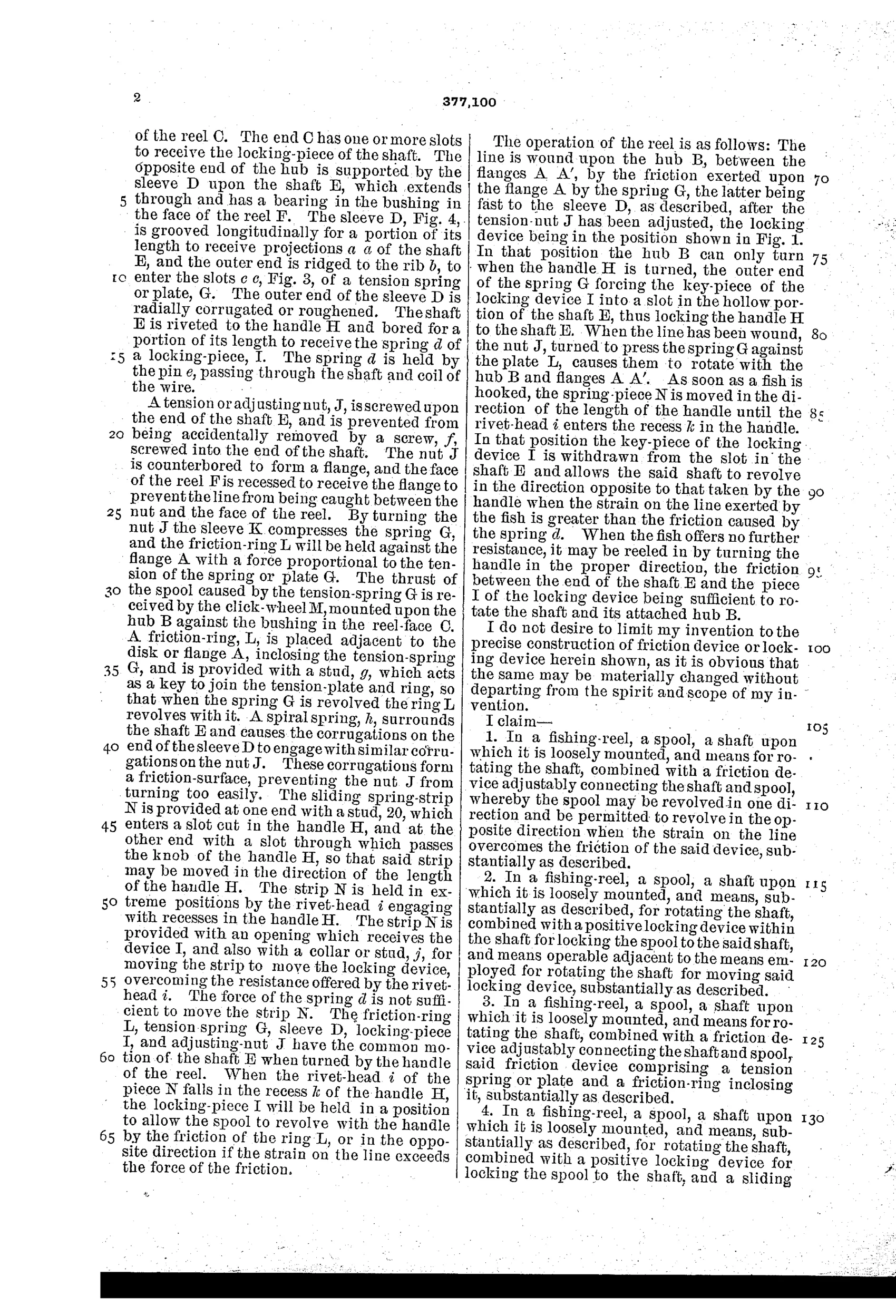
“1. In a fishing-reel, a spool, a shaft upon which it is loosely mounted, and means for rotating the shaft, combined with a friction device adjustably connecting the shaft and spool, whereby the spool may be revolved in one direction and be permitted to revolve in the opposite direction when the strain on the line overcomes the friction of the said device, substantially as described.”
In plain English: The reel has a spool that free-spins on its shaft, connected through an adjustable friction device so it turns with the handle to reel in, but slips and lets line out once the fish pulls harder than the friction setting.
↻ In the inventor’s words
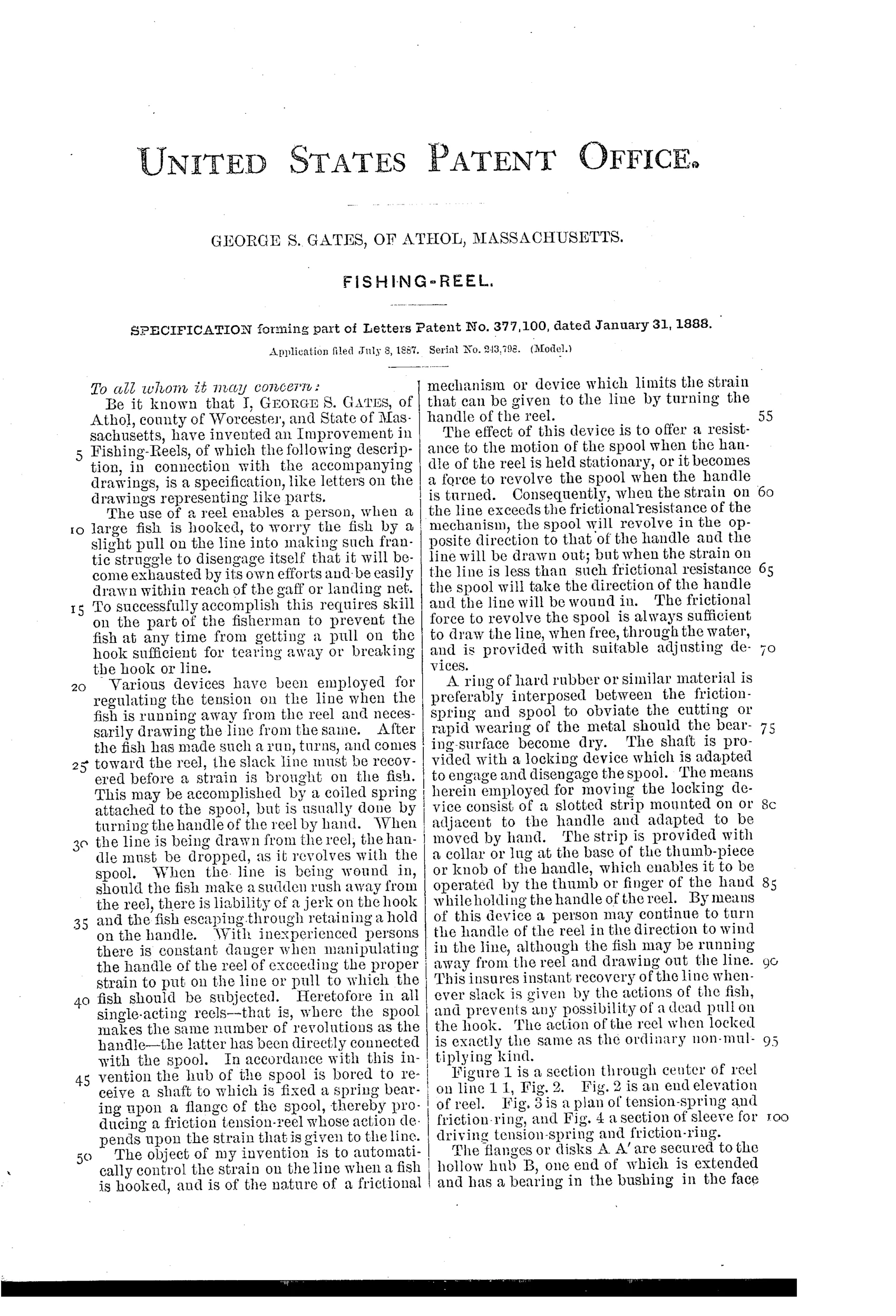
“The use of a reel enables a person, when a large fish is hooked, to worry the fish by a slight pull on the line into making such frantic struggle to disengage itself that it will become exhausted by its own efforts and be easily drawn within reach of the gaff or landing net.”— George S. Gates, from the specification
Fate unknown
Gates is not a known reel maker and no production example is documented; a specimen or trade listing bearing the January 31, 1888 date would settle it.
↻ Commentary
What Gates describes here is, in essence, the slipping clutch that would later make big-game reels possible: a spool loose on its shaft, coupled through a spring-loaded friction ring so it winds with the handle but slips and pays out line the moment a fish pulls harder than the preset tension. That is the working principle of the star drag, which the trade usually dates to the Boschen–vom Hofe work around 1913. Gates has the core idea twenty-five years early, worked out with a hard-rubber friction face and a corrugated nut-and-sleeve detent so the setting can't creep — a small, practical touch that shows he thought about what happens mid-fight.
Fig. 1 rewards a close look: the tension spring, friction ring, and locking strip all live inside the spool arbor along the shaft, keeping the outside clean. The slotted spring-strip at the handle gives a positive lock, converting the reel to a solid direct-drive when you don't want any slip. That two-mode design — free drag or locked — is genuinely thoughtful.
The honest caveats: this is a single-action reel from a Massachusetts inventor outside the Kentucky and Brooklyn manufacturing orbits, and the market of 1888 wasn't yet asking for adjustable drags. The idea was right; the moment was wrong. It reads as a dead end that history later vindicated by other hands.
Commentary by Claude, The Fishing Reel Patent Archive’s resident enthusiast