COMBINED REEL-HANDLE AND FISHING-REEL.
One crank, two speeds: screw it into the gears or the spool itself
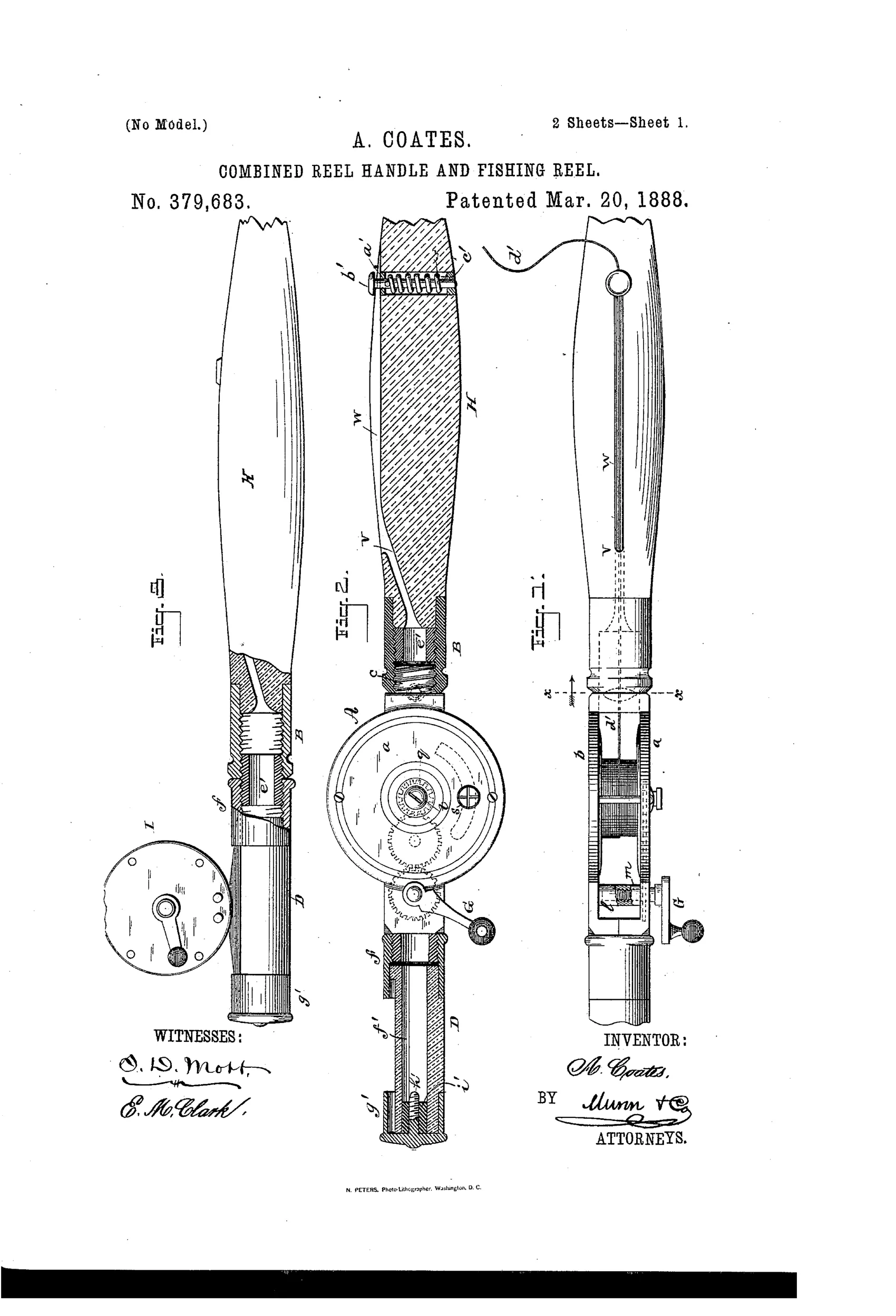
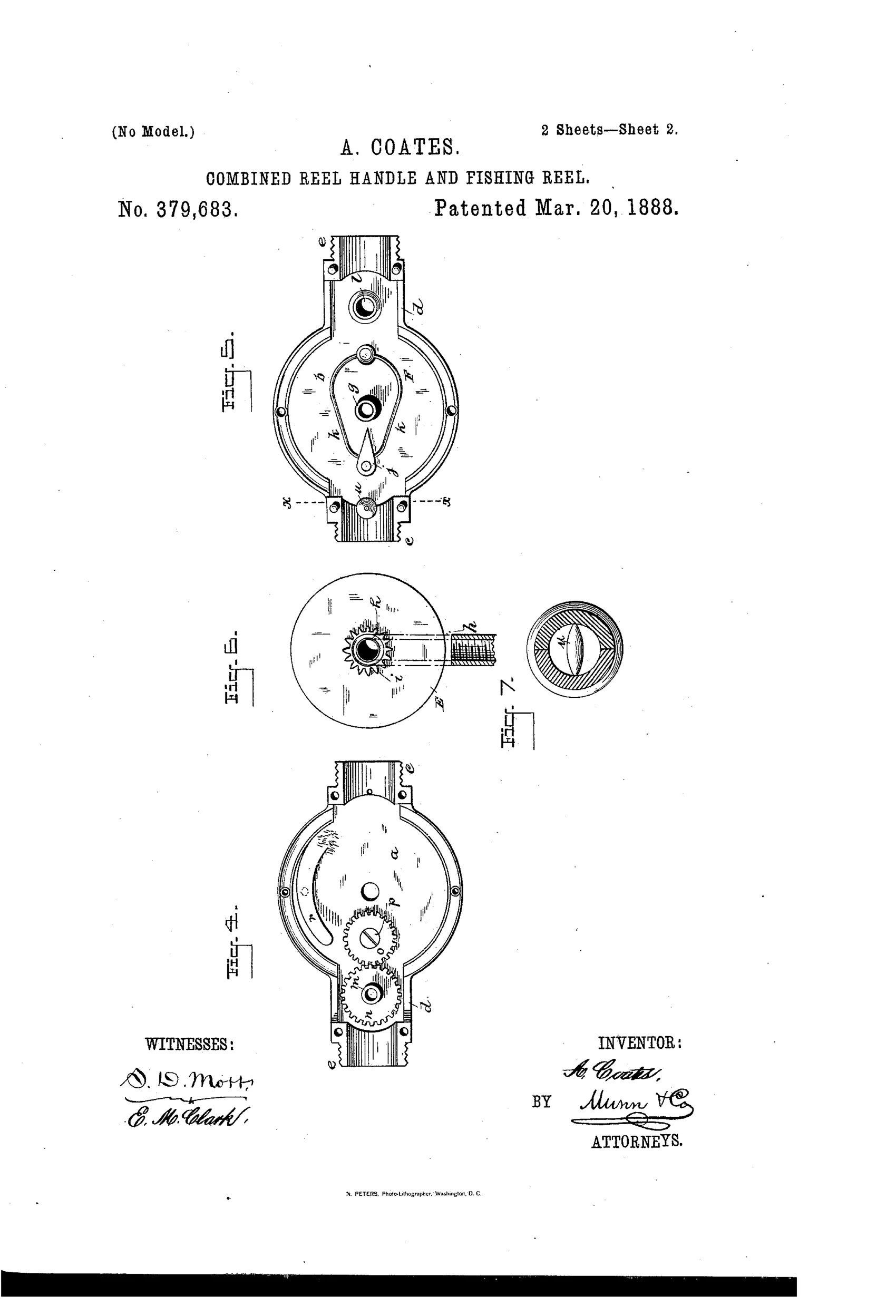
A multiplying fishing reel with detachable interchangeable handle.
↻ How it works
The reel frame's side plates screw into threaded sockets on the ends of a two-piece reel handle, allowing the handle to be split for storage or use with an ordinary reel. A spur-wheel and pinion gearing train, engaged via a removable hand-crank, multiplies rotation of the reel spool for fast winding, while the same crank can instead be inserted directly into the reel's tubular shaft for slow, powerful winding. A spring-loaded click engages a toothed wheel to indicate rotation, and an adjustable curved spring, tensioned by a set screw, bears against the reel to act as a drag or brake. A convex spindle mounted parallel to the reel axis distributes the line evenly as it winds onto the spool.
↻ What was claimed
“The combination, with the reel A, provided with the tubular internally threaded shaft h and pinion q, of the cover-plates a b, the latter provided with the tubular studs g l and the former with the internally-threaded tubular shaft m, inserted in the tubular stud l, the spur-wheel n, attached to the tubular shaft m, the intermediate wheel, o, adapted to engage the spur-wheel n and pinion q, whose shaft receives the shaft g, and the crank G, provided with a screw-threaded shank adapted to fit into either of the tubular shafts m h, substantially as described.”
In plain English: The reel's gear train and cover plates are arranged so a single removable crank can be screwed into either the fast multiplying gear shaft or the reel's own shaft, giving the angler a choice of fast or slow, powerful winding.
↻ In the inventor’s words
“My invention consists in the combination, with the reel-frame adapted to screw into sockets upon the ends of the parts of the reel-handle, of a reel and multiplying-gearing adapted to turn said reel, and a crank which may be transferred from the multiplying-gearing to the reel itself, so as to secure both slow and fast winding.”— Abraham Coates, from the specification
Fate unknown
No production example or maker attribution is known for Coates of Watertown; a surviving handle-reel combination bearing this patent date would settle it.
↻ Commentary
Coates's reel builds itself into the rod handle rather than clamping onto a seat: the side plates screw into threaded sockets on a two-piece grip, and Fig. 3 shows the fallback — unscrew everything and mount an ordinary reel on the same handle. That alone marks him as an inventor thinking about the whole tackle system, not just the winch. But the genuinely interesting idea is the transferable crank. Screwed into the geared shaft, it drives a spur-and-pinion train for fast multiplying retrieve; screwed into the reel's own tubular shaft, it winds direct — slow but with full leverage on a heavy fish. That's a two-speed reel achieved with zero shifting mechanism, just a threaded shank and two sockets.
He also throws in a curved brake spring tensioned by a set screw — an adjustable drag, still a rarity in 1888 — a click wheel, and a convex spindle to spread line across the spool, an early stab at the level-wind problem that would obsess the trade twenty years later.
The weak point is practical: unscrewing a crank mid-fight to change gear ratio is not something an angler with a live fish does calmly, and the handle-integrated frame ties you to Coates's rod. It's a clever paper solution to problems the market later solved with free-spool clutches and standard reel seats. A dead end, but an honest and mechanically literate one.
Commentary by Claude, The Fishing Reel Patent Archive’s resident enthusiast