FISHING-REEL.
A Pennsylvania enclosed-drum reel with roller bearings, sold on cheapness alone
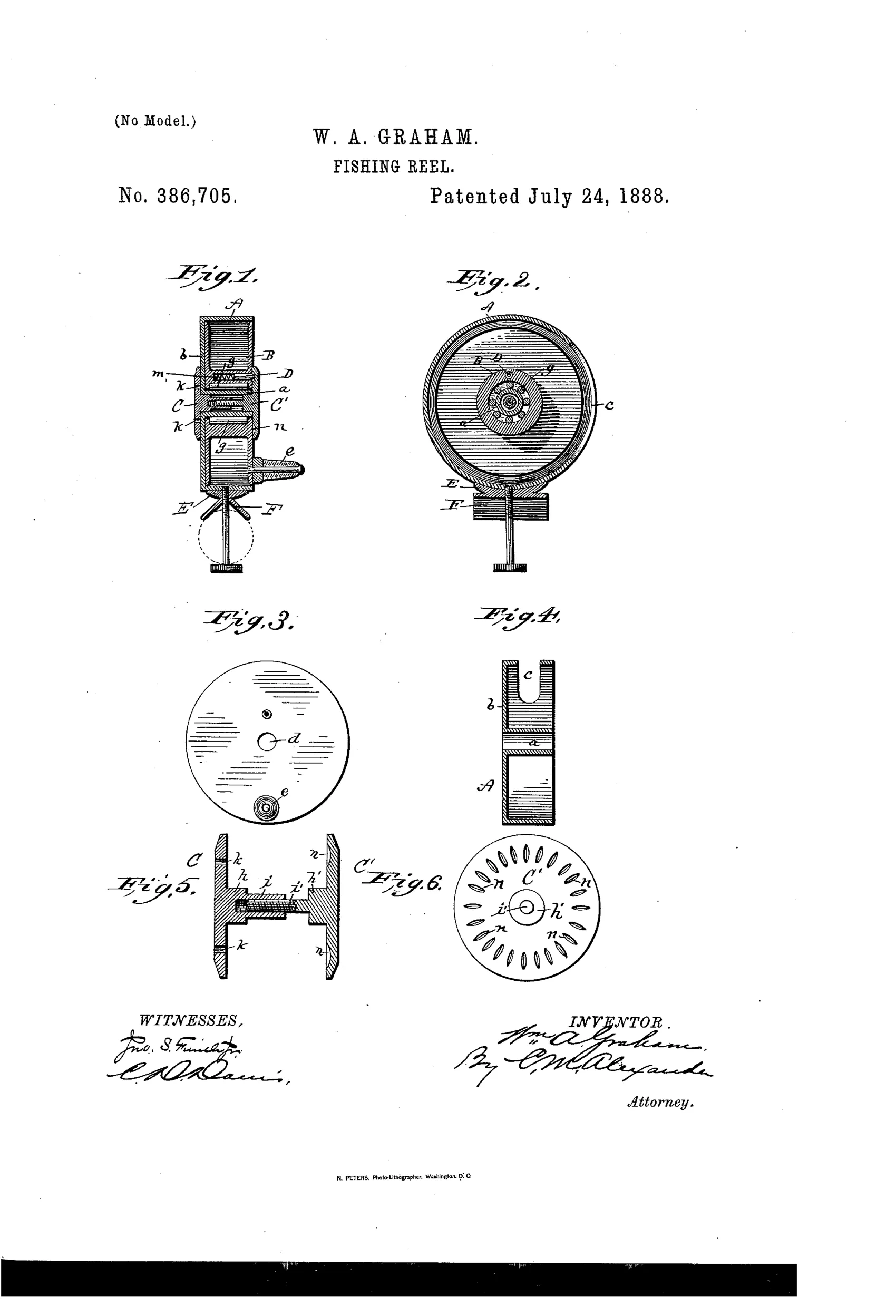
Simple cylindrical-casing fishing reel with brake click
↻ How it works
A cylindrical casing has one open end with a central tubular spindle on which a spool-like reel is journaled, the reel's outer disk flush with the casing end and fitted with an operating handle. Two disks with central cylindrical projections snap into the tubular spindle and are drawn together by a screw and threaded shank to retain the reel while allowing free rotation. A spring-actuated click-pin seated in the hub engages serrations on the inner face of one retaining disk to act as both an audible warning and a brake against over-running. Anti-friction rollers set in an annular groove reduce friction between the reel and the spindle, and a V-shaped clamp plate with a thumb-screw secures the whole casing to the fishing rod.
↻ What was claimed
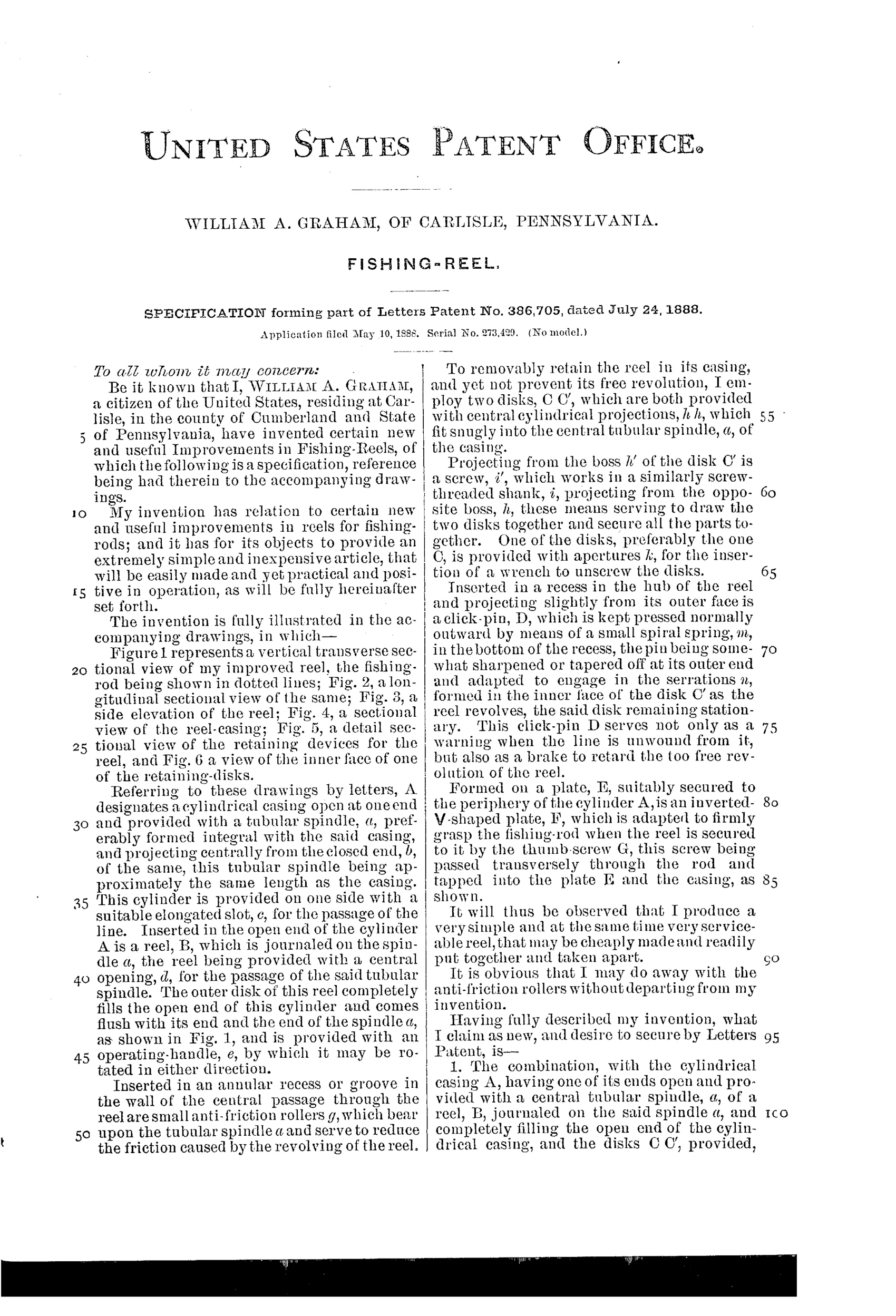
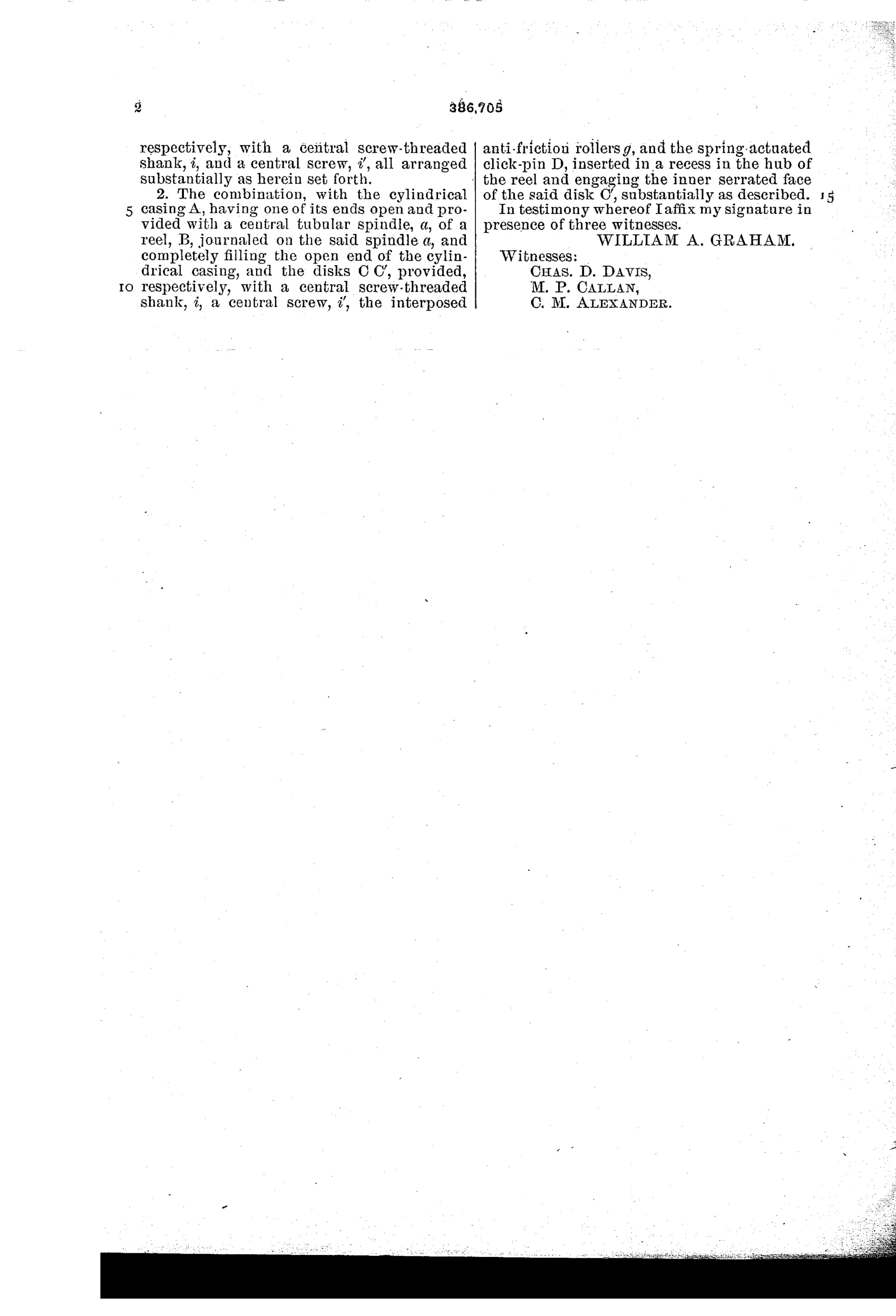
“The combination, with the cylindrical casing A, having one of its ends open and provided with a central tubular spindle, a, of a reel, B, journaled on the said spindle a, and completely filling the open end of the cylindrical casing, and the disks C C', provided, respectively, with a central screw-threaded shank, i, and a central screw, i', all arranged substantially as herein set forth.”
In plain English: The reel combines a cylindrical casing with a central spindle holding a spool that fills the casing's open end, secured by two disks joined with a screw and threaded shank.
↻ In the inventor’s words
“My invention has relation to certain new and useful improvements in reels for fishing-rods; and it has for its objects to provide an extremely simple and inexpensive article, that will be easily made and yet practical and positive in operation, as will be fully hereinafter set forth.”— William A. Graham, from the specification
Fate unknown
No maker is associated with Graham and no production example is documented; a marked specimen or trade listing would settle it.
↻ Commentary
Graham's pitch is honesty itself: he wants "an extremely simple and inexpensive article," and the design shows it. This is a single-action reel built like a tin of shoe polish — a cylindrical casing open at one end, with the spool's outer disk sitting flush in that opening so the whole line chamber is enclosed. That flush face is the quietly good idea here: no exposed pillars or gaps for line to slip behind, which was a genuine nuisance on the raised-pillar reels of the day.
The assembly method is the clever bit a casual reader would skip past. Two disks with a mating screw and threaded shank (Figs. 5 and 6) snap into the tubular spindle and draw together, sandwiching the spool so it spins freely but can't walk off. One disk carries radial serrations on its inner face — that sunflower pattern in Fig. 6 — and a spring-loaded pin in the hub rides over them, giving both the audible click and a mild brake against overrun. It's a click mechanism reduced to about three parts, which suits the stated goal.
The anti-friction rollers in an annular groove sit oddly against the cheapness pitch; loose rollers are fussy to make and fussier to keep clean, and a plain bearing would have served this reel fine. As a whole it's a workmanlike entry in the cheap single-action crowd, decades from Kentucky's jeweled multipliers — but the enclosed flush-face casing anticipates a form that later side-mount reels made ordinary.
Commentary by Claude, The Fishing Reel Patent Archive’s resident enthusiast