FISH-LINE REEL
Yank a cord like a spinning top to reel in your slack
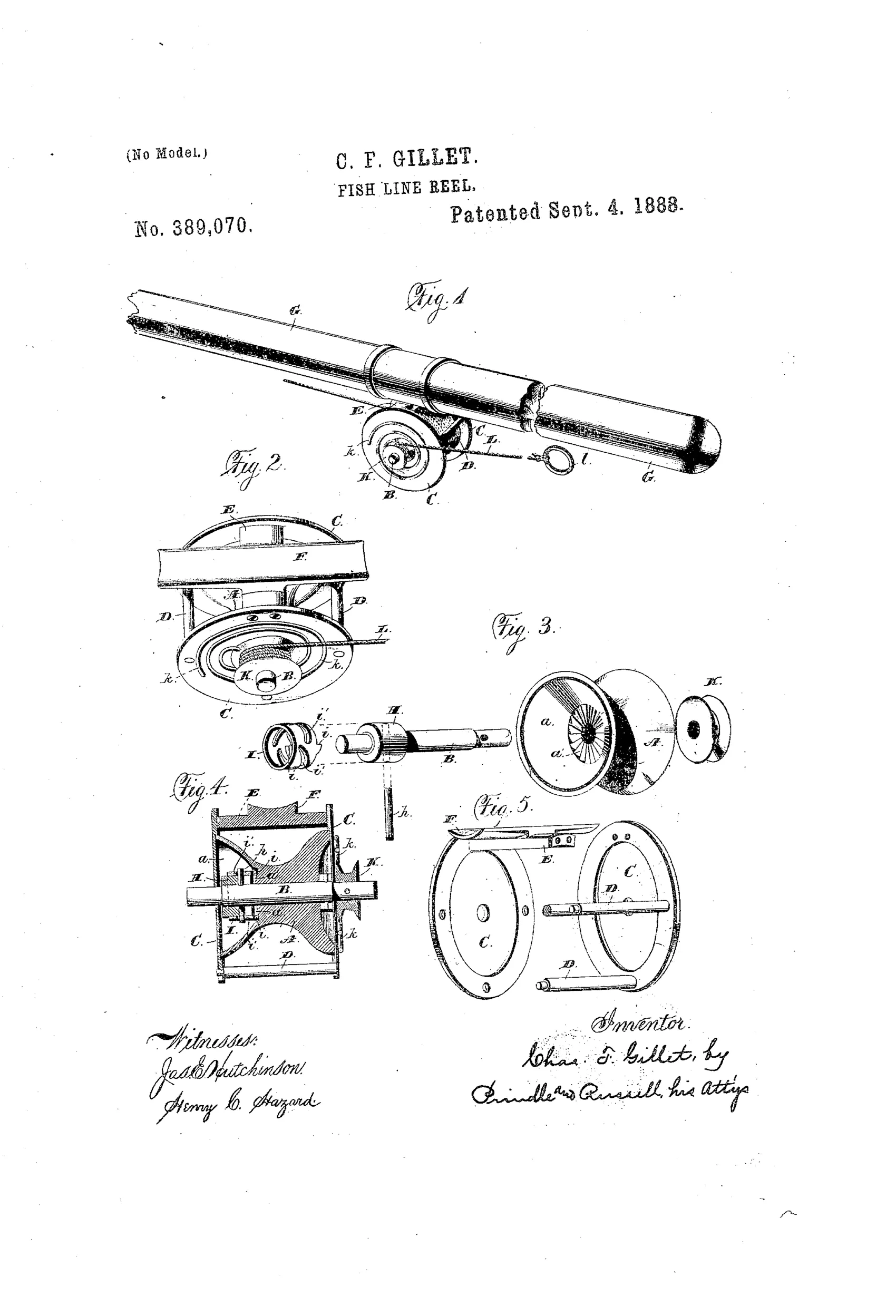
Fishing reel with cord-driven anti-backlash clutch mechanism
↻ How it works
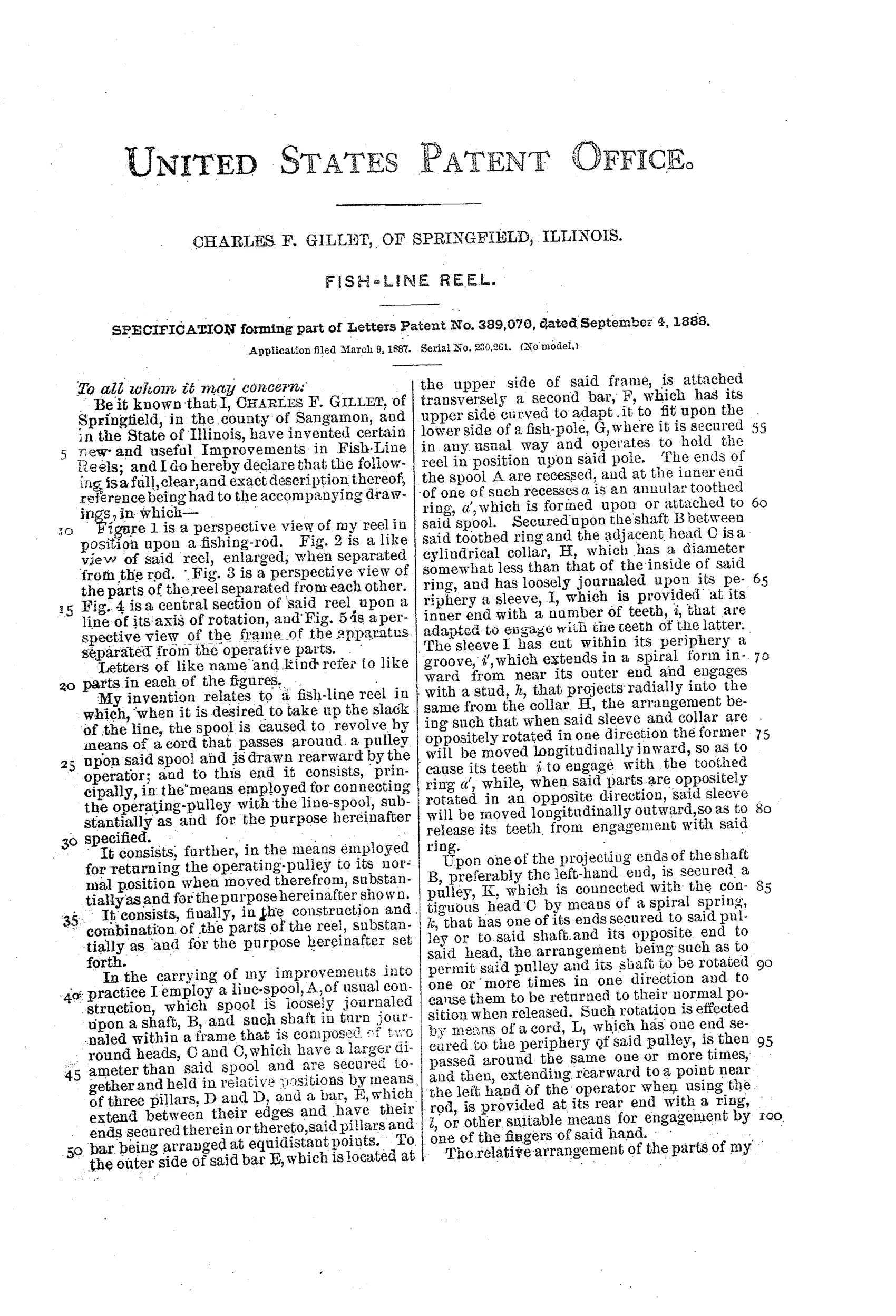
A line-spool is loosely journaled upon a shaft that turns within a frame formed of round heads and pillars. A cord-operated pulley on the shaft is connected to the frame by a spiral spring, so a sharp pull rotates the shaft and then returns it to normal position. A sleeve with a spiral groove engaged by a stud moves longitudinally in response to shaft rotation, forcing its teeth into a toothed ring on the spool to take up slack, then automatically disengaging by momentum when forward motion stops, allowing free running of the line otherwise.
↻ What was claimed
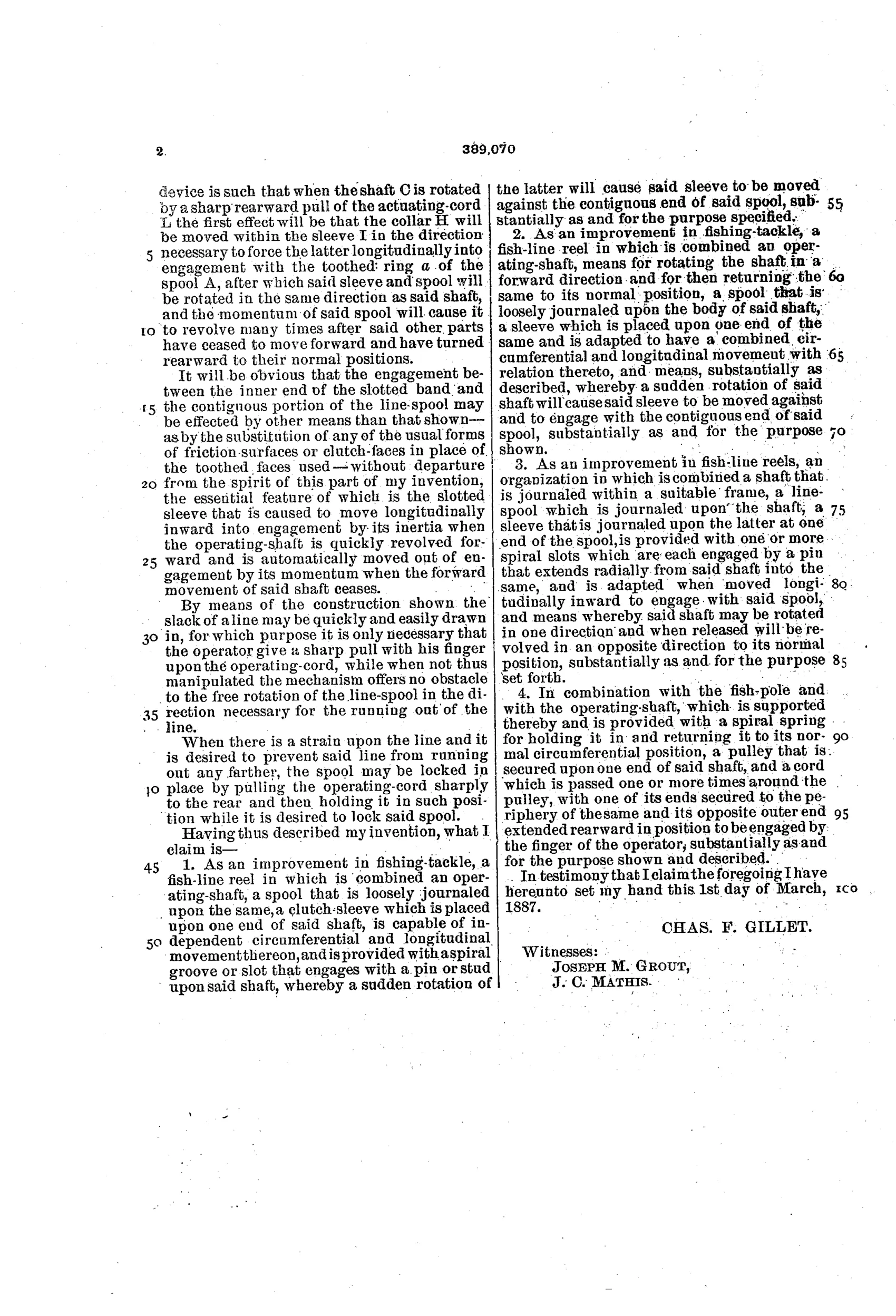
“1. As an improvement in fishing-tackle, a fish-line reel in which is combined an operating-shaft, a spool that is loosely journaled upon the same, a clutch-sleeve which is placed upon one end of said shaft, is capable of independent circumferential and longitudinal movement thereon, and is provided with a spiral groove or slot that engages with a pin or stud upon said shaft, whereby a sudden rotation of the shaft C is rotated by a sharp rearward pull of the actuating-cord L the first effect will be that the collar H will be moved within the sleeve I in the direction necessary to force the latter longitudinally into engagement with the toothed ring a of the spool A, after which said sleeve and spool will be rotated in the same direction as said shaft...”
In plain English: A fishing reel with a shaft-mounted clutch sleeve that, when the shaft is sharply rotated by a pull-cord, slides longitudinally to engage a toothed ring on the spool and spin it to take up line, then disengages automatically once the pull stops.
↻ In the inventor’s words
“By means of the construction shown the slack of a line may be quickly and easily drawn in, for which purpose it is only necessary that the operator give a sharp pull with his finger upon the operating-cord, while when not thus manipulated the mechanism offers no obstacle to the free rotation of the line-spool in the direction necessary for the running out of the line.”— Charles F. Gillet, from the specification
Paper patent — likely never produced
No production example or maker association is known, and the cord-pull operation runs against every practical convention of the trade; a marked specimen would be a genuine surprise.
↻ Commentary
Gillet's reel has no crank in the usual sense. Instead, a pull-cord wraps a pulley on the main shaft, and a spiral spring rewinds it — the same starter-cord logic you'd later see on outboard motors. Give the cord a sharp yank and the shaft spins; a sleeve riding a spiral groove on that shaft screws itself sideways into a toothed ring on the spool, the spool whirls and gathers slack, and when the yank ends, momentum backs the sleeve out of engagement. At rest the spool floats free on its shaft, so line pays out with no drag at all.
That clutch is the genuinely clever bit, and it's worth studying Fig. 3, where the grooved sleeve, collar, and toothed ring are laid out separately. The spiral-groove-and-stud engagement is a legitimate one-way, self-releasing clutch — the same family of mechanism that makes Bendix starter drives work decades later. Gillet got the geometry right.
Where it falls apart is the fishing. Slack recovery in jerky, cord-length increments is no substitute for continuous cranking, and there's no evident way to fight a fish under tension — the moment you stop pulling, the clutch lets go. It answers the free-running question that obsessed reel inventors, but by abandoning the multiplying crank that Kentucky makers had already perfected, it solves the wrong half of the problem. An honest dead end, elegantly engineered.
Commentary by Claude, The Fishing Reel Patent Archive’s resident enthusiast