FISHING-REEL.
A worm-gear level-wind in 1889, fifteen years before Shakespeare made it famous
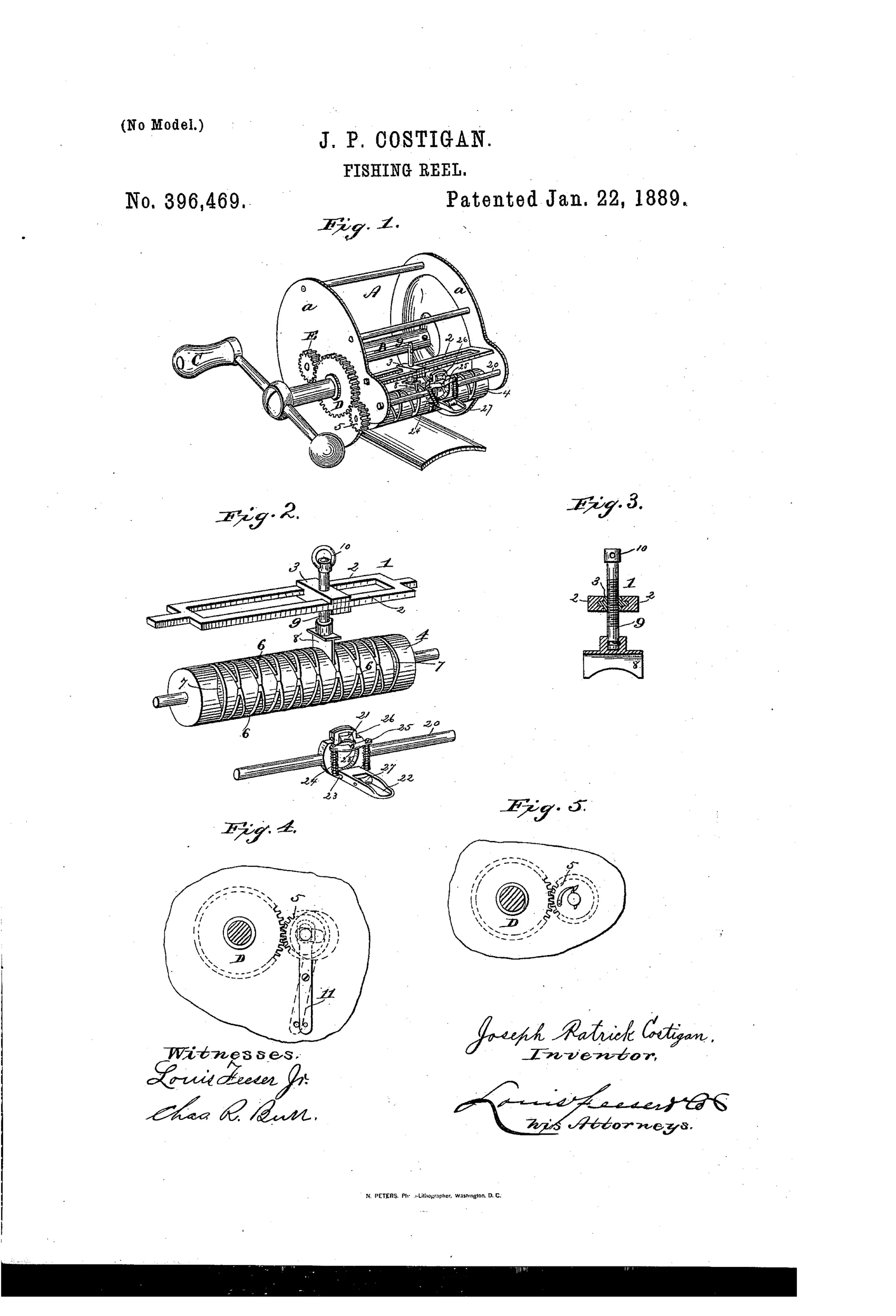
Fishing reel with automatic line-laying and tension mechanism
↻ How it works
The reel's winding drum is geared to a separate cylinder cut with reversed (right and left hand) crossing threads, causing a pinned blade riding in the slide to travel back and forth and guide the line evenly across the spool as it winds. A pivoted V-shaped yoke carrying a spring-mounted cross-bar and angularly-disposed eyes straightens kinks and twists in the line and can be swung up to act as a friction brake, applying drag tension while reeling in. A pawl-and-ratchet connection between the pinion and the grooved cylinder allows the spool to be rotated backward for casting without moving the level-wind cylinder. Rollers are set in the guide eyes to reduce friction on the line.
↻ What was claimed
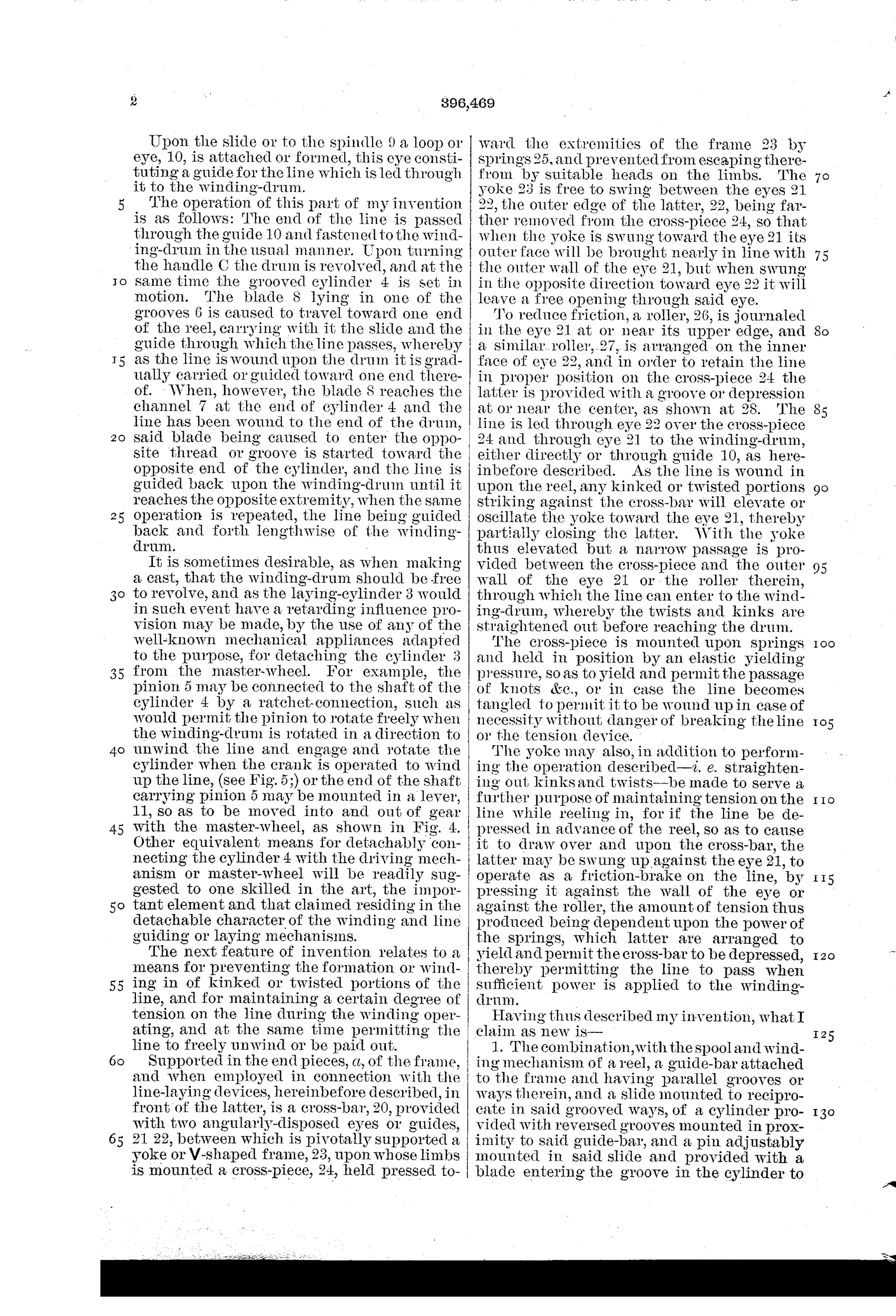
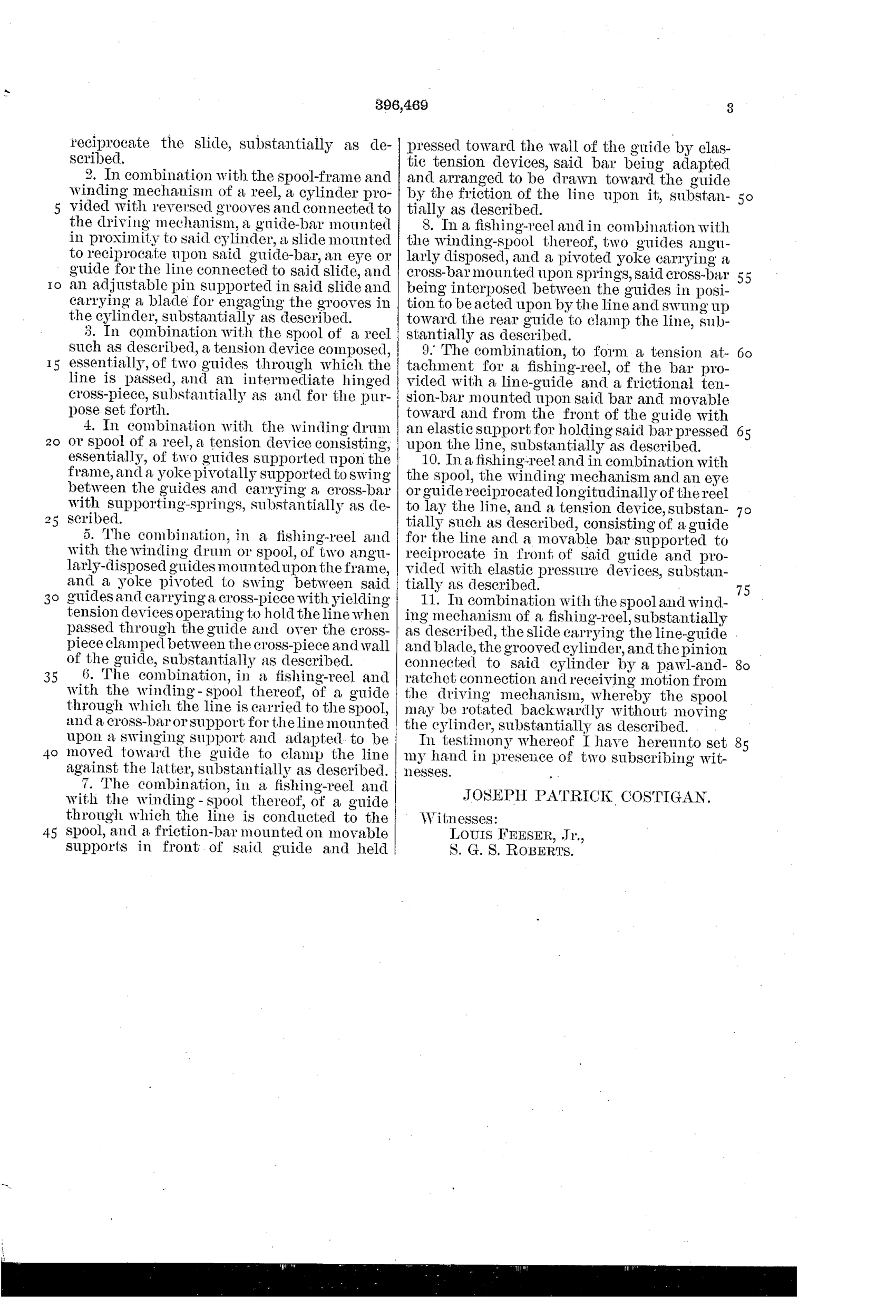
“1. The combination, with the spool and winding mechanism of a reel, a guide-bar attached to the frame and having parallel grooves or ways therein, and a slide mounted to reciprocate in said grooved ways, of a cylinder provided with reversed grooves mounted in proximity to said guide-bar, and a pin adjustably mounted in said slide and provided with a blade entering the groove in the cylinder to reciprocate the slide, substantially as described.”
In plain English: A guide-bar with a sliding block is combined with a reversed-groove cylinder so that a spring-loaded pin and blade in the slide follows the crossing grooves, moving the line guide back and forth automatically as the reel winds.
↻ In the inventor’s words
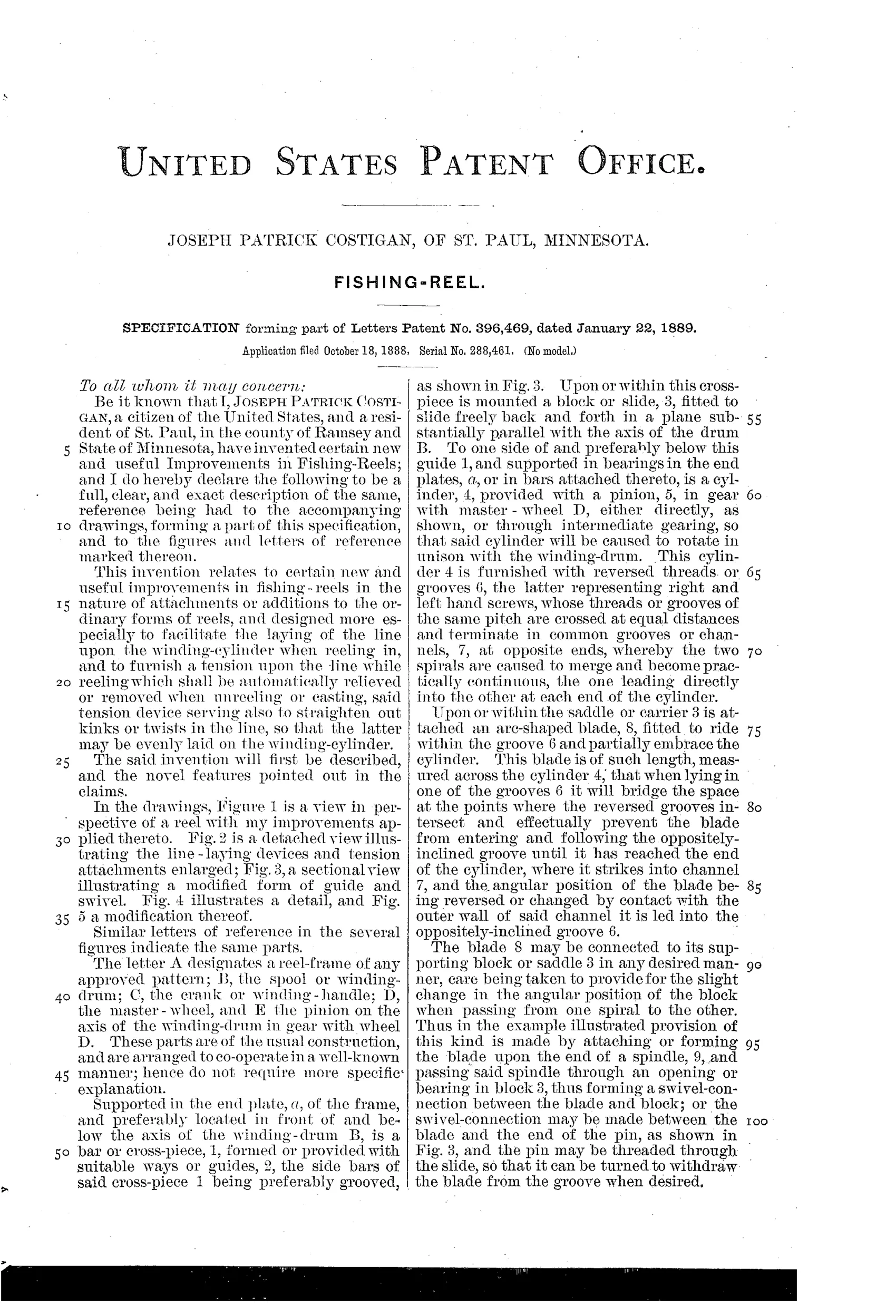
“The blade 8 may be connected to its supporting block or saddle 3 in any desired manner, care being taken to provide for the slight change in the angular position of the block when passing from one spiral to the other.”— Joseph Patrick Costigan, from the specification
Fate unknown
No Costigan-marked reel is documented among collectors; a surviving specimen or trade listing would settle whether this early level-wind ever left the drawing board.
↻ Commentary
The reversed-thread cylinder — a shaft cut with crossing right- and left-hand spirals so a follower blade shuttles endlessly back and forth — is the mechanism every level-wind reel of the twentieth century would eventually use. Costigan drew it out in St. Paul in 1888, well before Shakespeare and the Marhoff patent turned it into standard equipment. Look closely at Fig. 2: the grooved cylinder, the slotted guide-bar, and the pawl-and-ratchet that disconnects the cylinder when the spool spins backward for a cast. That last detail shows he understood the real problem — a level-wind that stays engaged during the cast adds drag and invites backlash. Decoupling it was the right instinct.
The patent's own candor is worth noting. That line about "care being taken to provide for the slight change in the angular position of the block when passing from one spiral to the other" is where these mechanisms live or die. The blade must pivot slightly at each end of the cylinder to cross from one thread to the other; get it wrong and the follower jams or jumps grooves. Later makers solved it with a captive pawl in an endless groove — Costigan is feeling his way toward it.
The pivoted V-yoke that doubles as kink-straightener and friction brake is more gadget than necessity, and the whole assembly is a lot of machinery for an 1889 reel shop. But the core idea sits squarely on the main line of reel history, ahead of schedule.
Commentary by Claude, The Fishing Reel Patent Archive’s resident enthusiast