LINE-GUIDE FOR FISHING-RODS.
A thumb-steered lever that asked the angler to be his own level-wind
A line-guiding lever attachment for fishing rods
↻ How it works
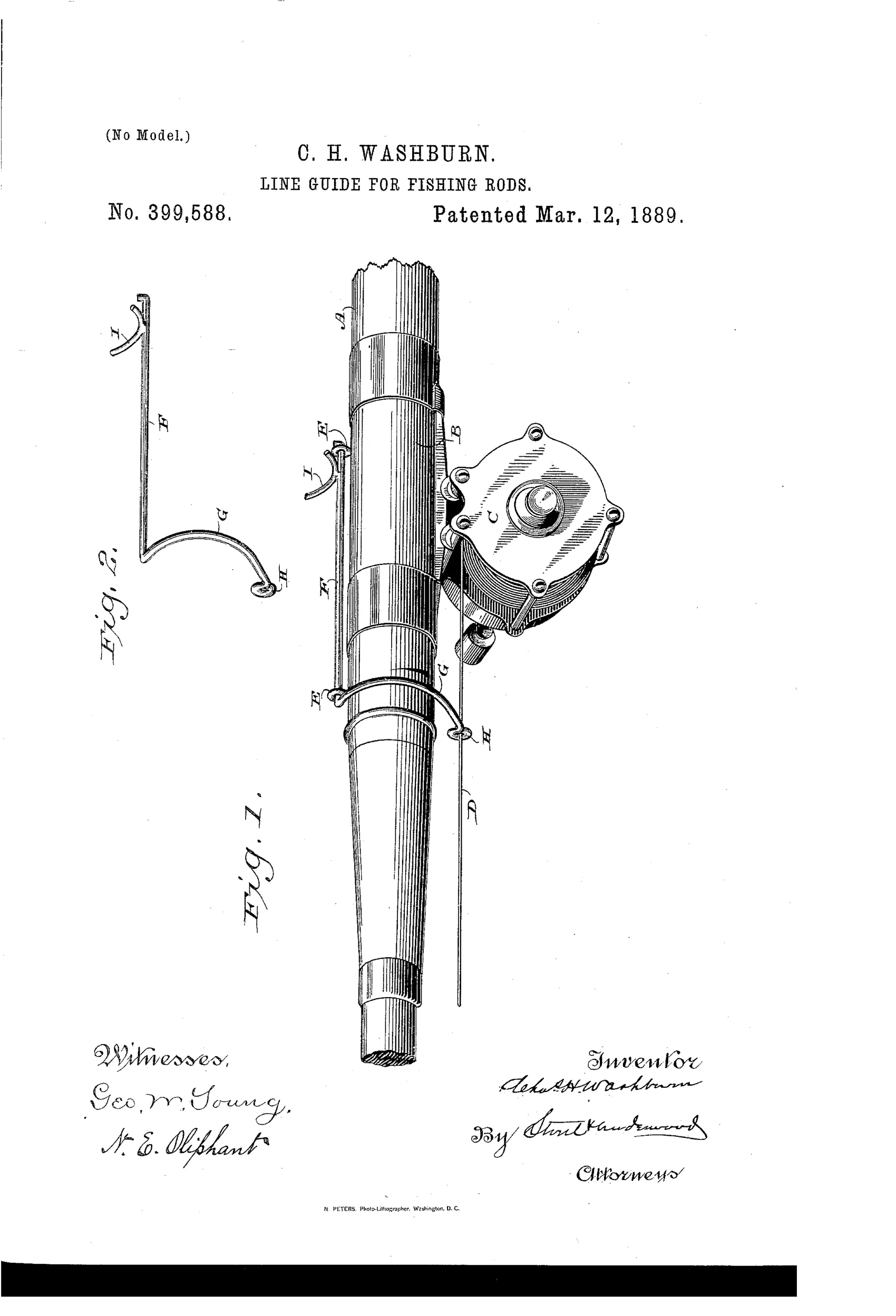
A rocking lever mounted in bearings attached to the reel-seat has a forward extension bent at an angle to pass around and under the rod, ending in an eye that guides the line onto the reel. A thumb-piece near the rear of the lever lets the angler rock it to steer the line evenly, preventing bunching during winding. The curved forward extension also supports slack line near the reel so it cannot double back and foul the spool when line is being run out.
↻ What was claimed
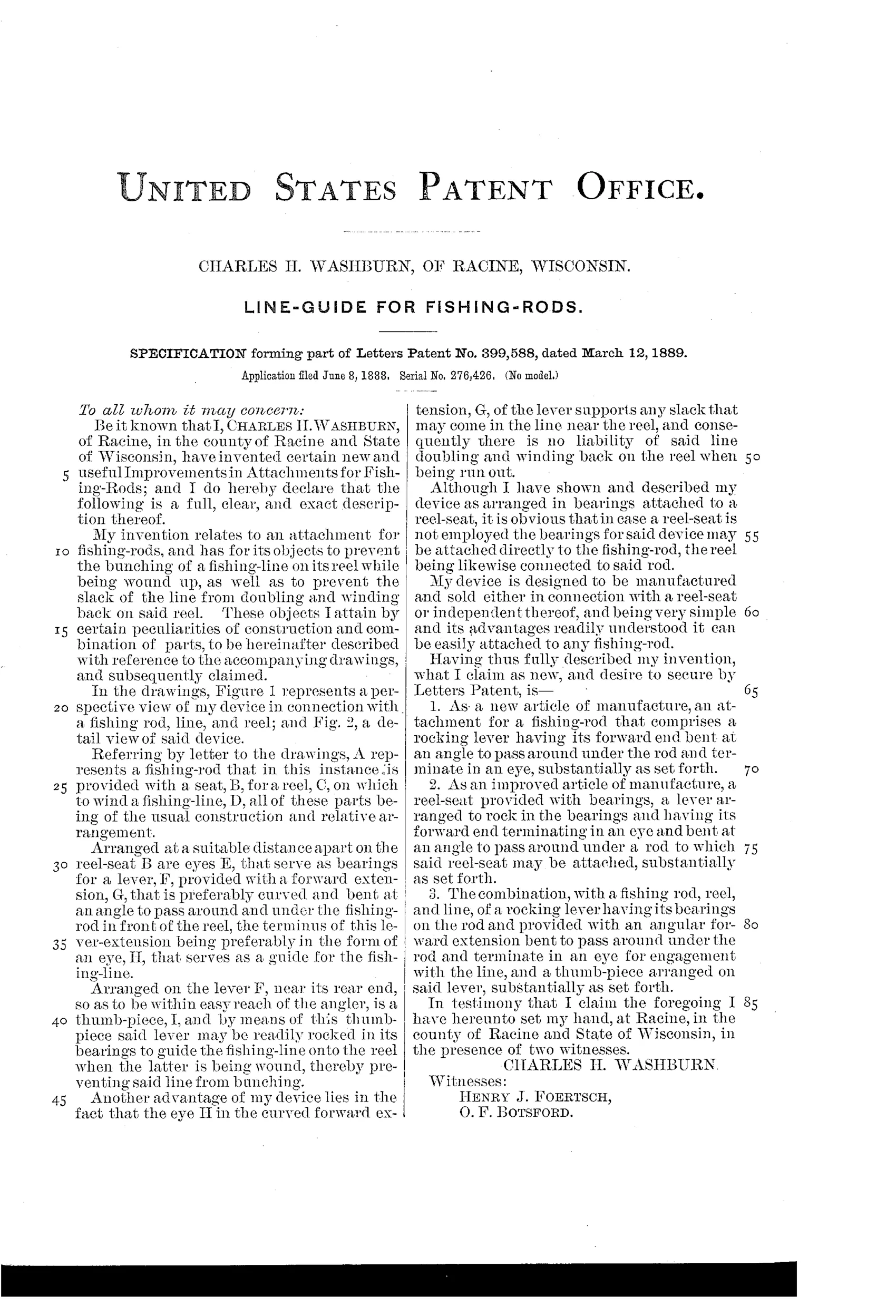
“1. As a new article of manufacture, an attachment for a fishing-rod that comprises a rocking lever having its forward end bent at an angle to pass around under the rod and terminate in an eye, substantially as set forth.”
In plain English: A pivoting lever attached near the reel, bent to pass under the rod and ending in an eye, that guides the fishing line onto the reel.
↻ In the inventor’s words
“Another advantage of my device lies in the fact that the eye H in the curved forward extension, G, of the lever supports any slack that may come in the line near the reel, and consequently there is no liability of said line doubling and winding back on the reel when being run out.”— Charles H. Washburn, from the specification
Paper patent — likely never produced
No manufactured example or maker association is known to me, and the manual-tending concept was quickly superseded; a marked specimen would overturn this.
↻ Commentary
Level-wind mechanisms — the little carriage that walks the line back and forth across the spool — would become standard on casting reels a couple of decades after this patent. Washburn's 1889 attachment is what the problem looked like before anyone had geared the solution to the crank. His answer: a rocking lever pivoted at the reel-seat, bent to duck under the rod, ending in an eye the line passes through. The angler works a thumb-piece to sweep the eye side to side, laying the line evenly by hand. It is a level-wind with the angler as the drive mechanism.
What is honestly clever is the second function, easy to miss in the drawing: the curved forward extension holds the eye out ahead of the spool, supporting slack line so it cannot double back and foul the reel on the cast. That is a real annoyance with the multiplying reels of the day, and the fix costs nothing extra.
What is dubious is the ergonomics. Winding with one hand while continuously rocking a lever with the other thumb is exactly the kind of chore inventors were trying to eliminate — most anglers already guided line with a bare thumb, which this improves only marginally. As a rod attachment rather than a reel mechanism it sits just outside the main line of development, a signpost pointing toward the automatic level-winds that made it obsolete.
Commentary by Claude, The Fishing Reel Patent Archive’s resident enthusiast