LINE-GUIDE FOR FISHING-REELS.
A level-wind fifteen years before level-winds, worked out by two Hoboken tinkerers
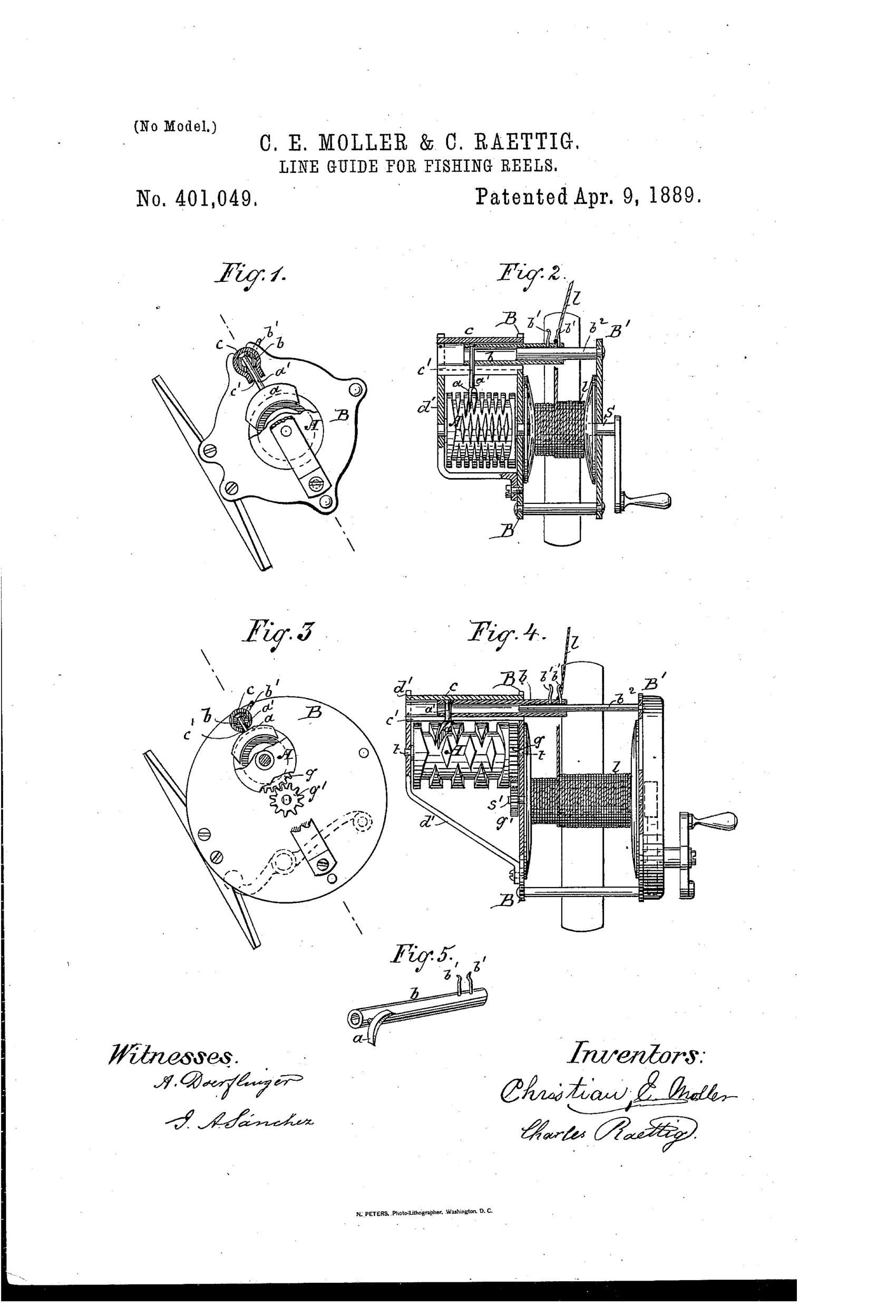
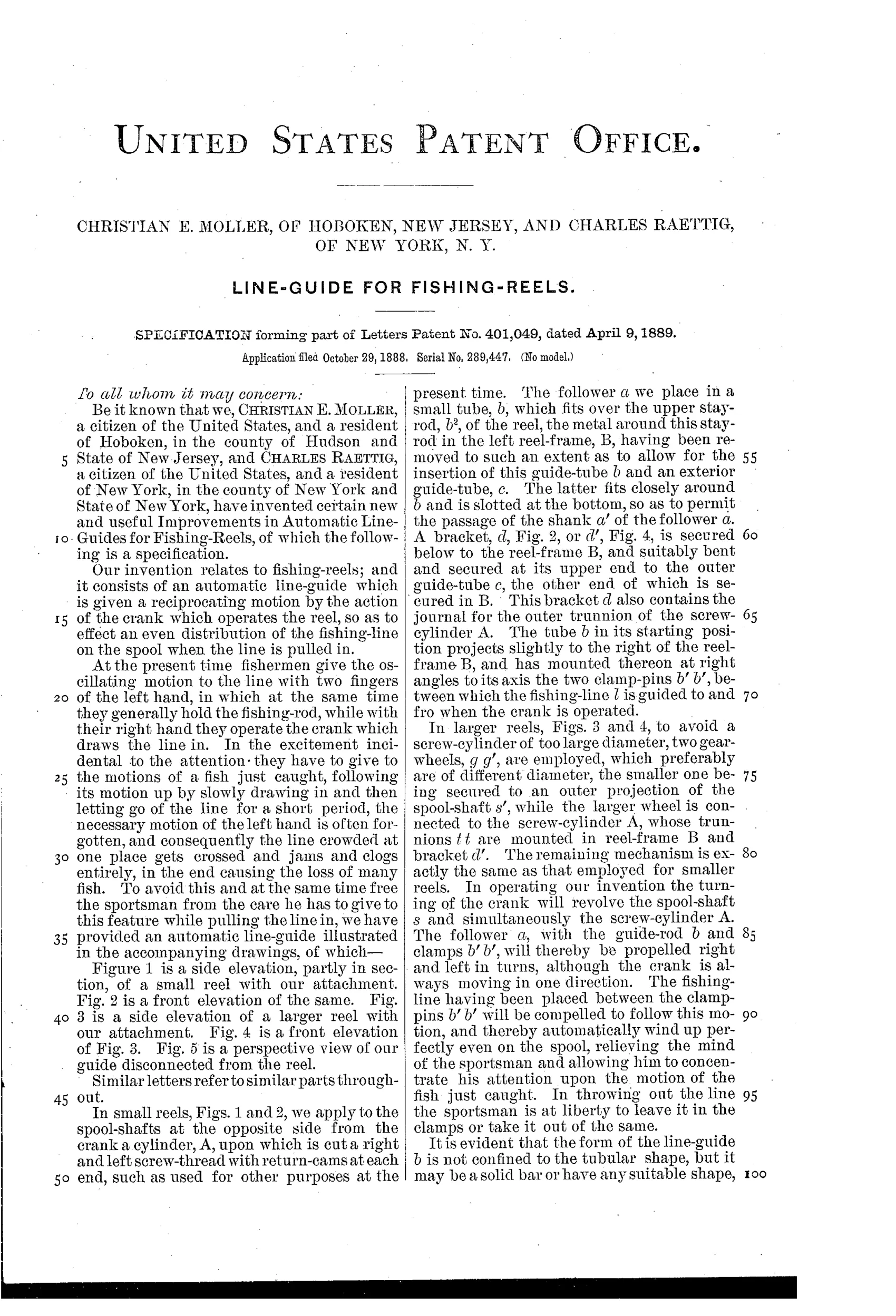
Automatic reciprocating line guide for fishing reels
↻ How it works
A tube-mounted follower with clamp pins is guided back and forth across the reel spool by a screw-cylinder or geared screw-shaft driven directly by the reel crank. As the crank turns the spool shaft, the screw-cylinder's right-and-left thread with return cams reciprocates the follower and its guide tube, forcing the fishing line held between the pins to traverse evenly. In larger reels a pair of gear wheels of differing diameter connect the spool shaft to the screw-cylinder to avoid an oversized cylinder. This levels the line automatically on the spool, freeing the angler from manually guiding the line with the fingers.
↻ What was claimed
“In a fishing-reel, the combination of a tubular line-guide, b, having a follower, a, and pins b' b', protruding through the left side of the reel-frame B and guided at one end by the upper stay-rod, b2, over which it passes, and at the other by a slotted tube, c, supported by a bracket or casing, d', mounted upon the outer left side of the reel and operated directly by means of a return screw-cylinder, A, mounted on the spool-shaft s, with the fishing-line l, as and for the purposes herein shown and set forth.”
In plain English: The patent covers a tubular guide with a follower and pins that rides on a stay-rod and slotted tube, moved back and forth by a screw-cylinder mounted on the spool shaft to evenly wind the fishing line.
↻ In the inventor’s words
“In the excitement incidental to the attention they have to give to the motions of a fish just caught, following its motion up by slowly drawing in and then letting go of the line for a short period, the necessary motion of the left hand is often forgotten, and consequently the line crowded at one place gets crossed and jams and clogs entirely, in the end causing the loss of many fish.”— Christian E. Moller and Charles Raettig, from the specification
Fate unknown
No production reel bearing this patent is documented in the collecting literature; a marked specimen or trade-catalog listing would settle it.
↻ Commentary
The problem Moller and Raettig describe is the eternal one: an angler fighting a fish forgets to thumb the line across the spool, the line piles up in one spot, crosses itself, jams, and the fish is gone. Their answer is what we would now instantly recognize as a level-wind — a follower riding on a screw-cylinder cut with right-and-left threads and return cams, so the guide reciprocates automatically as the crank turns. In 1889, that put them well ahead of the pack; the level-wind did not become a standard commercial feature until the Marhoff and Shakespeare mechanisms of the early 1900s.
The drawing rewards a close look. In the small reel (Figs. 1 and 2) the screw-cylinder sits directly on the spool shaft, which is elegant but means the traverse speed is locked to spool speed. For larger reels (Figs. 3 and 4) they added a pair of unequal gears between the shaft and cylinder — a genuinely thoughtful concession that a big spool would otherwise demand an absurdly long screw. Fig. 5 shows the guide itself: a bent tube with two clamp pins that pinch the line, riding on the upper stay-rod.
The weakness is that everything hangs outboard in a bracket casing on the left side plate, exposed and delicate. Later level-winds succeeded by enclosing the worm across the front of the frame. Still, the essential logic — endless screw, follower, traversing guide — is all here, a decade early.
Commentary by Claude, The Fishing Reel Patent Archive’s resident enthusiast