FISHING-REEL.
A clockwork mainspring that promises to out-reel any fish in the lake
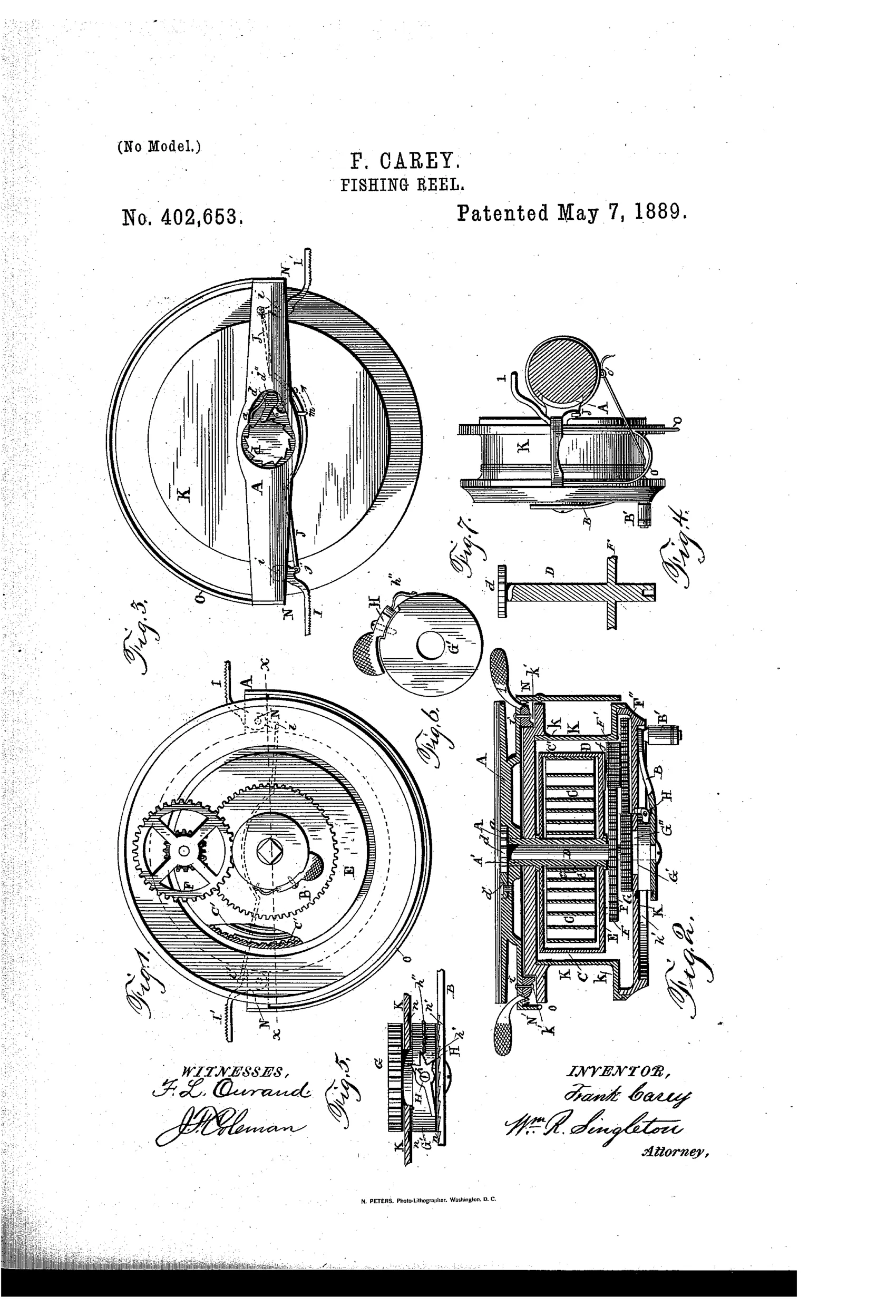
Spring-driven multiplying fishing reel with double brake
↻ How it works
A spiral spring coiled inside a corrugated barrel is wound by gearing driven from the crank through a train of spur gears and a pinion, storing power to help retrieve line. A ratchet-and-pawl on the central shaft prevents backward motion of the crank while allowing the spring to be wound fully or partially. A detachable clutch mechanism, using a bifurcated pawl engaging notches on the drum and crank, allows the gearing to be disengaged from the case so the spool can revolve freely. A double brake, consisting of two levers pivoted to the rod-plate and connected by a rod, can be applied above or below the handgrip to lock the case and control the reel in either orientation.
↻ What was claimed
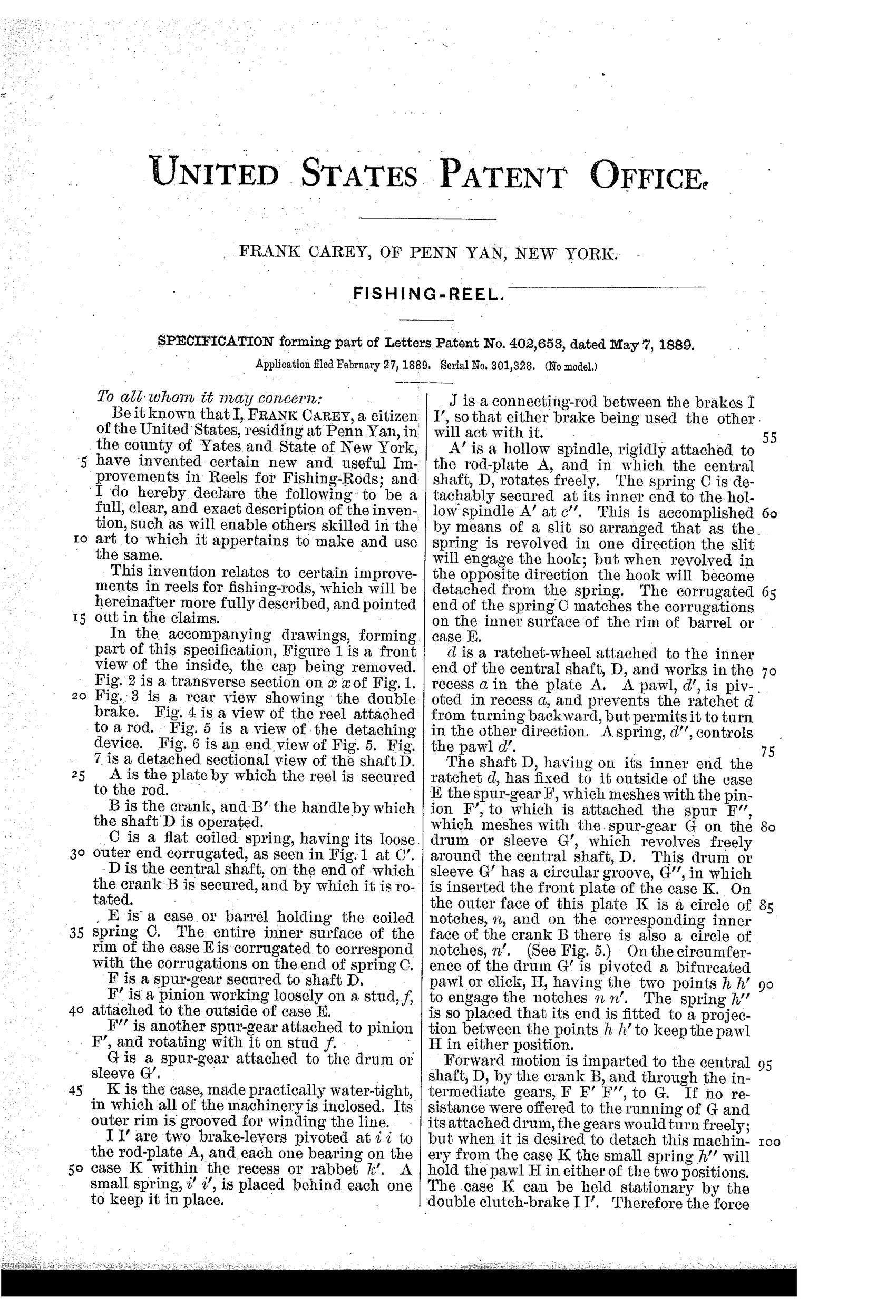
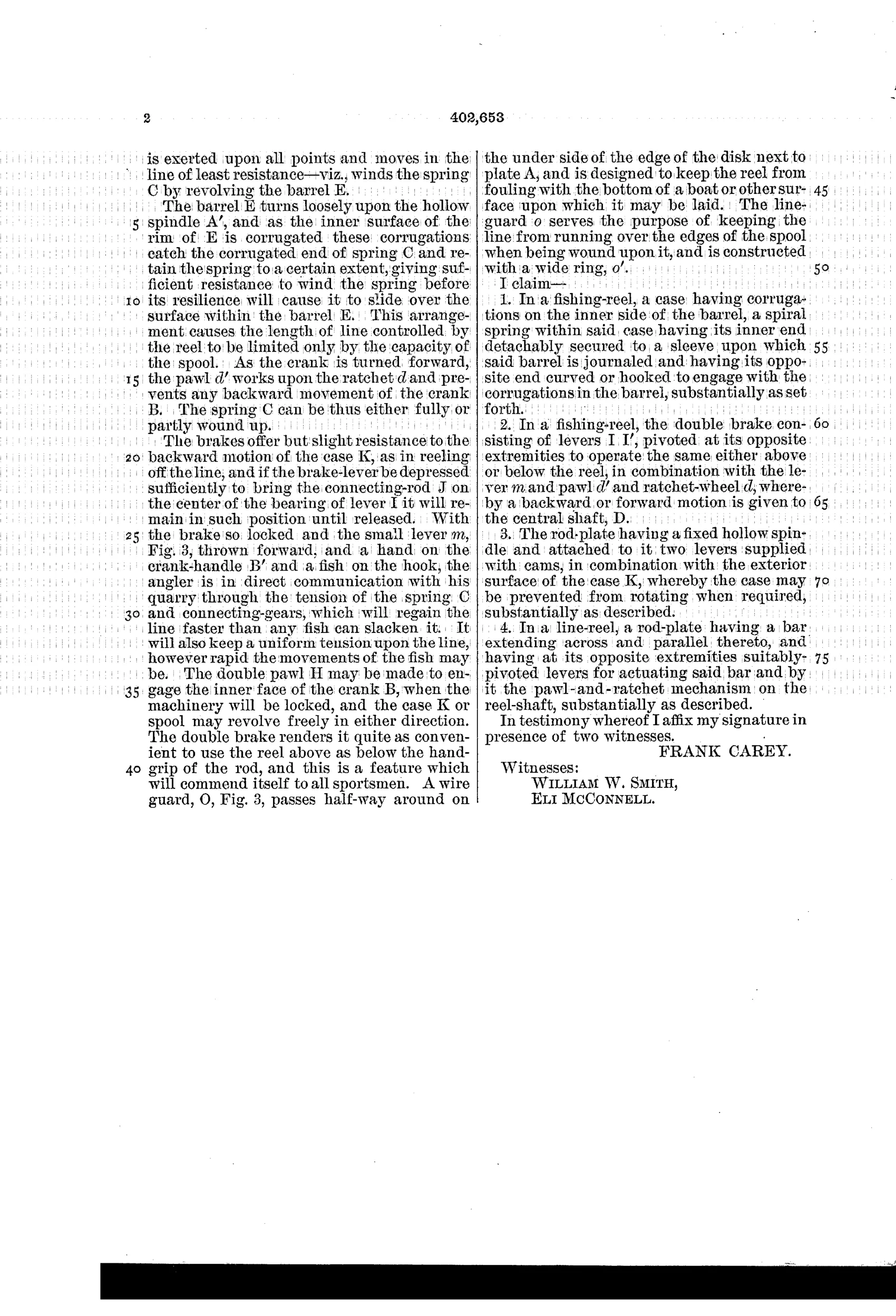
“1. In a fishing-reel, a case having corrugations on the inner side of the barrel, a spiral spring within said case having its inner end detachably secured to a sleeve upon which said barrel is journaled and having its opposite end curved or hooked to engage with the corrugations in the barrel, substantially as set forth.”
In plain English: The reel has a spring inside a ridged barrel, with one end of the spring hooked to a sleeve and the other end catching on the ridges so it can store and release winding tension.
↻ In the inventor’s words
“With the brake so locked and the small lever m, Fig. 3, thrown forward, and a hand on the crank-handle B' and a fish on the hook, the angler is in direct communication with his quarry through the tension of the spring C and connecting-gears, which will regain the line faster than any fish can slacken it.”— Frank Carey, from the specification
Fate unknown
Spring-driven reels of this era were manufactured by others, but no Carey-marked example is documented; a surviving specimen would settle it.
↻ Commentary
Frank Carey of Penn Yan tackled a real problem — a running fish can slacken line faster than an angler can crank — with a watchmaker's answer: put a mainspring in the reel. The spiral spring lives inside a corrugated barrel, its outer hook catching on the internal ridges (a slip-clutch of sorts, since an over-wound spring can jump a ridge rather than break), and the crank charges it through a spur-gear train with a ratchet holding the tension. Throw the little lever, and stored power takes up line on its own. His own words are the best pitch in the file: the spring 'will regain the line faster than any fish can slacken it.'
He wasn't alone in this thought. The Yawman & Erbe automatic fly reel, patented in 1880, proved spring retrieval could be built and sold, so Carey is refining a live idea, not chasing a fantasy. His additions are the detachable clutch — a bifurcated pawl that frees the spool entirely for casting — and the double brake, two linked levers reachable above or below the grip so the reel works in either orientation on the rod. That's thoughtful ergonomics for 1889.
The catch is weight and complexity. A gear train, a spring barrel, a clutch, and a two-lever brake add up to a heavy reel with many failure points, which is why automatics stayed a niche while simpler click reels ruled.
Commentary by Claude, The Fishing Reel Patent Archive’s resident enthusiast