REEL OR SWIFT.
Not a fishing reel at all: a folding yarn swift that clamps to tables
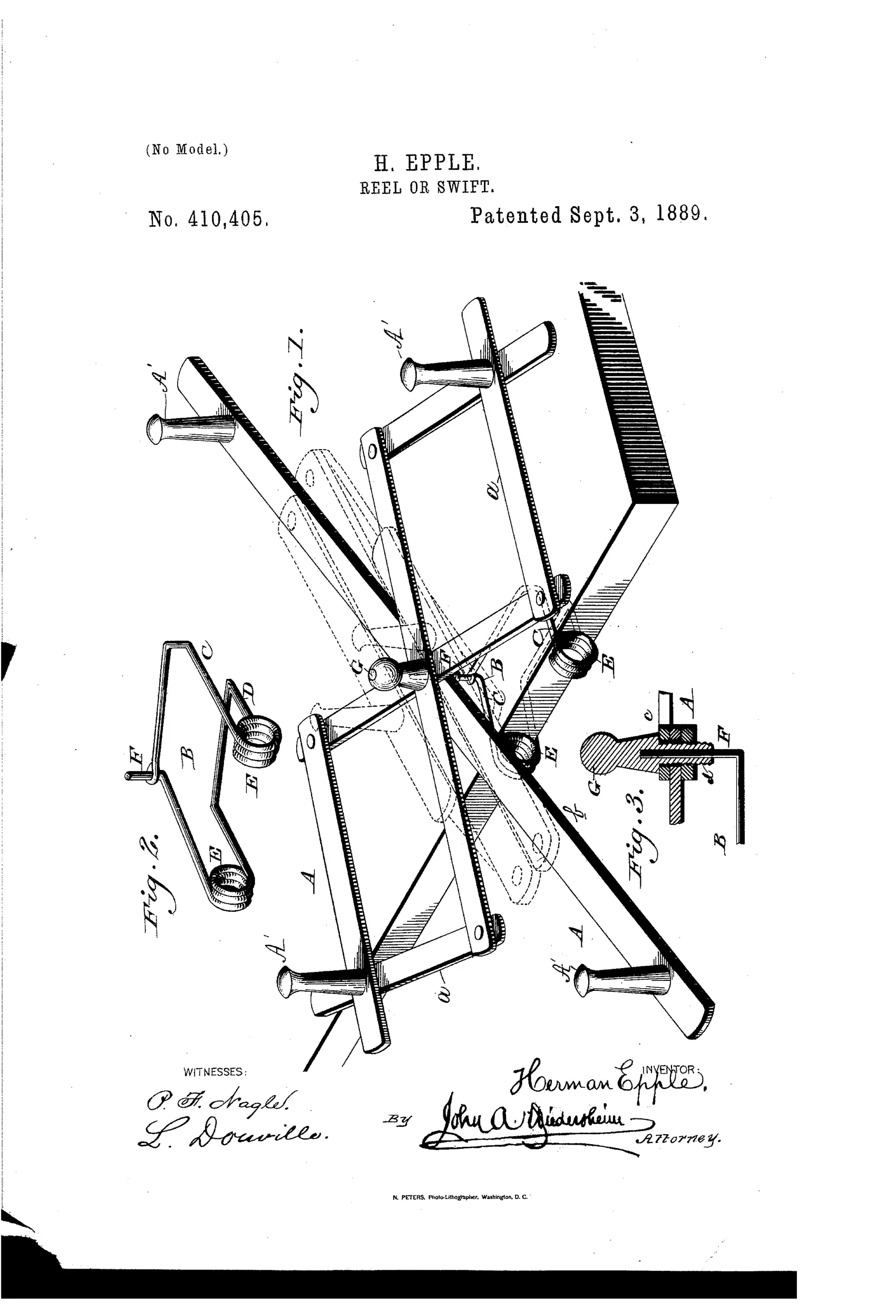
Collapsible lazy-tongs yarn reel with clamp
↻ How it works
The reel is formed of slats pivotally connected at their ends and centers in lazy-tongs fashion, allowing it to expand or contract to fit skeins of different lengths. A central screw-post with a shoulder and threaded portion draws the crossing slats together to lock the reel's size once adjusted. A separate wire clamp, bent into jaws and a spring coil, attaches the reel to a table edge via a standard that enters an opening in the screw-pin, forming a bearing so the reel can rotate freely for winding or measuring yarn.
↻ What was claimed
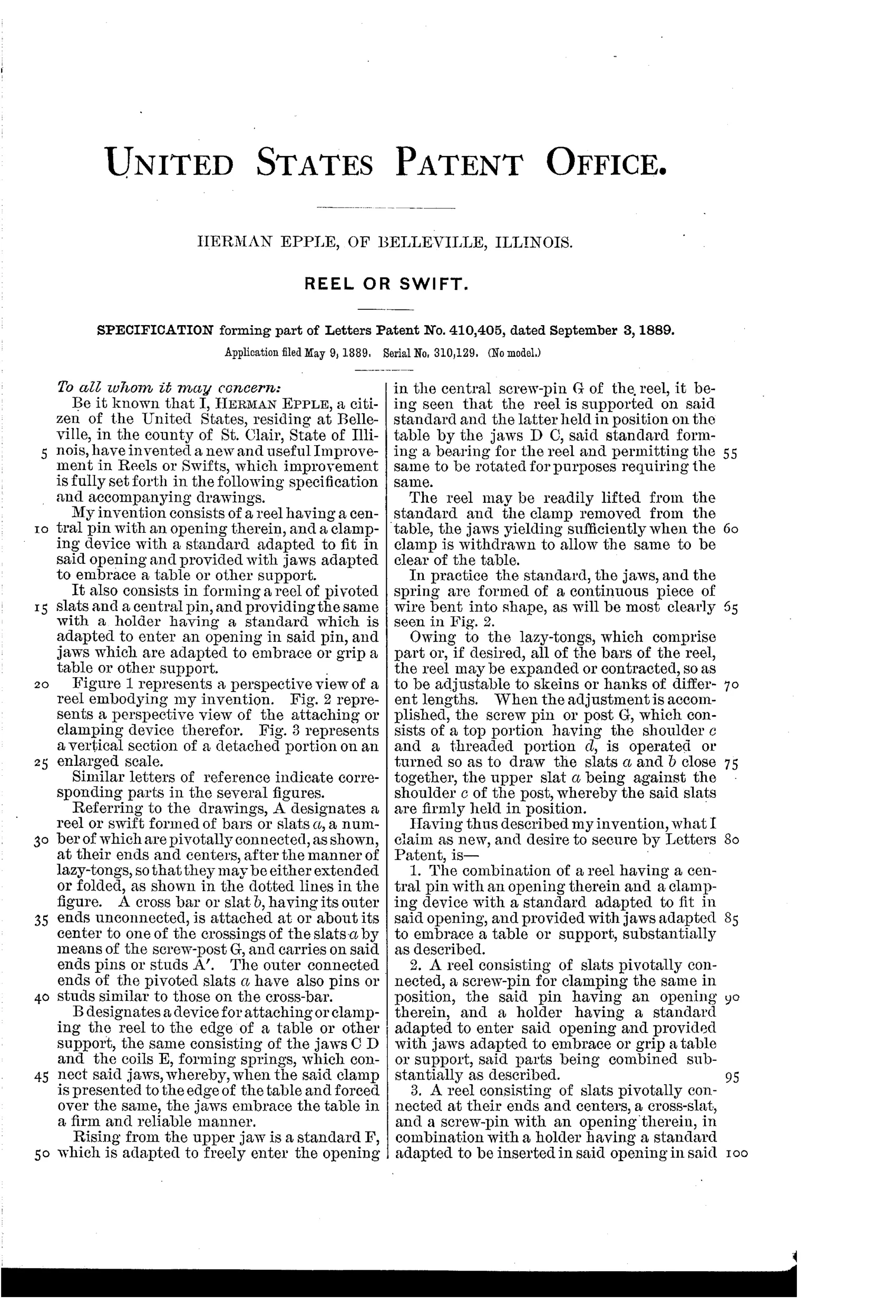
“The combination of a reel having a central pin with an opening therein and a clamping device with a standard adapted to fit in said opening, and provided with jaws adapted to embrace a table or support, substantially as described.”
In plain English: The invention combines a yarn reel whose central pin has a hole in it with a separate clamp whose post fits into that hole and whose jaws grip a table edge.
↻ In the inventor’s words
“Owing to the lazy-tongs, which comprise part or, if desired, all of the bars of the reel, the reel may be expanded or contracted, so as to be adjustable to skeins or hanks of different lengths.”— Herman Epple, from the specification
Fate unknown
Simple enough that small-shop production is plausible, but no marked example or maker is documented; a surviving swift traceable to Epple would settle it.
↻ Commentary
Let's be honest up front: this is one of those patents that lands in a fishing-reel collection because the Patent Office filed it under "reel," and here "reel or swift" means a yarn winder. Herman Epple of Belleville, Illinois was solving a domestic problem — holding a skein of yarn taut and letting it spin freely while someone winds it into a ball — not a casting problem. No gearing, no click, no drag; the whole apparatus is textile equipment.
That said, the mechanics are tidy. The lazy-tongs construction — slats pivoted at ends and centers, like a folding gate — lets the reel expand or collapse to match skeins of different lengths, and a central screw-post with a shoulder cinches the crossing slats to lock the chosen size. The cleverest detail is in Fig. 3: the screw-pin has an opening bored in it, and the separate wire table clamp (Fig. 2, with its sprung coil jaws) carries a standard that slips into that hole and doubles as the bearing. The clamp is thus both the mount and the axle, and the whole thing knocks down flat for storage.
For readers of this site, its value is as a boundary marker: it shows what the word "reel" covered in 1889, and why patent-number hunting by title alone will occasionally hand you a knitting accessory instead of a Kentucky multiplier.
Commentary by Claude, The Fishing Reel Patent Archive’s resident enthusiast