FISHING-REEL.
A hollow center post doubles as an oil reservoir on this Ithaca click reel
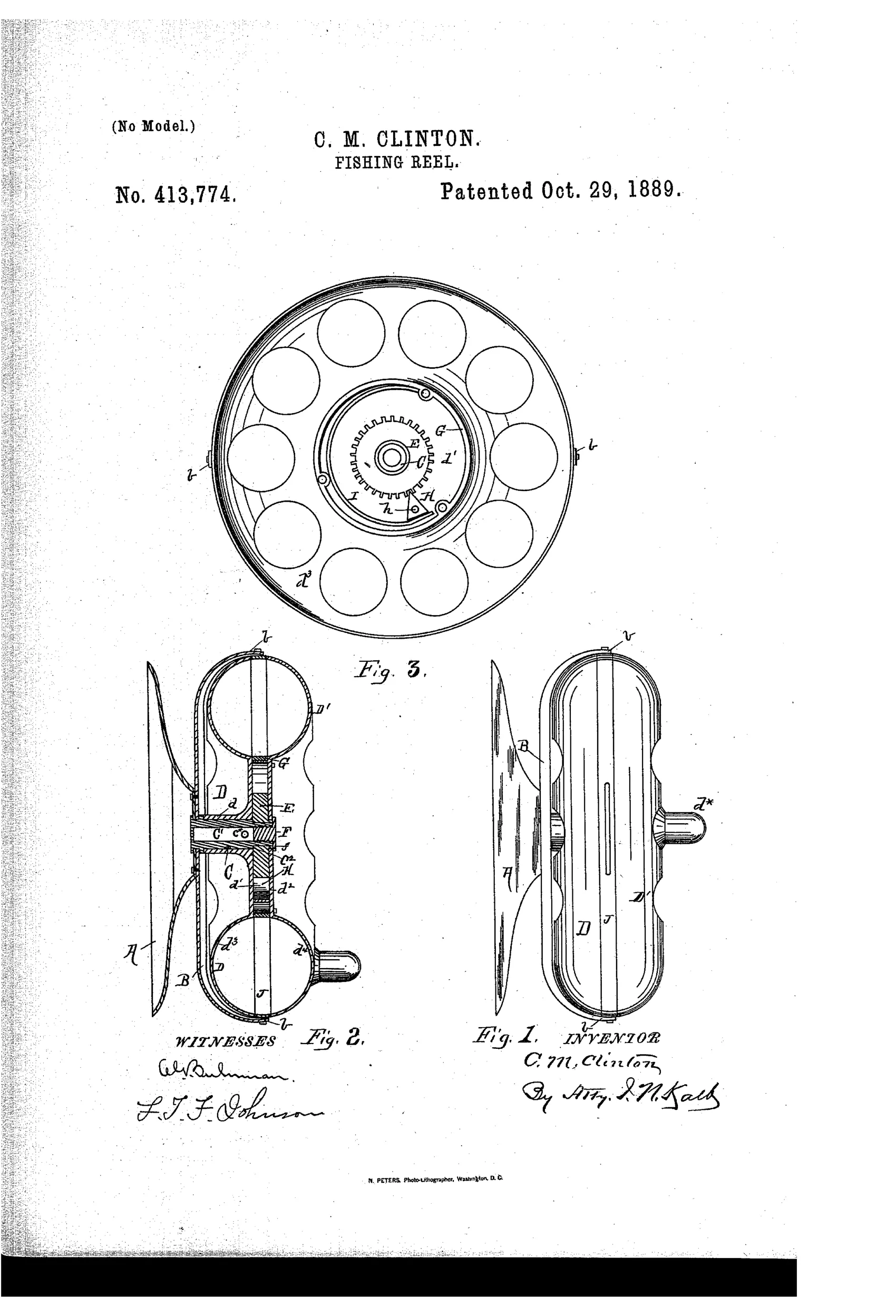
Self-oiling click reel for fishing rods
↻ How it works
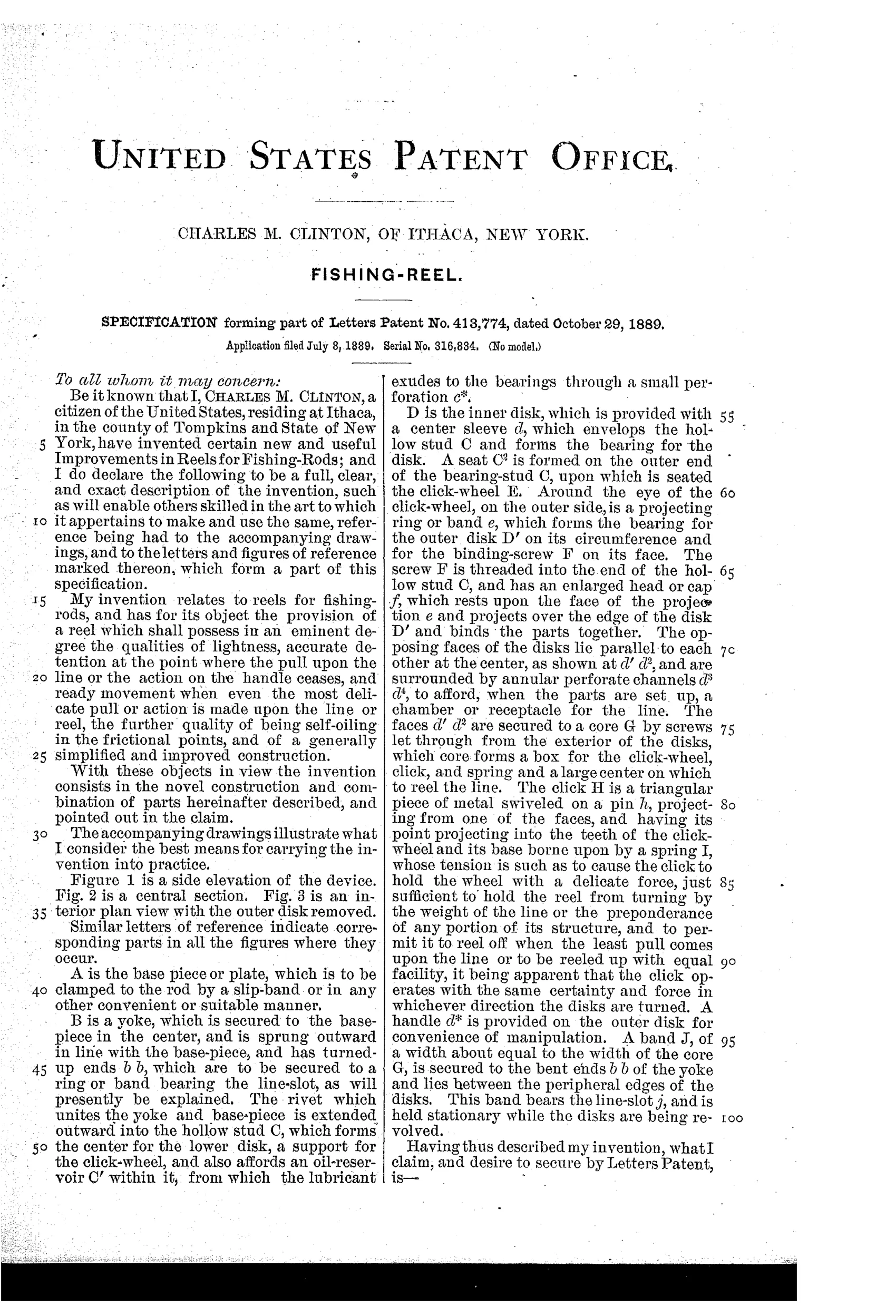
The reel has a hollow center stud that doubles as an oil reservoir, feeding lubricant through a small perforation to the bearings. Two disks with parallel opposing faces are secured to a central core by screws, forming a box that houses a click-wheel, spring-loaded click, and a large center spool for the line. A triangular click piece pivots on a pin and is pressed by a spring against the toothed click-wheel, providing just enough resistance to prevent the reel from overrunning while still allowing the line to be pulled or reeled smoothly in either direction. A stationary peripheral band between the disks carries the line slot and remains fixed while the disks revolve around it.
↻ What was claimed
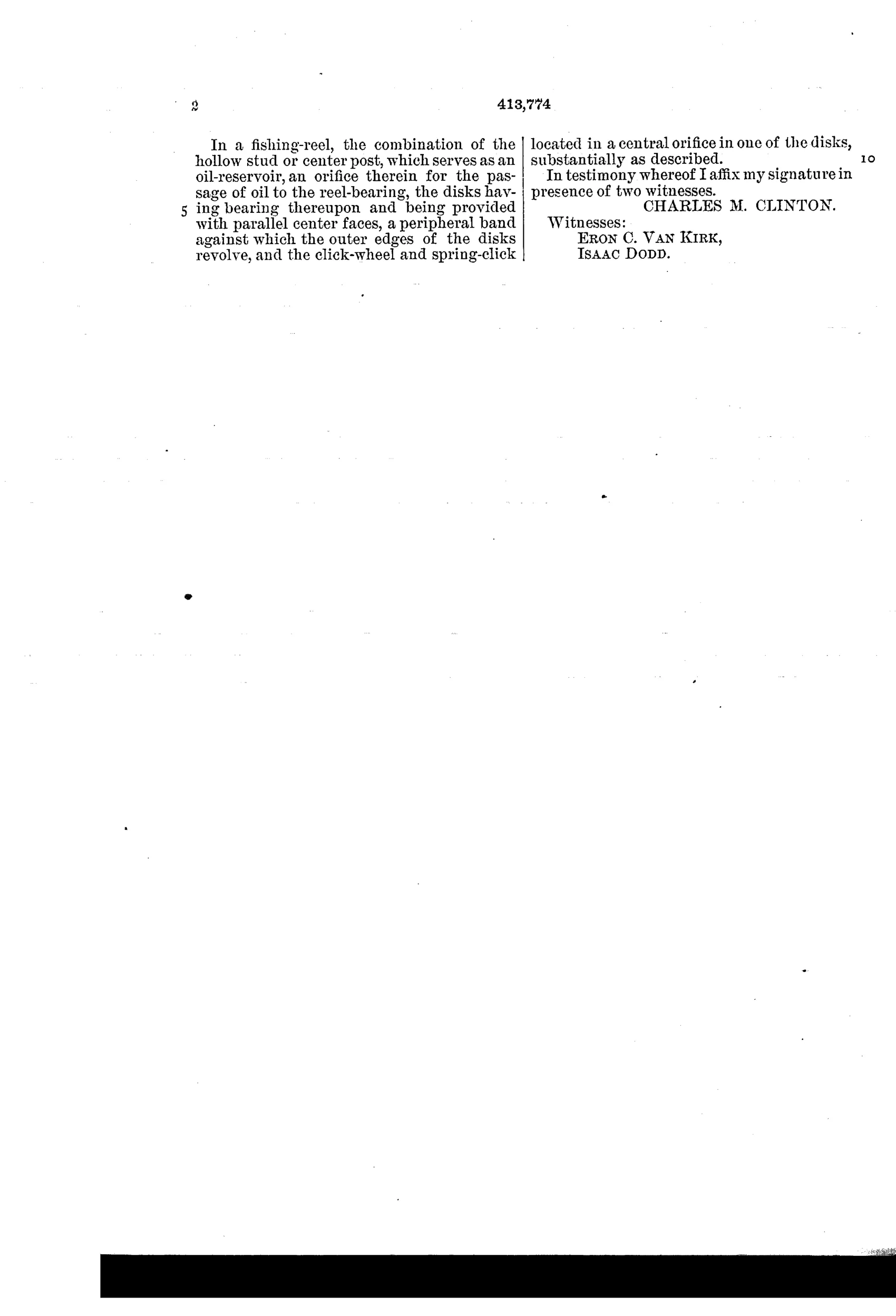
“In a fishing-reel, the combination of the hollow stud or center post, which serves as an oil-reservoir, an orifice therein for the passage of oil to the reel-bearing, the disks having bearing thereupon and being provided with parallel center faces, a peripheral band against which the outer edges of the disks revolve, and the click-wheel and spring-click located in a central orifice in one of the disks, substantially as described.”
In plain English: The reel combines a hollow oil-filled center post that lubricates the bearings, disks with matching parallel faces riding on a fixed outer band, and a spring-loaded click mechanism housed in the center of one disk.
↻ In the inventor’s words
“My invention relates to reels for fishing-rods, and has for its object the provision of a reel which shall possess in an eminent degree the qualities of lightness, accurate detention at the point where the pull upon the line or the action on the handle ceases, and ready movement when even the most delicate pull or action is made upon the line or reel, the further quality of being self-oiling in the frictional points, and of a generally simplified and improved construction.”— Charles M. Clinton, from the specification
Manufactured and sold
Marked C.M. Clinton reels bearing the October 29, 1889 patent date survive and are documented among fly reel collectors.
↻ Commentary
Clinton's patent attacks the least glamorous problem in reel design: lubrication. The center stud is drilled hollow and filled with oil, with a small orifice that weeps lubricant onto the bearing surfaces as the reel runs. It's a watchmaker's instinct applied to fishing tackle — instead of asking the angler to remember an oil can, the reel carries its own supply where the friction actually lives.
The rest of the architecture is just as unconventional. Look at Fig. 3: those big circular perforations aren't decoration but weight reduction, following Orvis's 1874 lead, and the whole reel is essentially two large disks spinning around a fixed peripheral band that carries the line slot. That inverts the usual arrangement, where a spool turns inside a stationary frame. The click work — a triangular pawl sprung against a toothed wheel, all housed in a central recess of one disk — is calibrated for what Clinton calls 'accurate detention': enough drag to stop overrun the instant pull ceases, little enough that a delicate take moves the line freely. That's exactly the balance a trout fisherman wants.
Clinton reels were in fact built, in modest numbers, and marked with this patent date. They stand as one of the more distinctive American fly reels of the era — not a mainstream success like vom Hofe's output, but a real, working expression of an inventor who thought a reel should maintain itself.
Commentary by Claude, The Fishing Reel Patent Archive’s resident enthusiast