FISHING-REEL.
A bayonet-twist end plate carries the whole gear train out of the frame
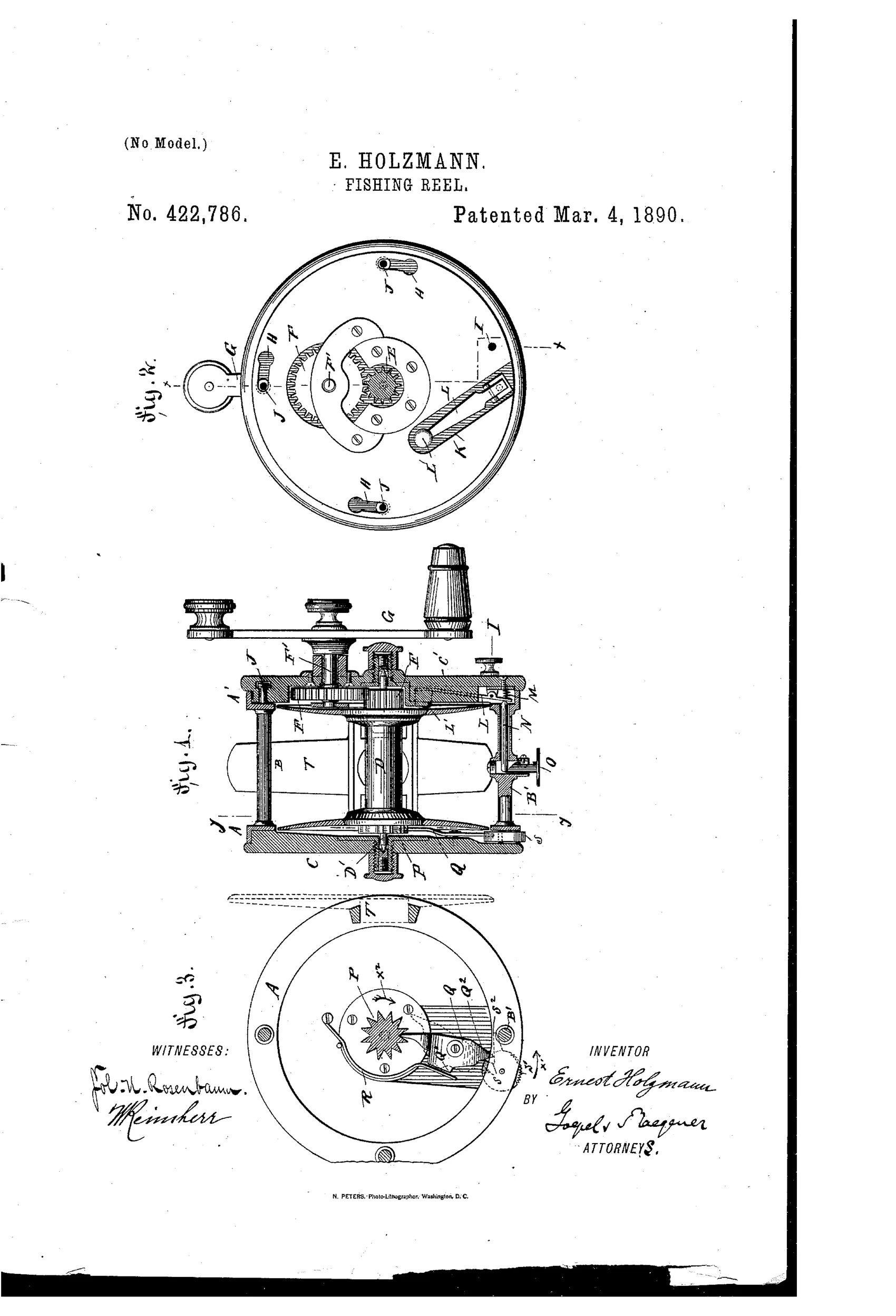
Fishing reel with detachable end plate and drag
↻ How it works
The reel casing consists of two flanged rings joined by cross-posts, one end plate fixed and the other attached by a bayonet-lock of headed studs in undercut grooves. A crank turns a pinion that meshes with a cog-wheel to rotate the spool, while a pivoted brake-lever pressed by a spring and actuated by an internal sliding rod and external push-pin bears against the spool's end plate to act as a drag. A separate ratchet-wheel and pawl, controlled by a rotatable serrated disk, can be engaged to click and prevent the line from unwinding too fast, and is automatically disengaged when the handle is turned to wind in line.
↻ What was claimed
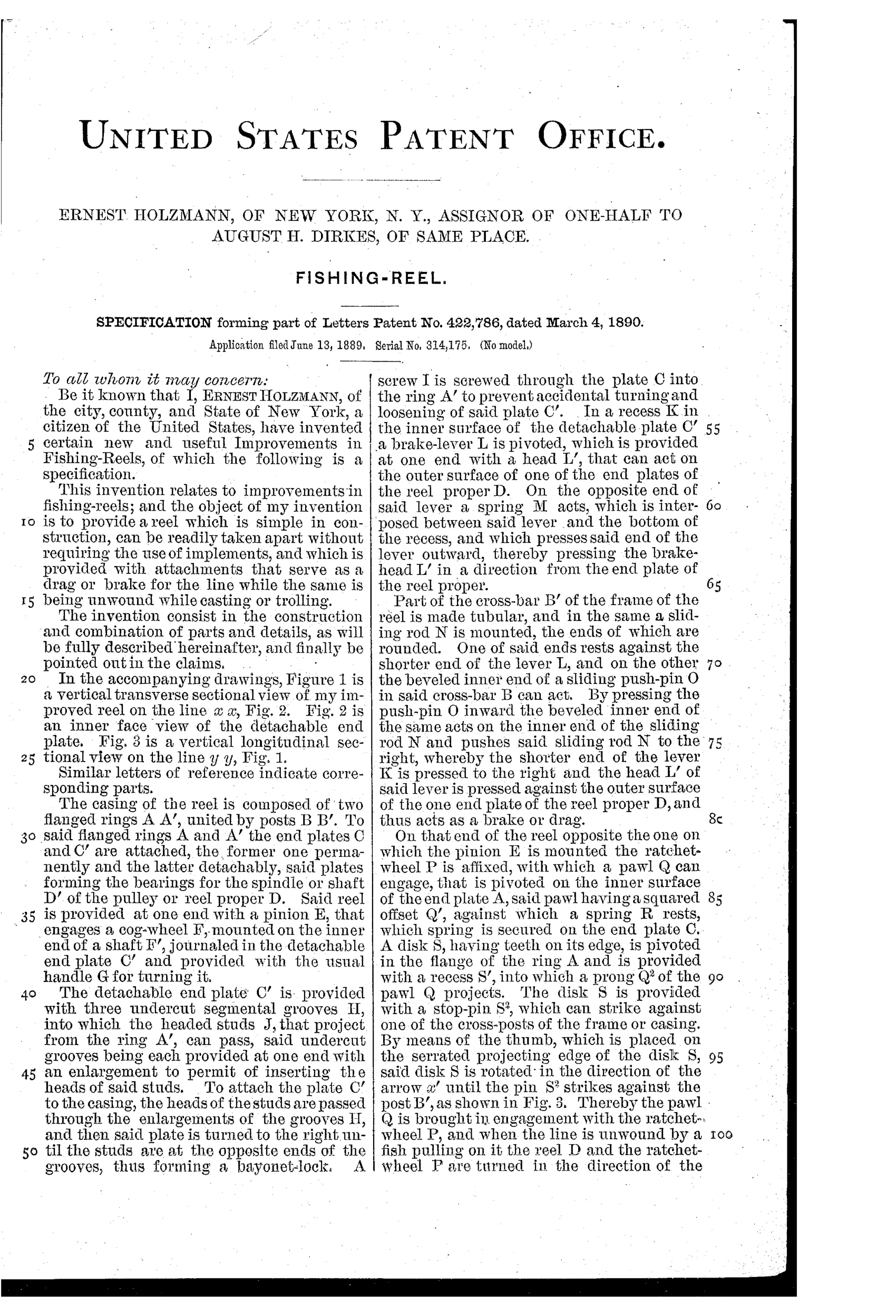
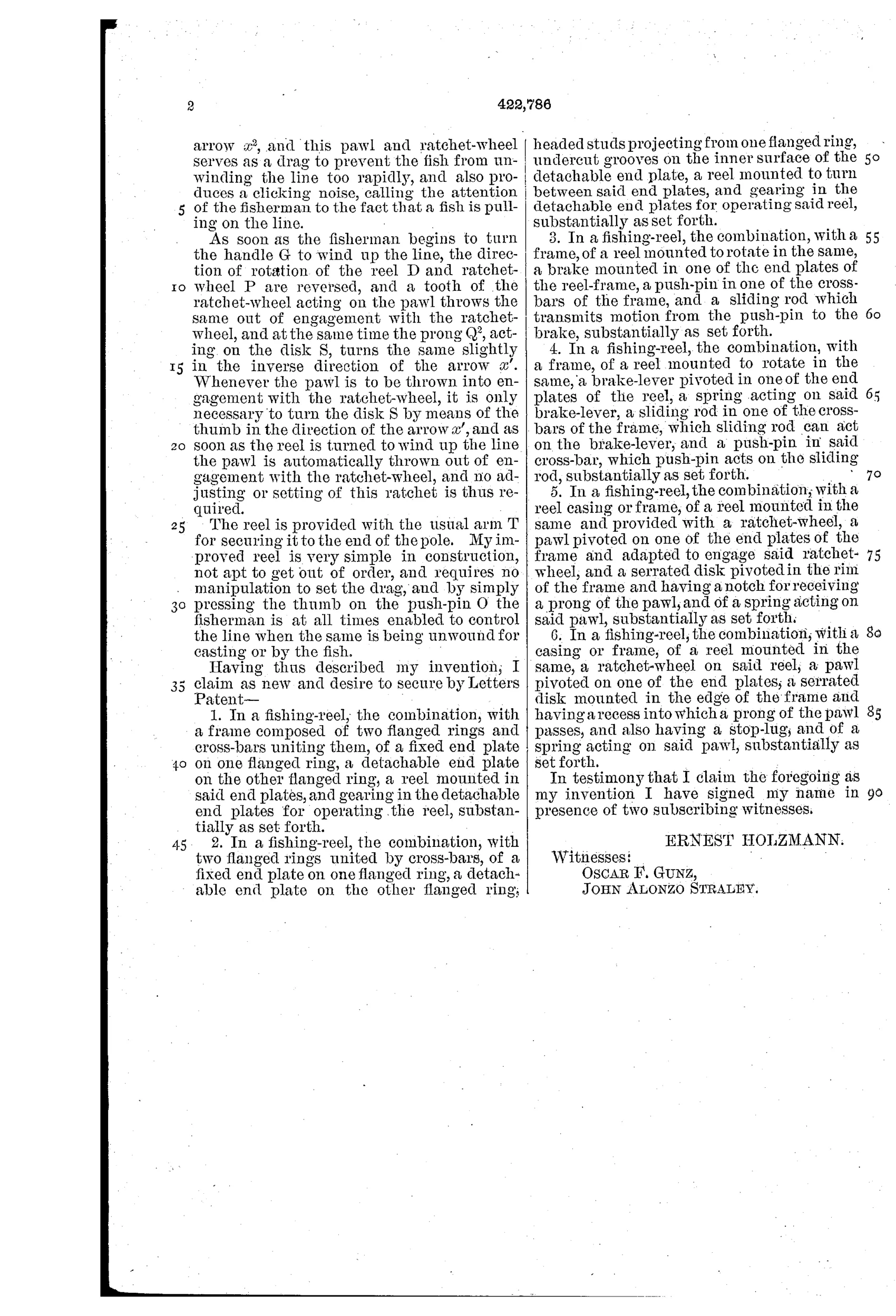
“In a fishing-reel, the combination, with a frame composed of two flanged rings and cross-bars uniting them, of a fixed end plate on one flanged ring, a detachable end plate on the other flanged ring, a reel mounted in said end plates, and gearing in the detachable end plates for operating the reel, substantially as set forth.”
In plain English: The reel has a frame of two rings joined by posts, one end plate fixed and one detachable, with the spool mounted between them and gears in the detachable plate to turn it.
↻ In the inventor’s words
“My improved reel is very simple in construction, not apt to get out of order, and requires no manipulation to set the drag, and by simply pressing the thumb on the push-pin O the fisherman is at all times enabled to control the line when the same is being unwound for casting or by the fish.”— Ernest Holzmann, from the specification
Fate unknown
Neither Holzmann nor assignee Dirkes appears among documented reel makers; a specimen with this bayonet-lock plate and patent date would settle it.
↻ Commentary
Holzmann's central idea is packaging: put the crank, pinion, cog-wheel, drag lever, and click mechanism all in one end plate, then lock that plate to the frame with headed studs riding in undercut grooves — a bayonet mount, decades before the term became camera jargon. Twist the plate off and the entire works comes away in your hand, spool exposed for cleaning or line changes. In an era when most reels had to be unscrewed post by post, or opened by pulling tiny screws streamside with cold fingers, that is genuinely thoughtful.
The drag is the other quiet feature. A push-pin on the outside of the plate drives a sliding rod that rocks a spring-loaded brake lever against the spool flange, so thumb pressure on the pin translates to friction on the spool. It is essentially a mechanized version of thumbing the spool directly — the universal casting technique of the day — but it keeps the thumb off the line and gives more consistent pressure. The click, meanwhile, disengages automatically when you crank in, which spares the angler the usual click-switch fumbling when a fish runs.
Nothing here is a dead end conceptually — takedown frames and lever drags both became standard ideas — but this particular combination, assigned to August Dirkes rather than any known manufacturer, sits outside the Meek–vom Hofe–Pflueger mainstream. It reads like a clever independent design that the trade passed by, whether for cost or inertia.
Commentary by Claude, The Fishing Reel Patent Archive’s resident enthusiast