FISHING-REEL
The whole reel motor hides inside the rod butt — nested springs and all
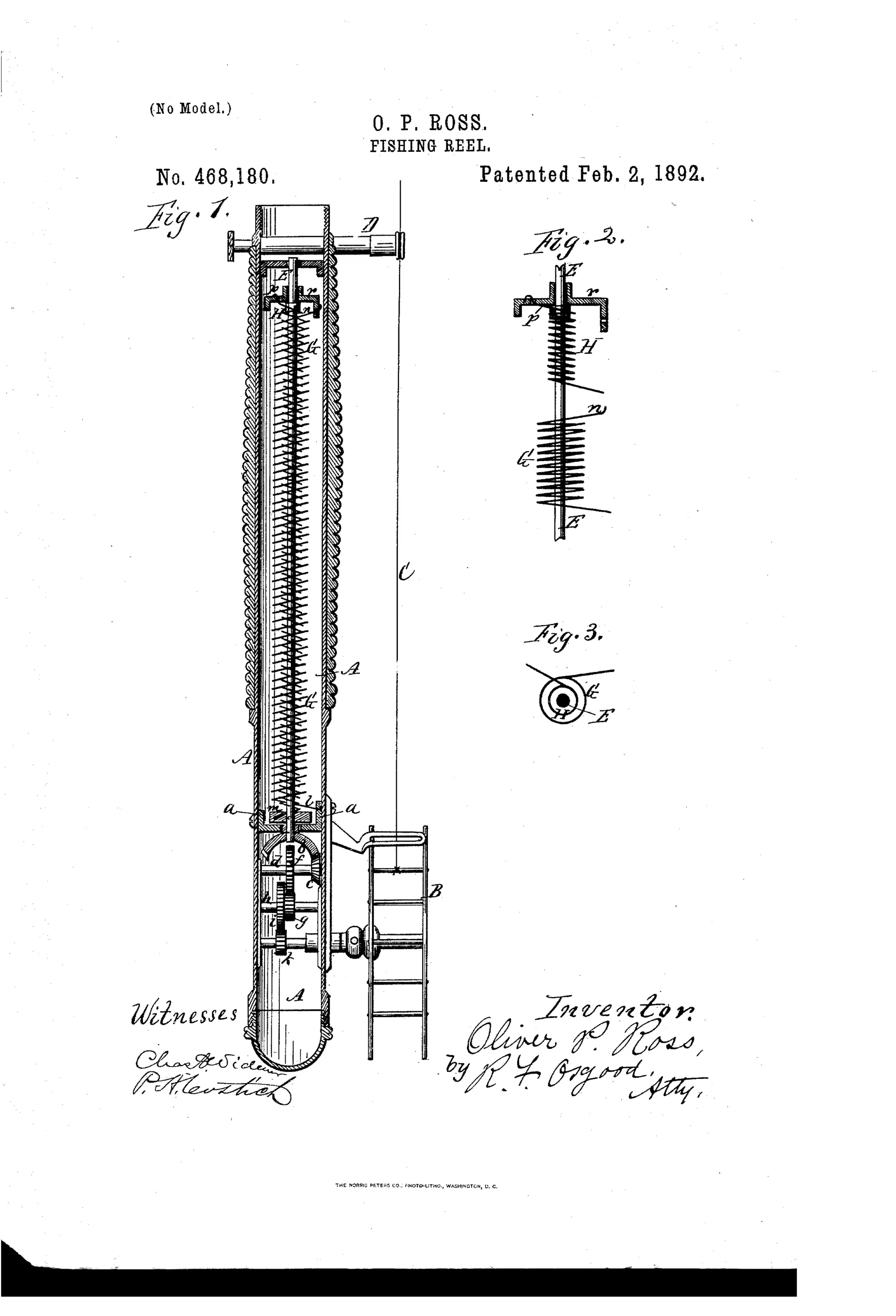
Spring-motor fishing reel with automatic winding mechanism
↻ How it works
A spring-driven spindle located inside the hollow butt of the fishing rod turns a set of bevel and spur gears that multiply motion to the winding spool. Two spiral springs, one nested inside the other, are wound by turning the spool, with their loose ends connected to a freely turning disk and a hub on the spindle. The resistance of the outer spring's fixed lower end to the bearing produces the winding tension, allowing the springs together to store enough energy to wind about one hundred fifty feet of line while keeping the butt to a normal length.
↻ What was claimed
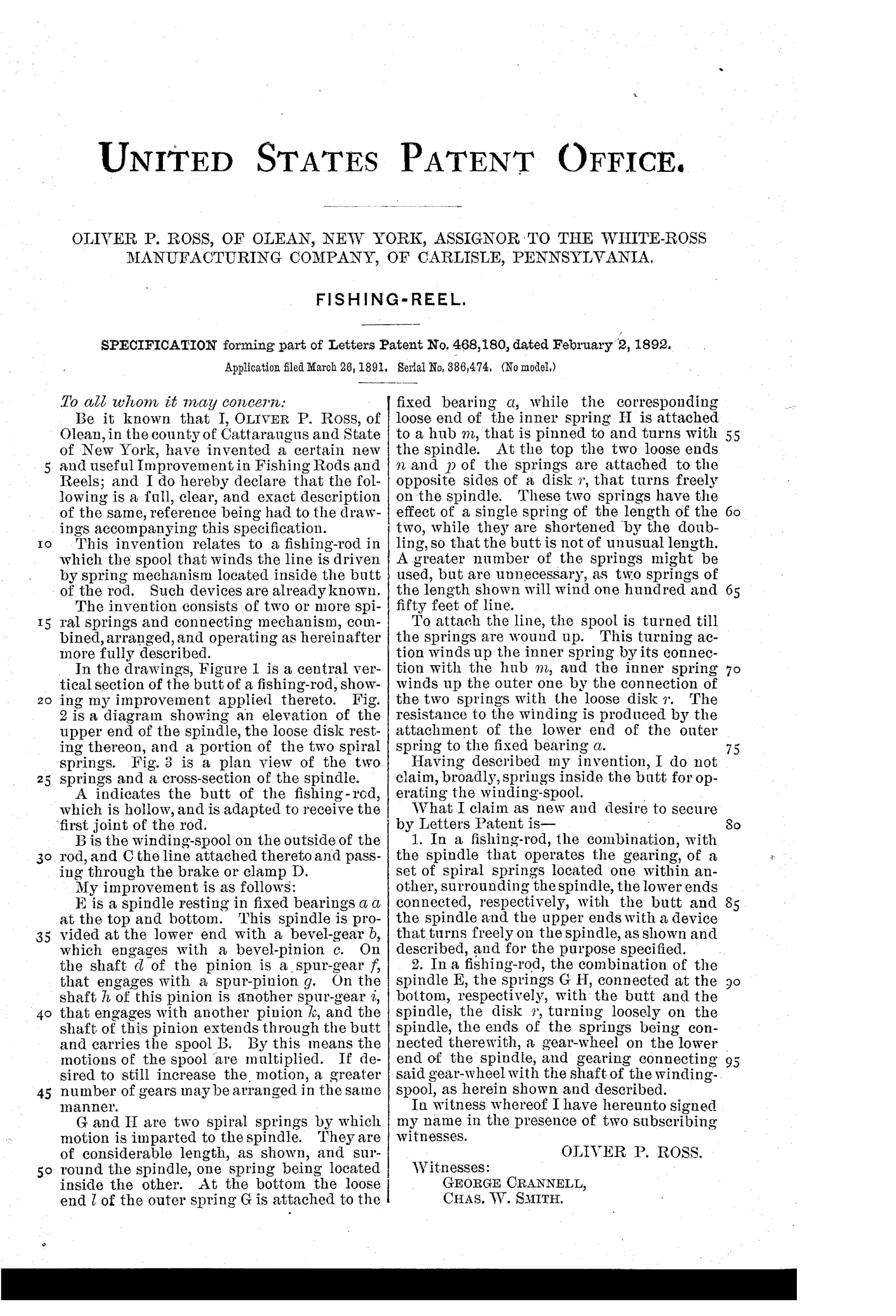
“1. In a fishing-rod, the combination, with the spindle that operates the gearing, of a set of spiral springs located one within another, surrounding the spindle, the lower ends connected, respectively, with the butt and the spindle and the upper ends with a device that turns freely on the spindle, as shown and described, and for the purpose specified.”
In plain English: The reel combines a spindle-driven gear system with nested spiral springs around the spindle, their lower ends fixed to the rod butt and spindle, and their upper ends attached to a freely rotating disk.
↻ In the inventor’s words
“These two springs have the effect of a single spring of the length of the two, while they are shortened by the doubling, so that the butt is not of unusual length.”— Oliver P. Ross, from the specification
Fate unknown
The assignment to White-Ross Manufacturing hints at production plans, but no surviving marked example is documented; one turning up would settle it.
↻ Commentary
Most automatic reels of this era — Yawman & Erbe's coiled-spring flyer being the famous one — hang the spring motor off the rod in a fat drum. Ross goes the other way: he stuffs the entire power plant down the hollow butt of the rod itself. Fig. 1 is the tell — that long ladder of spring coils running nearly the whole length of the section is the motor, and the little external spool with its handle at the bottom is almost an afterthought.
The genuinely clever detail is the nested springs. Two spirals, one inside the other, joined at the top through a disk that turns freely on the spindle. Mechanically they act in series — as Ross says, the effect of one spring twice as long, folded back on itself so the butt stays a normal length. That doubling is what gets him to a claimed 150 feet of stored line without a grotesque handle. Fig. 2 and Fig. 3 show the arrangement in isolation, and it's a tidy bit of watchmaker-style thinking applied to tackle.
The trouble is everything downstream. Bevel and spur gears multiplying spring torque to a spool, all packed into a tube you also have to grip, wave, and fight a fish with — the butt would be heavy, the balance strange, and any grit in that gear train fatal. The assignment to a named manufacturing company suggests real commercial intent, but the in-butt automatic never became a line anyone recognizes. A dead-end branch, thoughtfully engineered.
Commentary by Claude, The Fishing Reel Patent Archive’s resident enthusiast