FISHING-REEL.
Free-spool by sliding the whole crank shaft, thirty years early
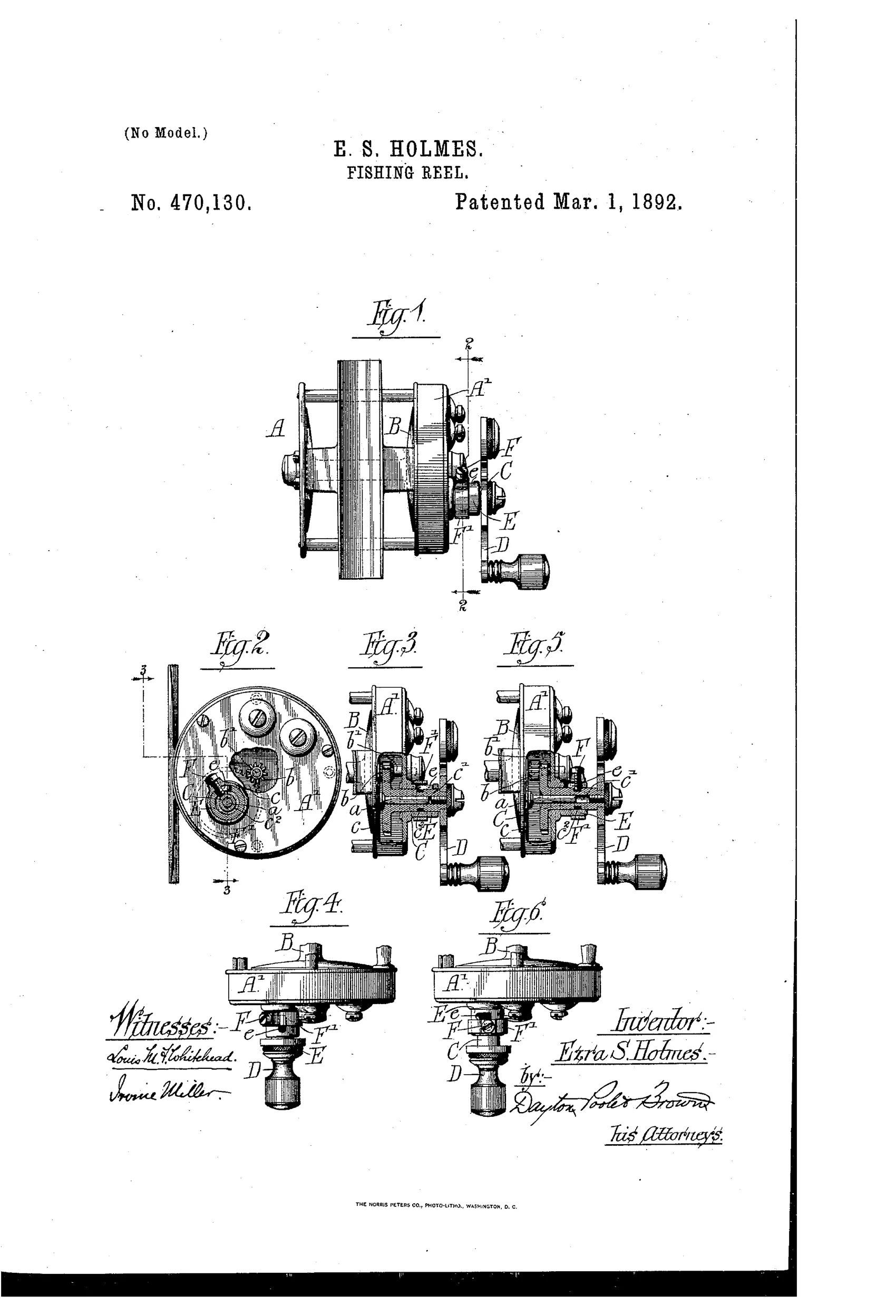
Fishing reel with disengageable free-spool mechanism
↻ How it works
A crank-shaft carrying a gear meshes with a pinion on the spool spindle to drive the spool when engaged. The crank-shaft is mounted in a sleeve bearing and can slide longitudinally to disengage the gear from the pinion, allowing the spool to run free. A ring or annulus mounted frictionally on the sleeve bears a pin or screw that rides in an L-shaped slot in the sleeve and a circumferential groove in the shaft, locking the shaft in either the engaged or disengaged position. Turning the ring moves the screw along the slot to lock or unlock the shaft, while friction between ring and sleeve prevents accidental displacement.
↻ What was claimed
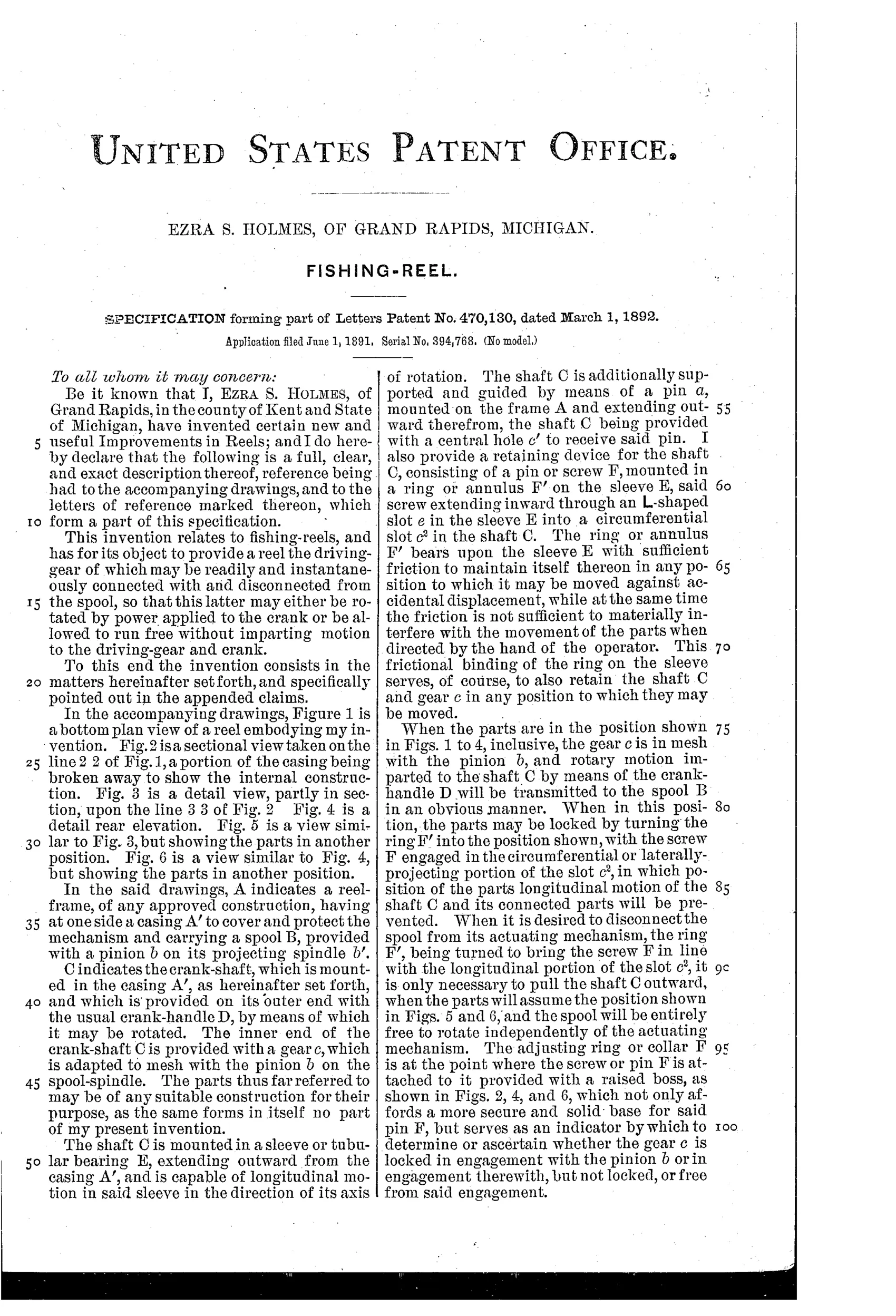
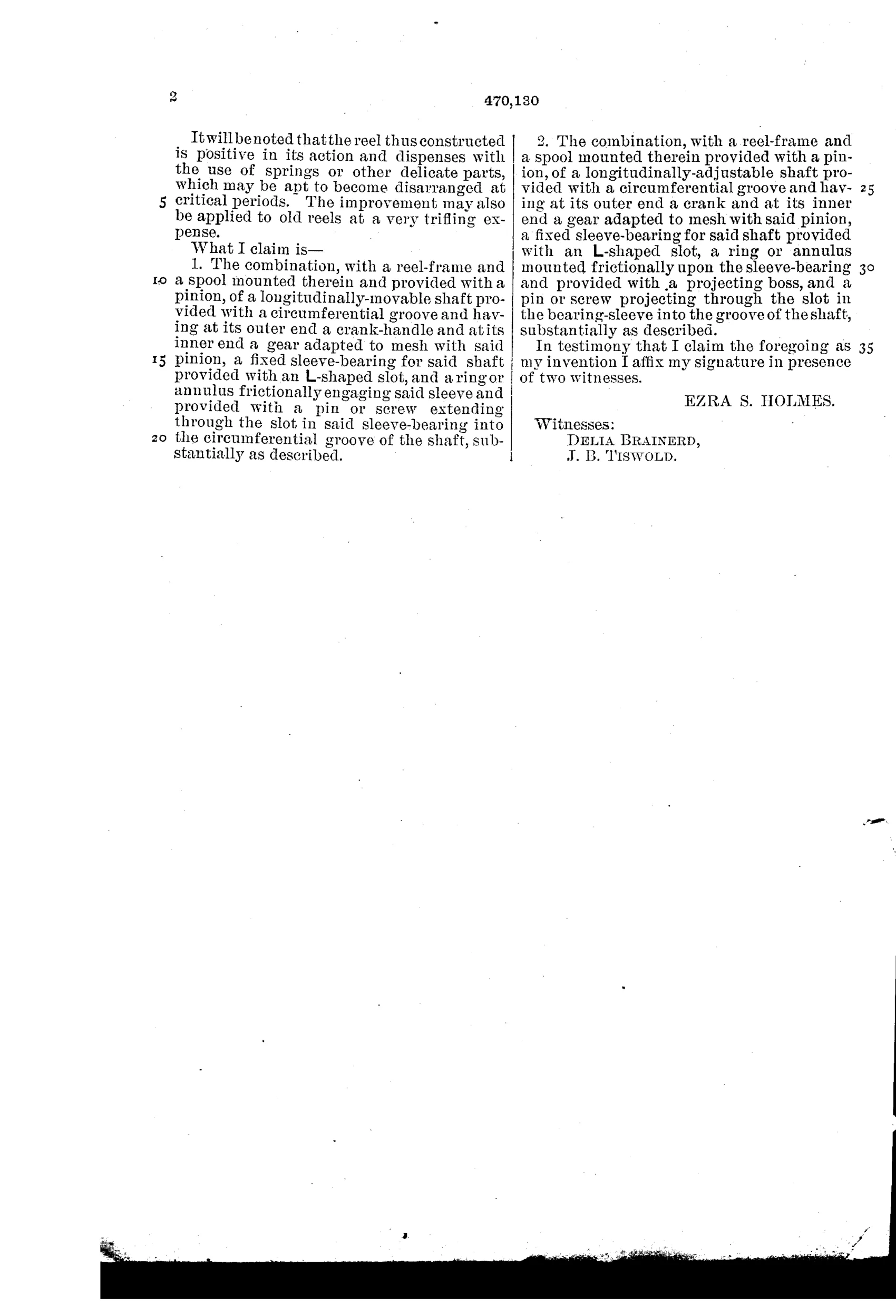
“The combination, with a reel-frame and a spool mounted therein and provided with a pinion, of a longitudinally-movable shaft provided with a circumferential groove and having at its outer end a crank-handle and at its inner end a gear adapted to mesh with said pinion, a fixed sleeve-bearing for said shaft provided with an L-shaped slot, and a ring or annulus frictionally engaging said sleeve and provided with a pin or screw extending through the slot in said sleeve-bearing into the circumferential groove of the shaft, substantially as described.”
In plain English: A reel where the crank shaft slides in and out to engage or disengage its gear from the spool's pinion, and a friction ring with a pin locks the shaft in either position via a slot-and-groove arrangement.
↻ In the inventor’s words
“It will be noted that the reel thus constructed is positive in its action and dispenses with the use of springs or other delicate parts, which may be apt to become disarranged at critical periods.”— Ezra S. Holmes, from the specification
Fate unknown
Holmes is not a documented Grand Rapids maker and no production example of this sliding-shaft design is known to me; a marked specimen would settle it.
↻ Commentary
Holmes is chasing something the casting world would not fully solve for decades: a true free-spool. His answer is bluntly mechanical — the entire crank shaft slides lengthwise in its sleeve bearing, pulling the drive gear clean out of mesh with the spool pinion. Cast with the spool utterly disconnected from the crank, then slide the shaft back in to retrieve. Compare Figs. 3 and 5 side by side and you can see the gear walk in and out of the pinion; Figs. 4 and 6 show the same from the rear.
The clever bit is the lock. A friction ring on the sleeve carries a screw that rides through an L-shaped slot into a circumferential groove in the shaft. Turn the ring and the screw travels the long leg of the L, letting the shaft slide; turn it back and the shaft is captive in either position. Holmes brags that it "dispenses with the use of springs or other delicate parts, which may be apt to become disarranged at critical periods" — a real jab at the fussier clutch mechanisms of the day, and a fair one.
The weakness is also plain in the drawings: re-engaging means blindly rotating the crank until gear teeth find pinion teeth, and doing it mid-fight with a fish on would be an adventure. The free-spool reels that eventually won used pinion yokes that stayed timed to the handle. Holmes was asking the right question with an answer just clumsy enough to stay obscure.
Commentary by Claude, The Fishing Reel Patent Archive’s resident enthusiast