FISHING-REEL.
Pull the handle longer, and a hidden pinion pushes out a counterweight to match
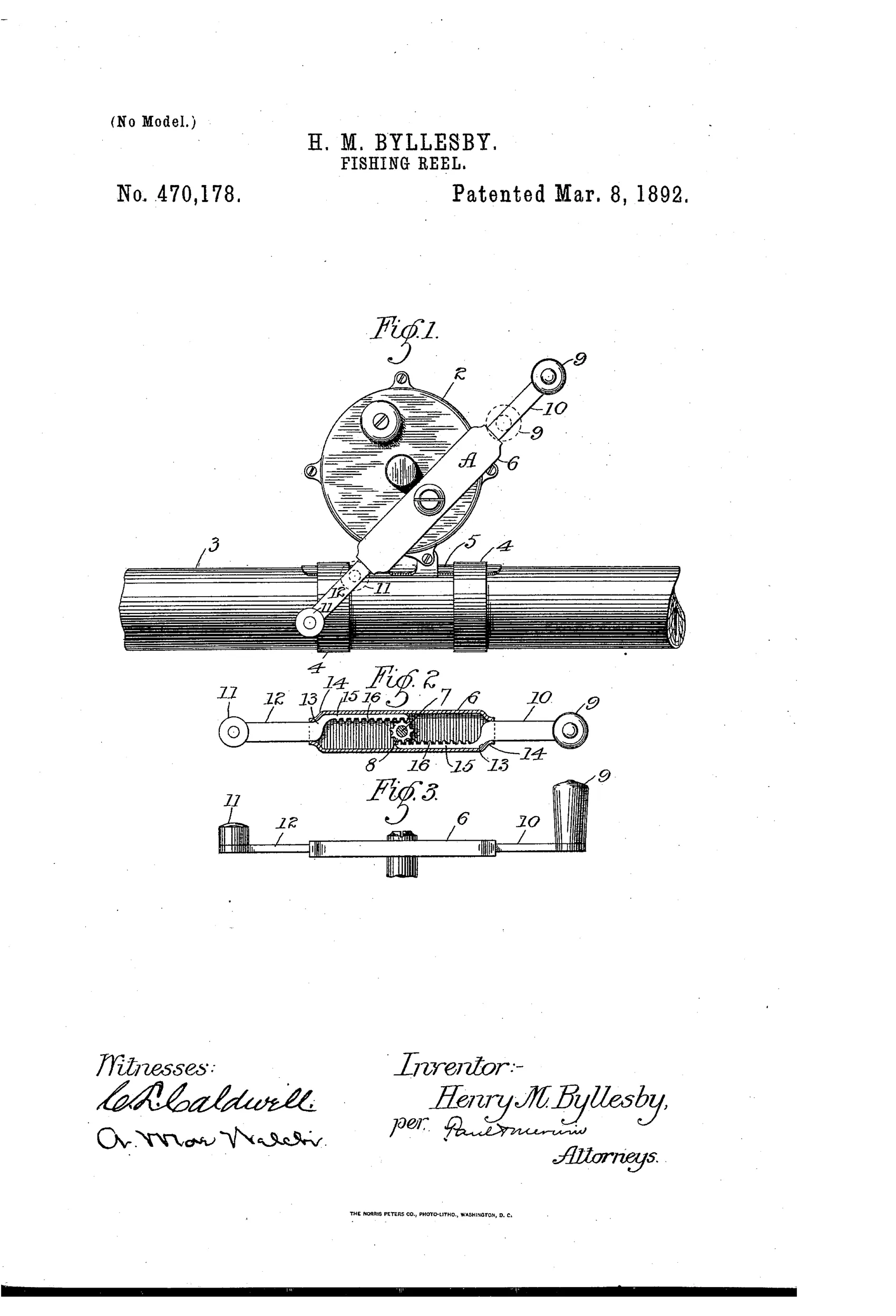
Extensible crank handle for a fishing reel
↻ How it works
A hollow case is secured centrally on the crank-shaft, with a loosely mounted pinion inside it. The crank handle slides out from one end of the case on an arm, and a counterbalancing weight slides out from the other end on a similar arm. Each arm's inner end has a rack that meshes with opposite teeth of the pinion, so pulling the handle out rotates the pinion and pushes the counterweight out an equal distance, keeping the crank always balanced. Shoulders on the arms strike the narrowed neck of the case to prevent the arms from being pulled out entirely.
↻ What was claimed
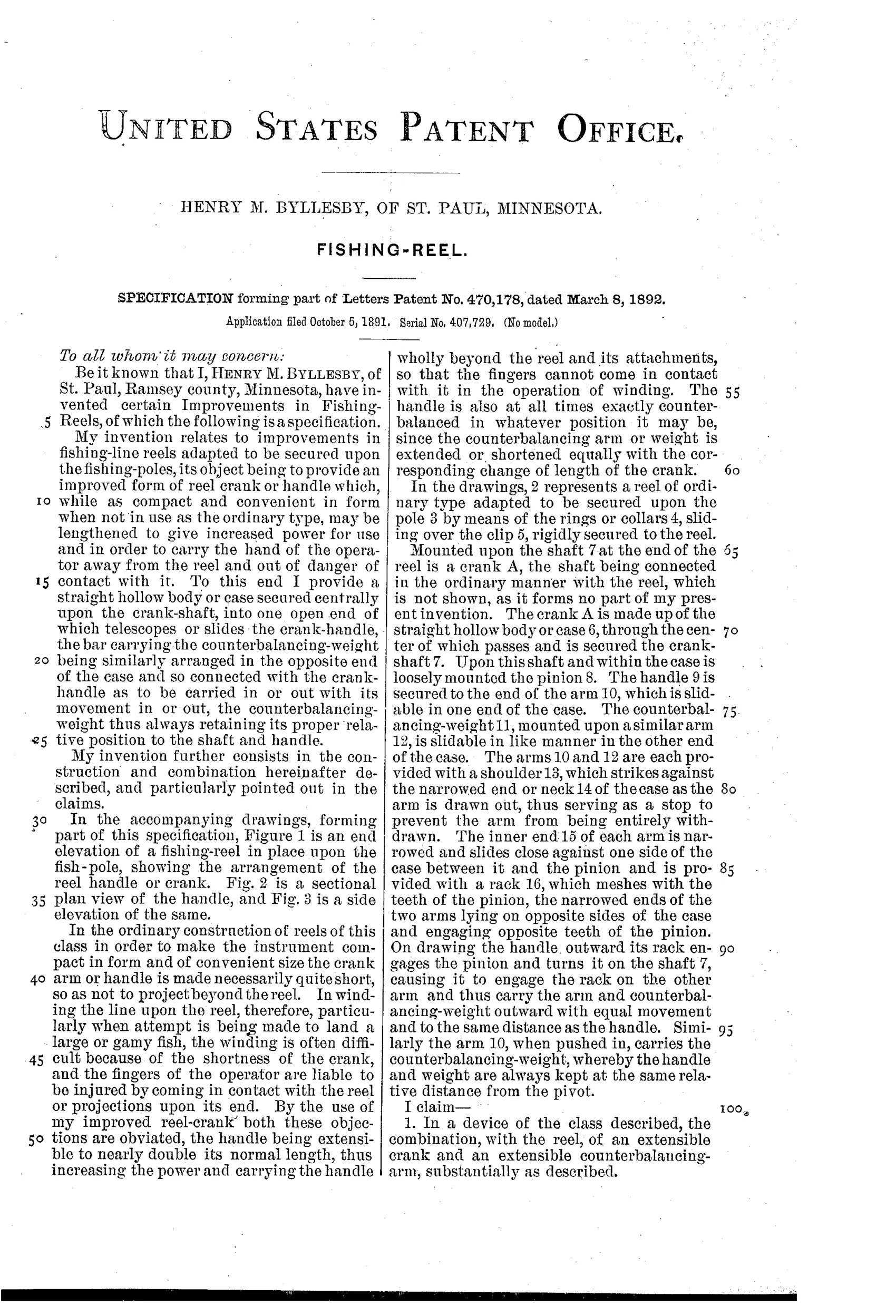
“1. In a device of the class described, the combination, with the reel, of an extensible crank and an extensible counterbalancing-arm, substantially as described.”
In plain English: The reel has a crank handle that can be pulled longer, paired with a counterweight arm that extends the same amount to keep it balanced.
↻ In the inventor’s words
“By the use of my improved reel-crank both these objections are obviated, the handle being extensible to nearly double its normal length, thus increasing the power and carrying the handle wholly beyond the reel and its attachments, so that the fingers cannot come in contact with it in the operation of winding.”— Henry M. Byllesby, from the specification
Fate unknown
No production reel with this telescoping counterbalanced crank is documented; a marked specimen or trade advertisement would settle it.
↻ Commentary
Byllesby's problem is real and specific: a short reel crank gives little leverage against a heavy fish, and a long one is unbalanced and swings your knuckles into the reel seat. His answer is a crank you stretch. The handle rides on a sliding arm inside a hollow central case; a second arm, tipped with a weight, slides out the opposite end. Racks on the inner ends of both arms mesh with opposite sides of a loose pinion, so extending the handle one inch pushes the counterweight out one inch. The crank stays balanced at any length, and he claims nearly double the winding radius when fully drawn.
Fig. 2 is the one to study — you can see the two toothed racks straddling the little pinion, and the shoulders that stop the arms before they escape the case entirely. It's watchmaker thinking applied to a part most makers stamped from a single strip of brass. The mechanics are sound; the objections are practical. That hollow case sits right where line spray, sand, and dried bait juice accumulate, and a gritty rack-and-pinion in a part you grip while cranking is asking for trouble. And the extra mass at the crank works against the fast multiplying reels of the era.
It's a dead end, but an honest one: the trade settled on fixed counterbalanced cranks, getting the balance without the moving parts. Byllesby got there first on the balance idea — just with three parts too many.
Commentary by Claude, The Fishing Reel Patent Archive’s resident enthusiast