REEL.
The whole reel vanishes into the rod handle, spring-wound by the fish itself
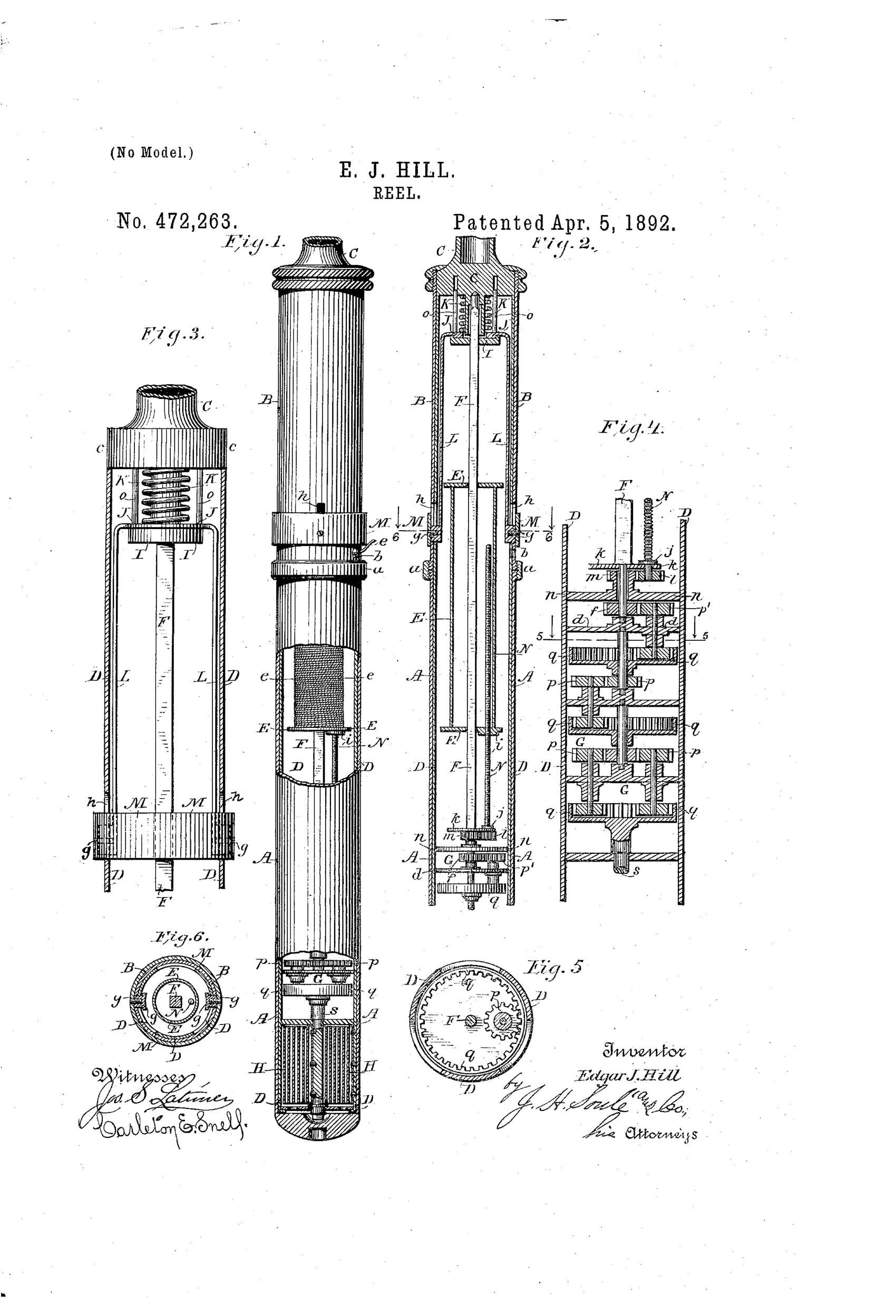
Spring-powered automatic fishing reel hidden in rod handle
↻ How it works
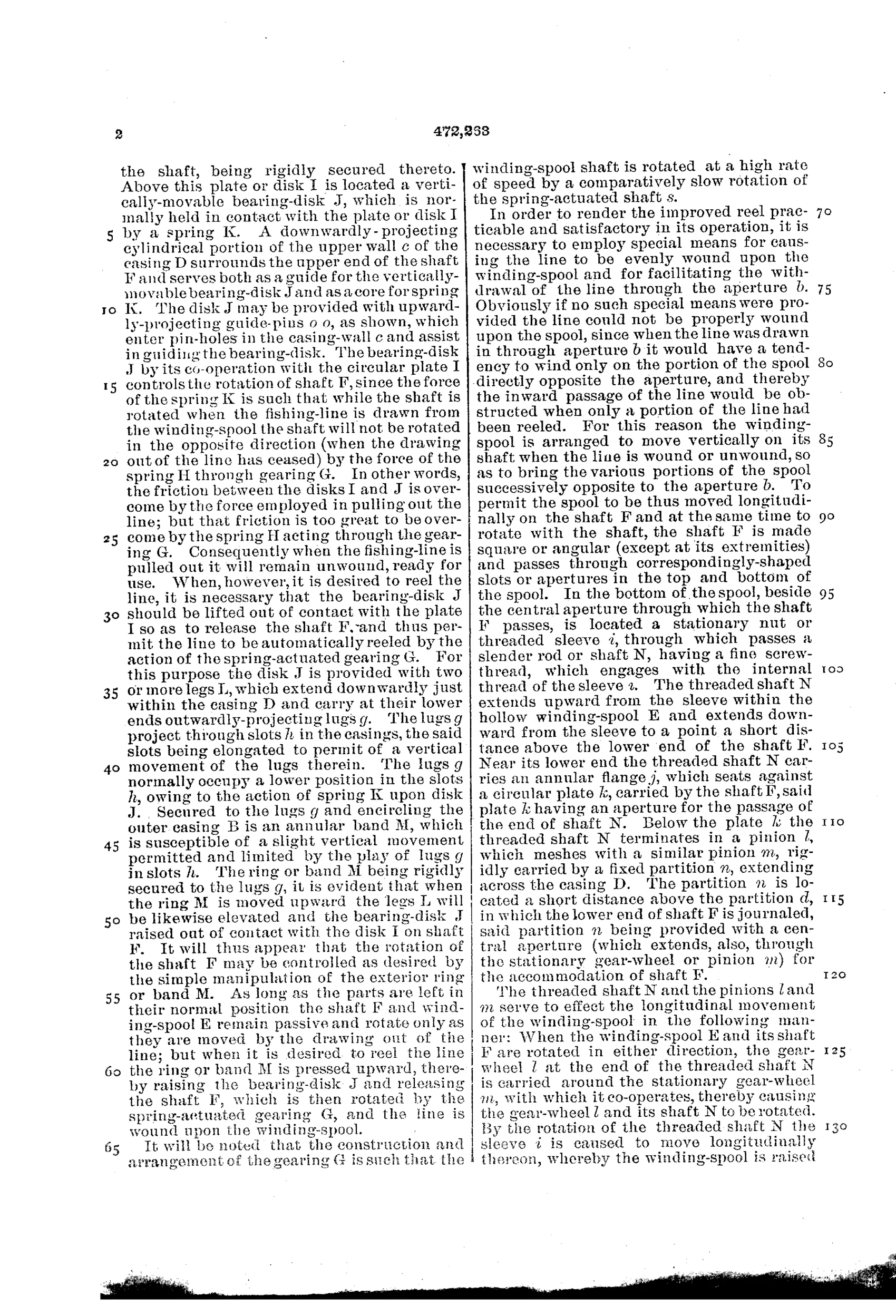
A hollow winding-spool E is carried on a shaft F journaled inside the rod handle's inner casing D, and the line is drawn out through an aperture in the handle to unreel it. Unreeling rotates shaft F which, through multiplying gearing G, winds a coiled spring H; a friction disk I on the shaft and a spring-loaded bearing-disk J normally lock the shaft so the spring cannot reverse it and rewind the line automatically. Pressing an exterior sliding band M lifts the bearing-disk J off the friction disk, releasing the shaft so the wound spring, acting through the gearing, automatically reels the line back onto the spool. A separate finely threaded shaft N, engaging a threaded sleeve on the spool and meshing pinions l and m, slowly and continuously shifts the spool lengthwise on its shaft as it rotates so that the line winds evenly across the spool's length opposite the handle aperture.
↻ What was claimed
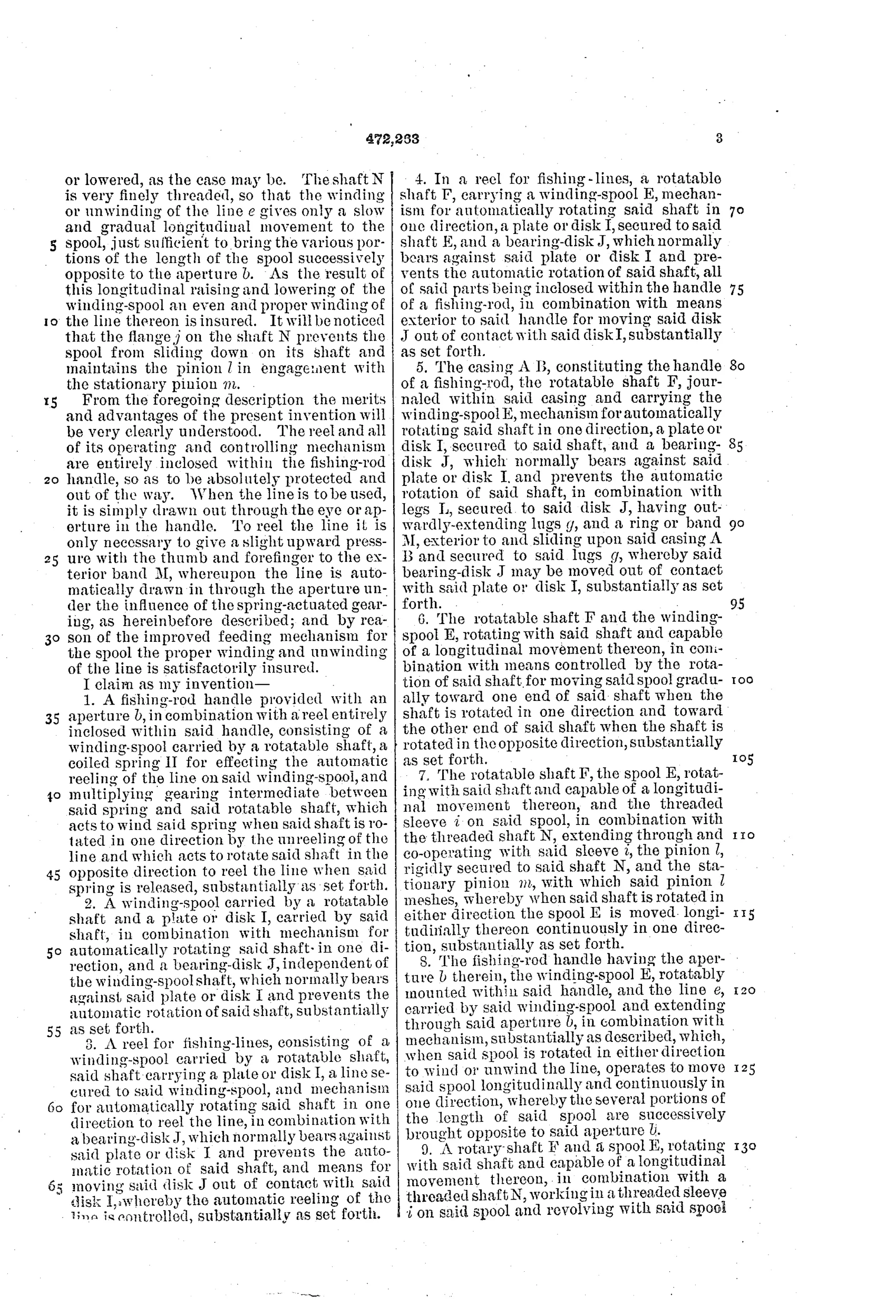
“1. A fishing-rod handle provided with an aperture b, in combination with a reel entirely inclosed within said handle, consisting of a winding-spool carried by a rotatable shaft, a coiled spring H for effecting the automatic reeling of the line on said winding-spool, and multiplying gearing intermediate between said spring and said rotatable shaft, which acts to wind said spring when said shaft is rotated in one direction by the unreeling of the line and which acts to rotate said shaft in the opposite direction to reel the line when said spring is released, substantially as set forth.”
In plain English: A fishing rod handle with a fully enclosed reel whose spool shaft, when the line is pulled out, winds a spring through gearing, and when released that spring reels the line back in.
↻ In the inventor’s words
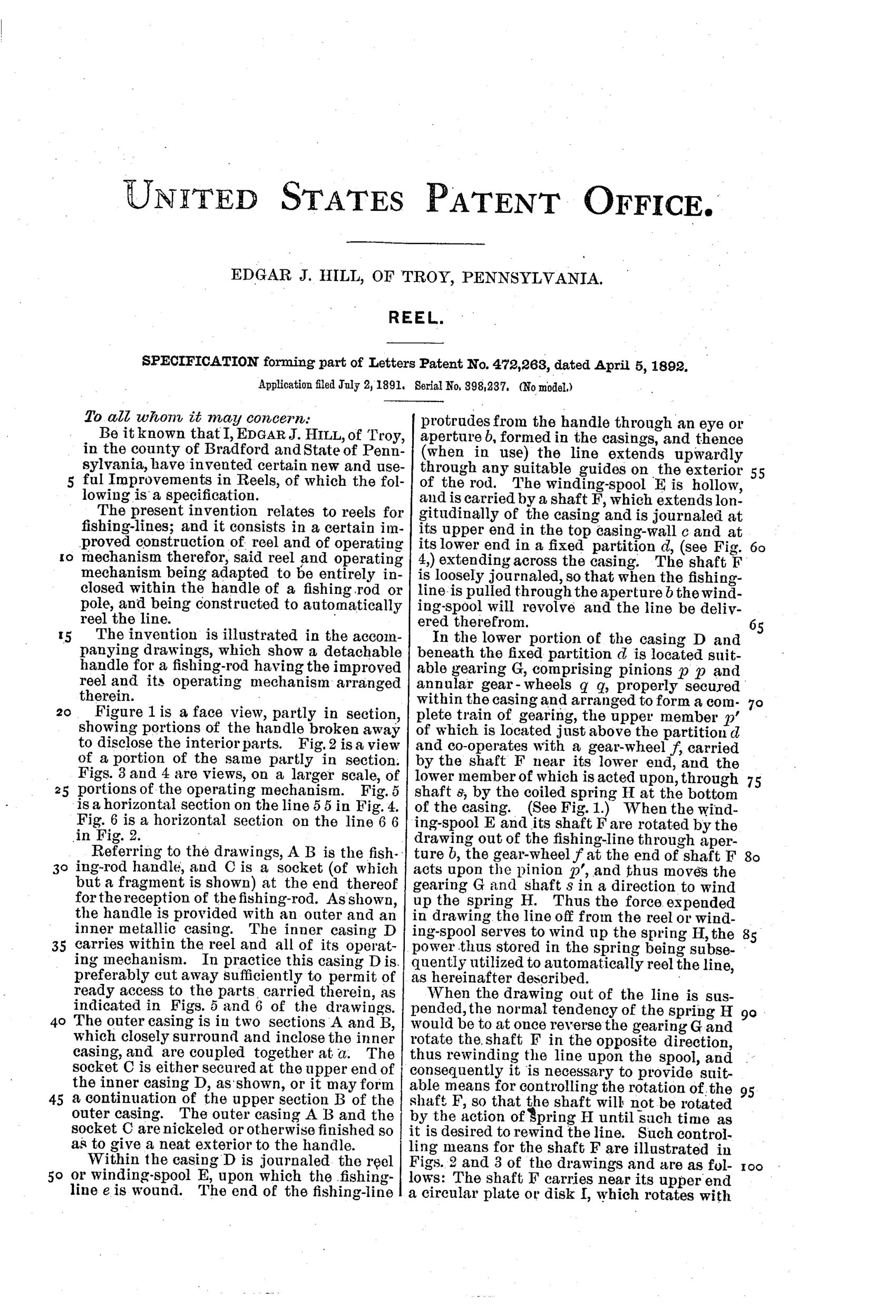
“The reel and all of its operating and controlling mechanism are entirely inclosed within the fishing-rod handle, so as to be absolutely protected and out of the way.”— Edgar J. Hill, from the specification
Fate unknown
No production example or maker association is documented; a surviving marked handle-reel would settle it, though the complexity suggests it stayed on paper.
↻ Commentary
Edgar Hill's answer to the exposed, snag-prone reel was radical: eliminate it from view entirely. The spool, spring motor, gearing, and controls all live inside the rod handle, with the line emerging through a small aperture. Pulling line out winds a coiled spring through multiplying gears; press the sliding band M on the handle's exterior and a friction clutch releases, letting the spring reel everything back in. The fish, in effect, charges the battery that retrieves it.
The drawing rewards a close look. Fig. 4 shows the gear train stacked between partitions like a clock movement — no surprise for an era when Kentucky watchmakers set the standard — and the threaded shaft N is the quiet star. It shifts the spool lengthwise as it turns so the line lays evenly across the barrel. That is a working level-wind, patented well before the level-wind craze of the 1900s, buried inside a reel almost nobody would ever see.
The practical problems are real, though. Spool capacity inside a handle is meager, a friction-disk clutch holding against a fully wound spring invites slip or lockup, and a bird's nest inside a sealed handle is a trip to the workbench, not a moment's picking. Martin's exposed automatic fly reels won this niche precisely by staying serviceable. Hill's version is ingenious, dense, and a dead end — but an honorable one.
Commentary by Claude, The Fishing Reel Patent Archive’s resident enthusiast