FISHING-ROD.
A level-wind chain drive hidden inside the rod handle, eight years early
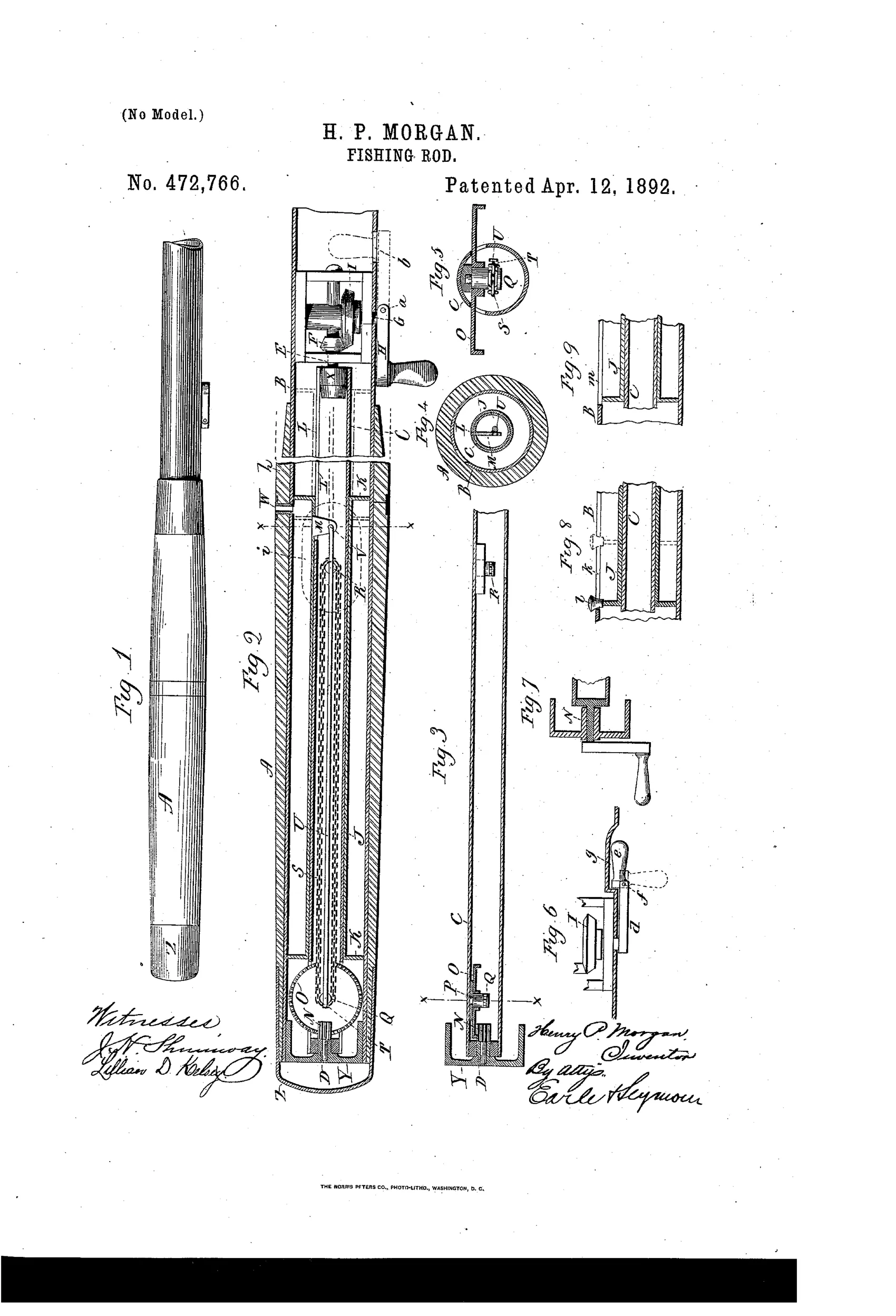
Fishing rod with built-in internal reel mechanism
↻ How it works
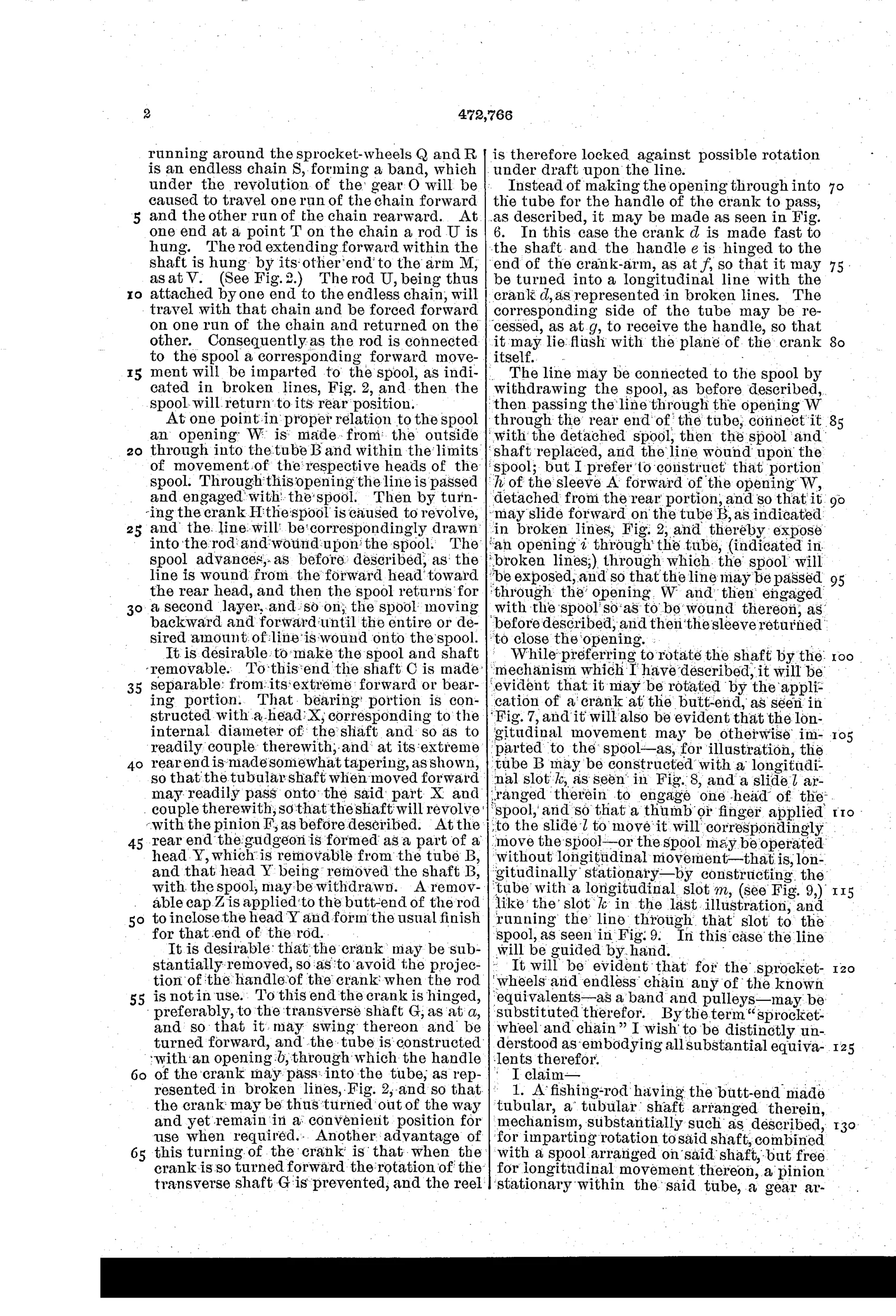
The rod's tubular butt section houses a rotating shaft driven by an external crank turning a bevel-pinion gear. A spool slides along the shaft on a spline, coupled by an arm running in a longitudinal groove so it revolves with the shaft while free to move lengthwise. Rotation of the shaft drives a gear meshing with a stationary pinion, which turns a sprocket-wheel connected by an endless chain to a second sprocket further along the shaft; a rod linking the chain to the spool arm forces the spool to travel forward and backward, winding line evenly across its length as it is reeled in.
↻ What was claimed
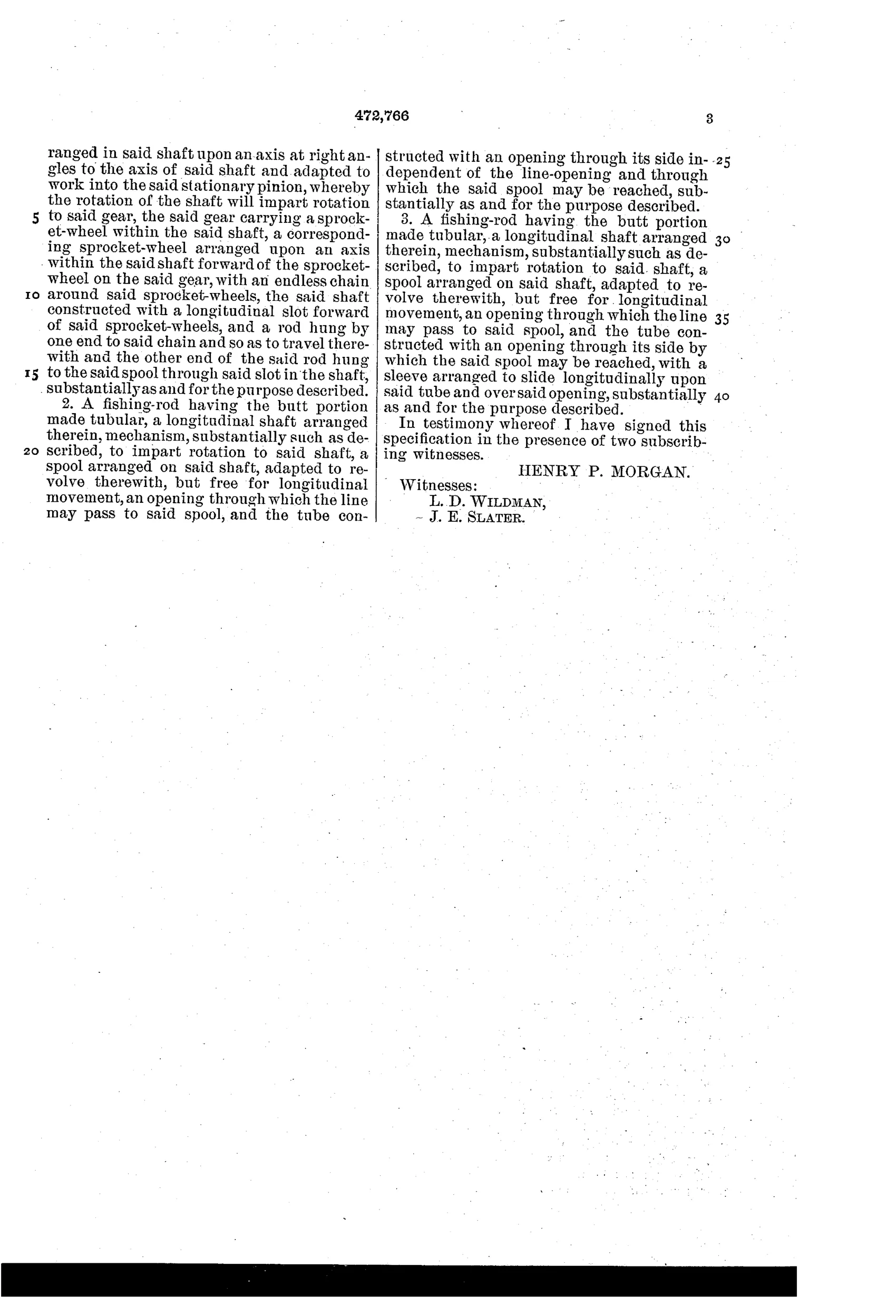
“A fishing-rod having the butt-end made tubular, a tubular shaft arranged therein, mechanism, substantially such as described, for imparting rotation to said shaft, combined with a spool arranged on said shaft, but free for longitudinal movement thereon, a pinion stationary within the said tube, a gear arranged in said shaft upon an axis at right angles to the axis of said shaft and adapted to work into the said stationary pinion, whereby the rotation of the shaft will impart rotation to said gear, the said gear carrying a sprocket-wheel within the said shaft, a corresponding sprocket-wheel arranged upon an axis within the said shaft forward of the sprocket-wheel on the said gear, with an endless chain around said sprocket-wheels, the said shaft constructed with a longitudinal slot forward of said sprocket-wheels, and a rod hung by one end to said chain and so as to travel therewith and the other end of the said rod hung to the said spool through said slot in the shaft, substantially as and for the purpose described.”
In plain English: The rod has a hollow handle containing a rotating internal shaft that drives a gear-and-chain mechanism, which pushes a rod through a slot to move the line spool back and forth so it winds evenly as the shaft turns.
↻ In the inventor’s words
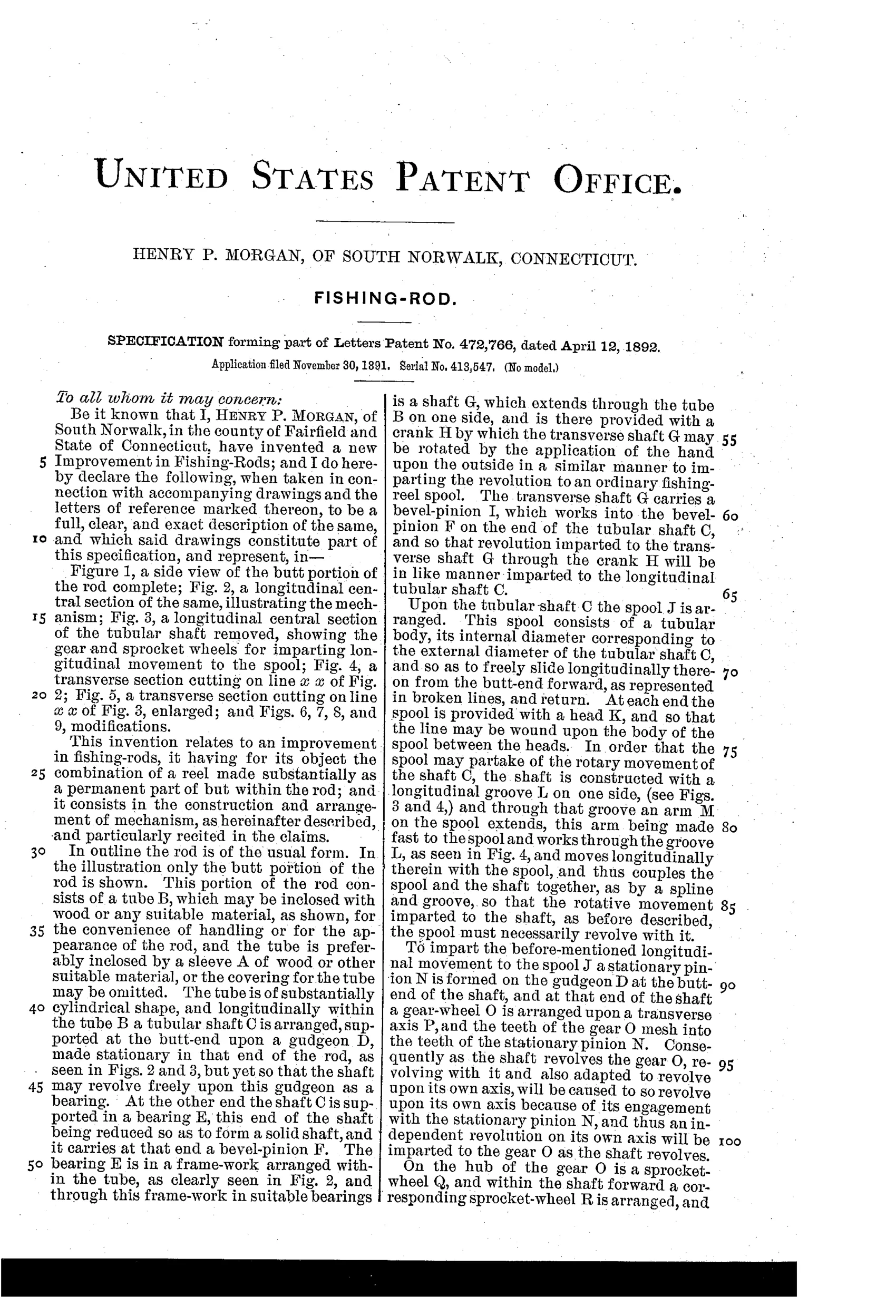
“This invention relates to an improvement in fishing-rods, it having for its object the combination of a reel made substantially as a permanent part of but within the rod.”— Henry P. Morgan, from the specification
Paper patent — likely never produced
The internal chain-driven traverse would have been costly and fragile to produce, and no manufactured example or commercial descendant is known.
↻ Commentary
Morgan's idea is to abolish the reel as a separate fitting entirely: the butt of the rod is a tube, and inside it live the spool, the drive shaft, and — this is the remarkable part — a complete traversing mechanism. Fig. 2 repays a slow look. That long ladder-like element running down the center of the section is an endless sprocket chain inside the hollow shaft, and the rod pinned to it passes out through a longitudinal slot to shuttle the spool back and forth on its spline. The spool spins with the shaft but slides along it, so line lays evenly across its whole length. In 1892 that puts Morgan ahead of the level-wind craze; commercially successful level-winds on conventional casting reels were still years away.
The cleverness is also the trouble. The spool is buried where you can't see a tangle, can't thumb the line, and can't clear a jam without disassembly — and every wet, sandy trip goes straight into that gear-and-chain train. The stationary pinion driving a gear inside a rotating shaft is watchmaker's thinking applied to a tool that lives in mud.
Figs. 6 through 9 show Morgan hedging with simpler variants, including one where you guide the line by hand through a slot — a quiet admission of how ambitious the main mechanism was. As a rod it's a dead end; as an early level-wind concept, it's a genuinely interesting footnote.
Commentary by Claude, The Fishing Reel Patent Archive’s resident enthusiast