FISHING-REEL.
Push-pull free-spool clutch in 1892, plus a line-drying brake pad
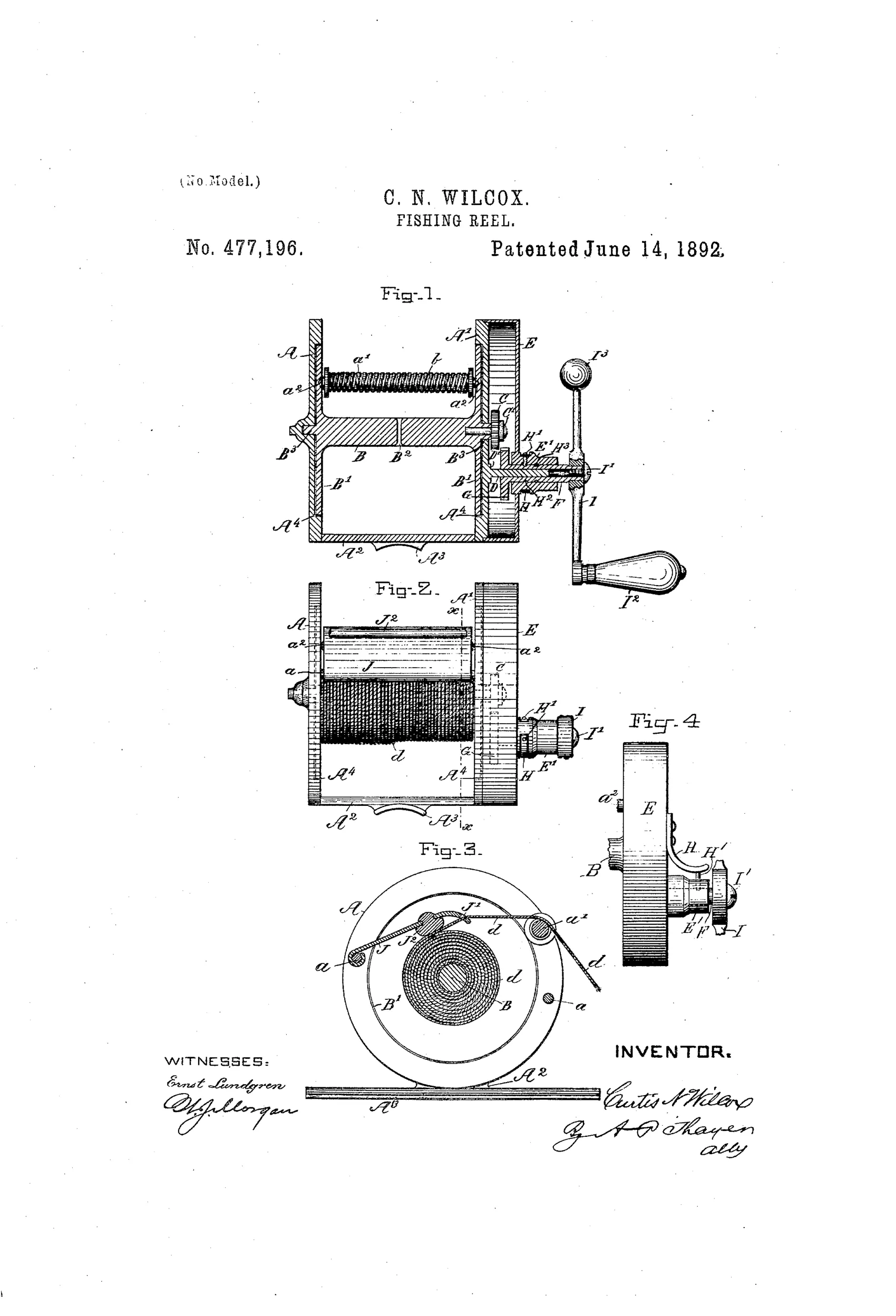
Fishing reel with disengageable winding pinion and line brake
↻ How it works
The reel's crank handle is mounted on a sleeve that slides lengthwise on a fixed shaft projecting from one end piece of the frame. Pushing the sleeve inward meshes its pinion with the spool's pinion so turning the handle winds in the line, while pulling it outward disengages the gears so the spool spins freely for casting with minimal drag. A spring-loaded pin engages one of two annular grooves on the sleeve to hold it in either the engaged or disengaged position. A hinged brake with a detachable absorbent pad bears against the outhanging line to control its delivery and dry it as it is wound in, and an independently pivoted right-and-left spirally grooved roller guides the line evenly back and forth across the spool without being geared to it.
↻ What was claimed
“The combination, with the spool, its frame, and the pinion on the spool, of a shaft rigid with the end piece of the frame, a sleeve movable on said shaft and carrying a pinion, and a handle upon said sleeve and adapted to rotate it or to move it lengthwise upon the shaft, substantially as described.”
In plain English: The reel's crank handle sits on a sliding sleeve on a fixed shaft so it can be pushed in to engage the winding pinion with the spool for reeling in, or pulled out to disengage it for free casting.
↻ In the inventor’s words
“This invention relates to certain new and useful improvements in reels; and it has for its object, among others, to provide simple and cheap yet efficient means for withdrawing the handle and the pinion employed for winding up the line from engagement with the pinion upon the spool, so that the line may be cast or thrown out farther and more freely with a minimum of drag and resistance from the spool, but which may be made to readily engage with the pinion on the spool by slight pressure longitudinally, so that the turning of the handle will at once begin to wind in or up the line.”— Curtis N. Wilcox, from the specification
Fate unknown
Wilcox is not a known reel maker and the assignment to a private party suggests hope rather than a factory; no documented specimen is known, and a marked example would settle it.
↻ Commentary
The heart of this patent is the sliding sleeve under the crank handle: push it in and the pinion meshes with the spool's gear for winding, pull it out and the spool spins free of the whole gear train for casting. That is a free-spool clutch, described a good decade or two before the idea became standard on quality casting reels, and Wilcox's version is honestly simple — a spring-loaded pin dropping into one of two annular grooves holds the sleeve in either position. Fig. 1's section shows how little there is to it: no dogs, no ratchets, just a sleeve on a fixed stub shaft.
The supporting cast is more eccentric. The hinged brake arm crossing the spool in Fig. 2 carries a detachable absorbent pad meant to both meter the outgoing line and dry it as it comes back in — a genuine worry with linen lines that rotted when stored wet, but a pad dragging on line during a cast is exactly the friction the free-spool clutch was built to eliminate. The spirally grooved roller for laying line evenly is clever in that it is not geared to anything; the line itself is expected to walk along the right-and-left threads, which works in principle but drifts in practice.
Wilcox was chasing the right problems — cast resistance, line care, even winding — before the trade converged on better answers. A thoughtful, slightly overloaded entry from Brooklyn, vom Hofe's own neighborhood.
Commentary by Claude, The Fishing Reel Patent Archive’s resident enthusiast