FISHING-REEL.
Free-spool by letting go: an 1892 clutch that shifts itself
Fishing reel with automatic free-spool disengagement
↻ How it works
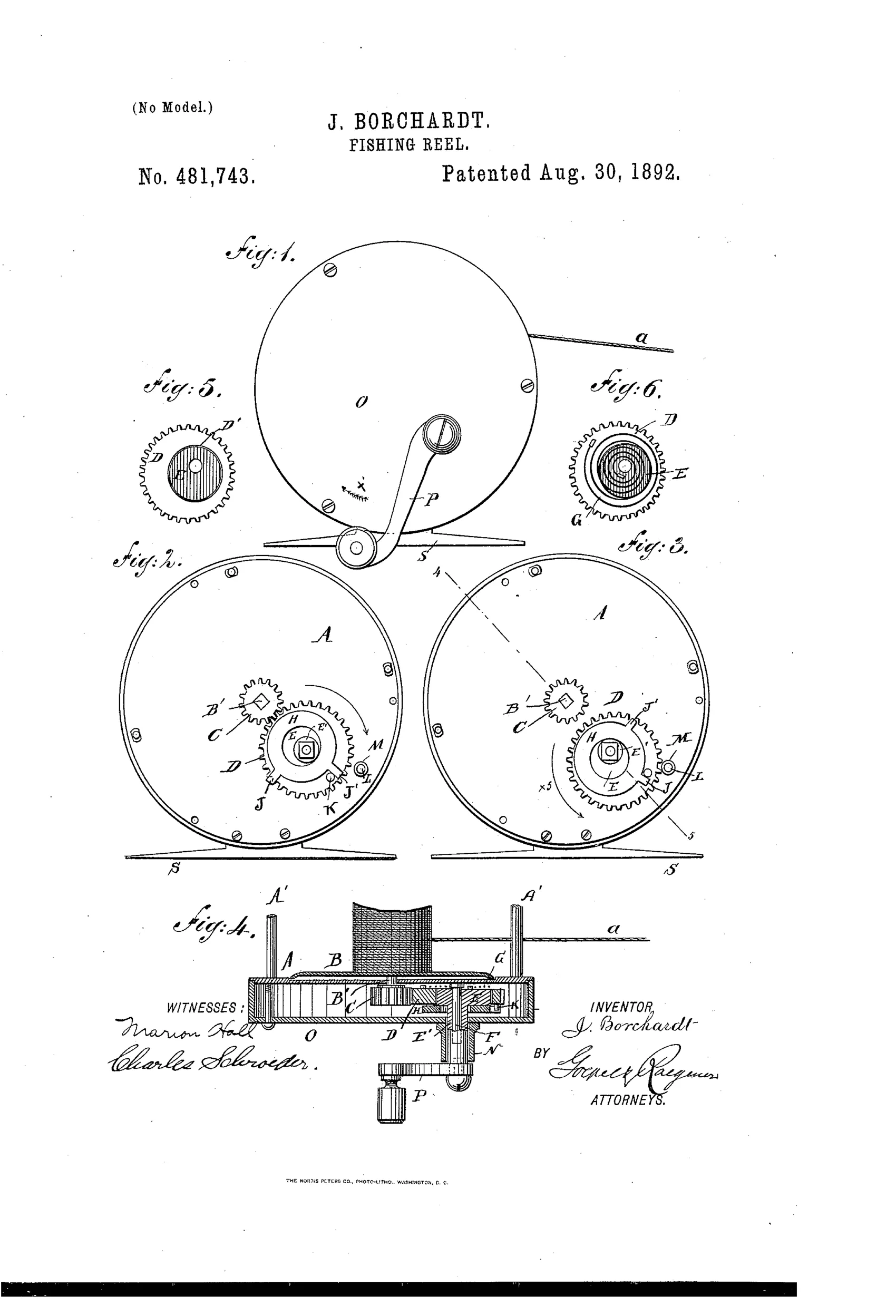
The reel has two end plates connected by rods, with a drum mounted centrally to rotate between them. A pinion fixed on the drum's axle can engage a cog-wheel that has an eccentric opening fitted with a disk on an eccentric sleeve, and the handle is secured to this sleeve. Turning the handle rotates the disk, bringing the cog-wheel into engagement with the pinion so the drum winds the line; when the handle is released, a spiral spring automatically turns the cog-wheel out of engagement with the pinion, freeing the drum to unwind the line without turning the handle or gearing.
↻ What was claimed
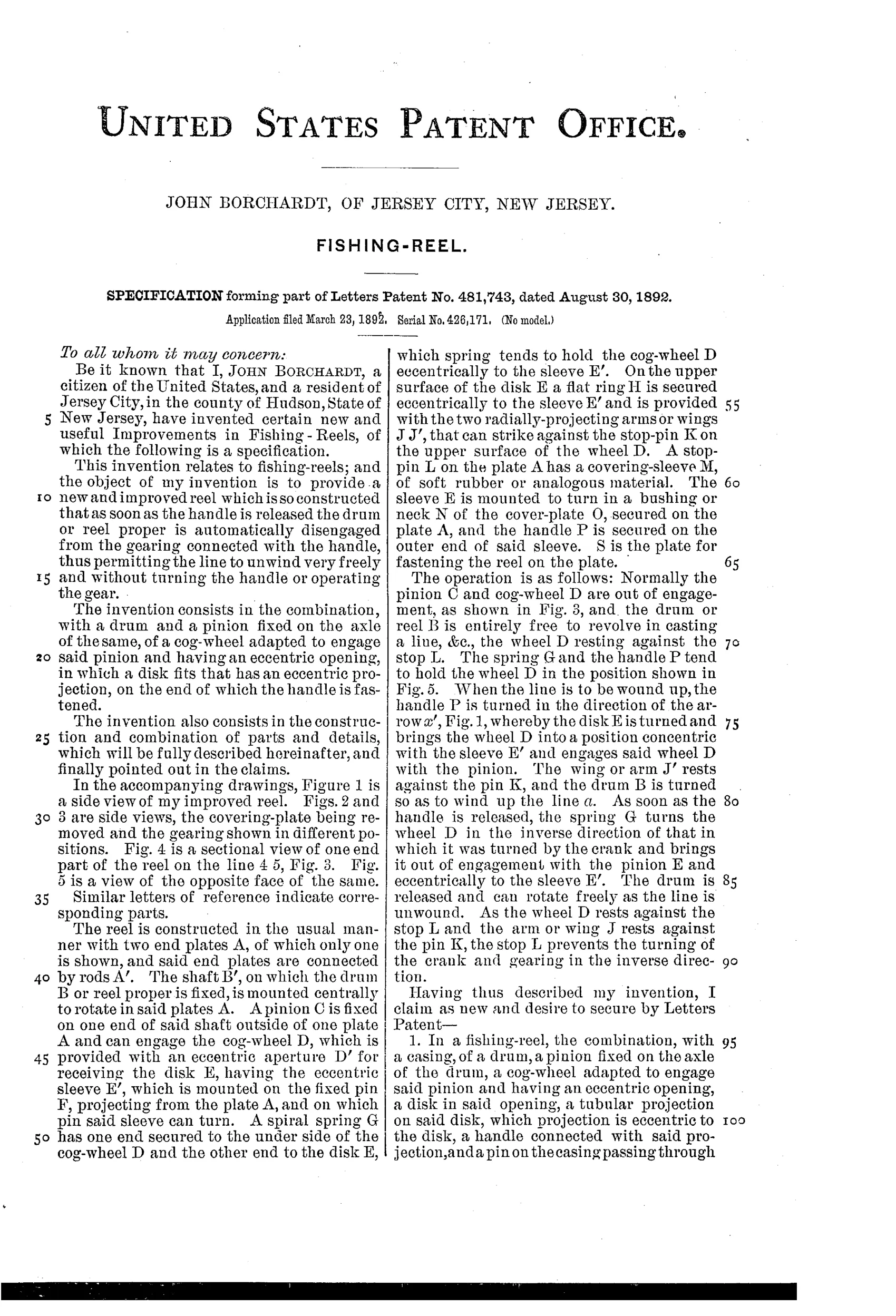
“1. In a fishing-reel, the combination, with a casing, of a drum, a pinion fixed on the axle of the drum, a cog-wheel adapted to engage said pinion and having an eccentric opening, a disk in said opening, a tubular projection on said disk, which projection is eccentric to the disk, a handle connected with said projection, and a pin on the casing passing through said tubular projection, arms on said disk, and a pin on said cog-wheel, substantially as set forth.”
In plain English: The reel combines a drum with a pinion on its axle, a cog-wheel with an eccentric opening holding a disk that has an eccentric tubular projection connected to the handle, plus pins and arms that allow the wheel to engage or disengage the pinion.
↻ In the inventor’s words
“the object of my invention is to provide a new and improved reel which is so constructed that as soon as the handle is released the drum or reel proper is automatically disengaged from the gearing connected with the handle, thus permitting the line to unwind very freely and without turning the handle or operating the gear.”— John Borchardt, from the specification
Paper patent — likely never produced
No manufactured Borchardt reel is documented, and the load-dependent gear engagement makes a production version implausible; a marked specimen would overturn this.
↻ Commentary
Free-spool casting — decoupling the spool from the handle gearing so line pays out without spinning the whole gear train — became standard equipment in the twentieth century, usually via a thumb lever or push button. Borchardt's answer in 1892 is bolder and stranger: the clutch is the crank itself. His main cog-wheel has an eccentric hole with a disk riding in it, and the handle attaches to an eccentric sleeve on that disk. Start cranking and the eccentric walks the cog-wheel into mesh with the spool pinion; let go, and a spiral spring swings it back out. Figures 2 and 3 show the two states side by side, and Figures 5 and 6 give you the eccentric-disk trick up close — that pair is the whole invention.
The idea is genuinely clever, and it aims at the right target: friction and inertia in the gearing were real cast-killers. But the execution invites trouble. Engagement depends on gear teeth meeting under load at whatever angle they happen to arrive — expect grinding, or the sickening slip of teeth riding tips when a fish hits and you grab the handle. A positive lock this mechanism lacks.
So it sits as an early, ingenious ancestor of the free-spool clutch, solved a different way than the levers that eventually won. A dead end mechanically, but a prescient one.
Commentary by Claude, The Fishing Reel Patent Archive’s resident enthusiast