FISHING-REEL.
Squeeze the rod, brake the spool: a hand-lever drag from 1892 New Jersey
Adjustable friction-brake fishing reel
↻ How it works
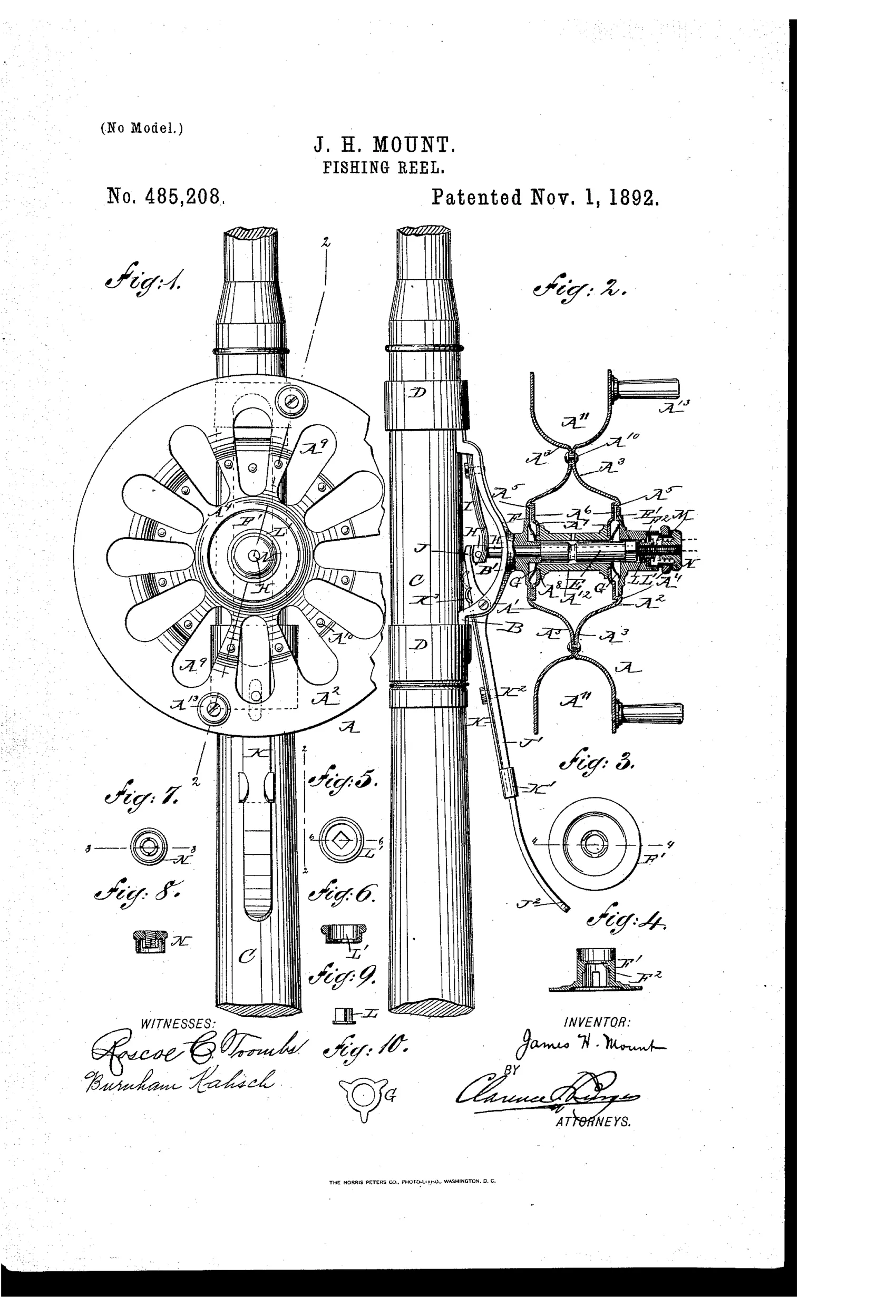
The bobbin is formed from two struck-up sheet-metal plates joined back to back to form a winding groove, and is mounted between two friction plates on a journal projecting from the base plate. A spring-loaded spindle, operated by a lever alongside the rod, pushes the outer friction plate against the bobbin to brake or drag it, while dished spider springs separate the plates when released to leave the bobbin free to run. A flanged nut and coiled spring on the spindle allow the drag to be adjusted or removed entirely by simply squeezing the lever with the hand gripping the rod.
↻ What was claimed
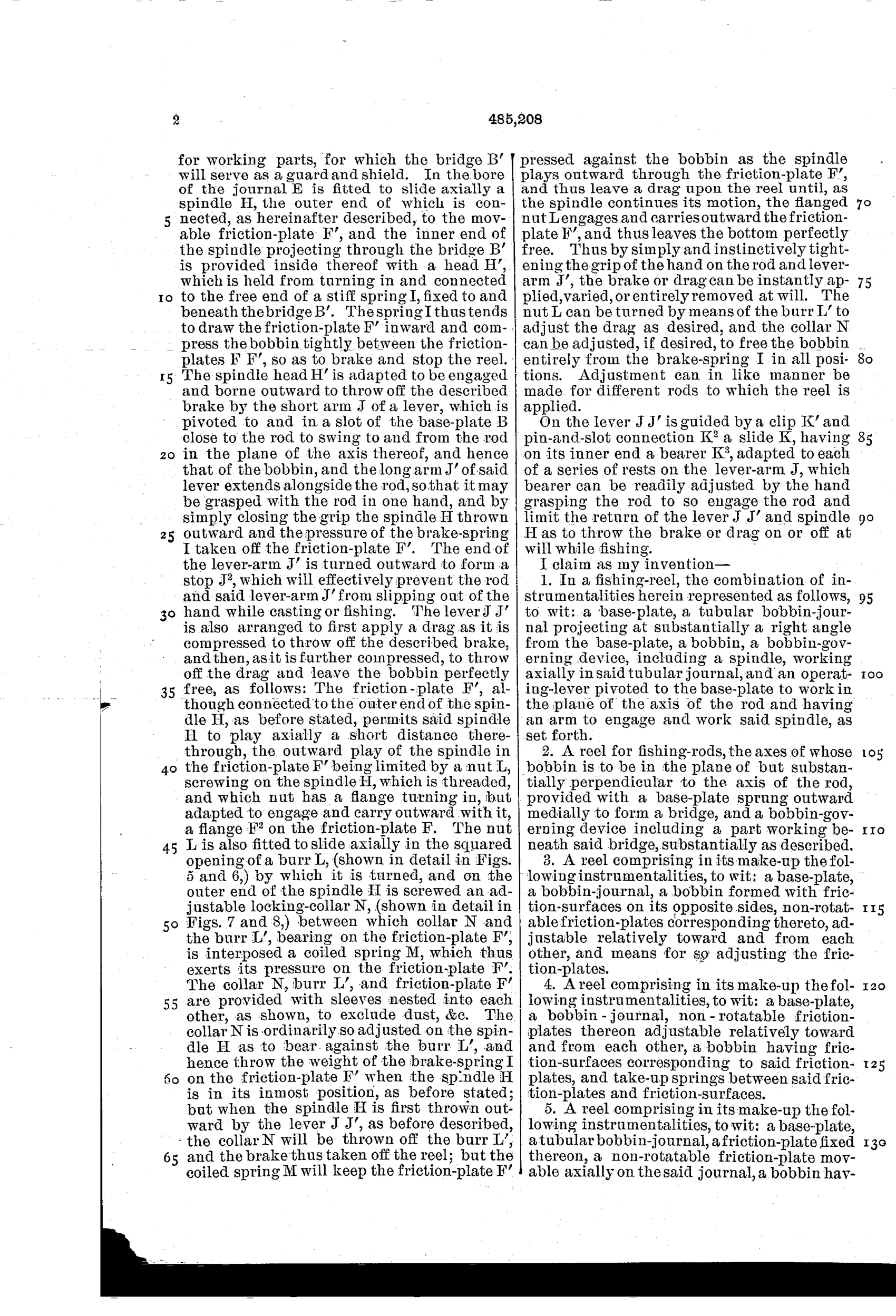
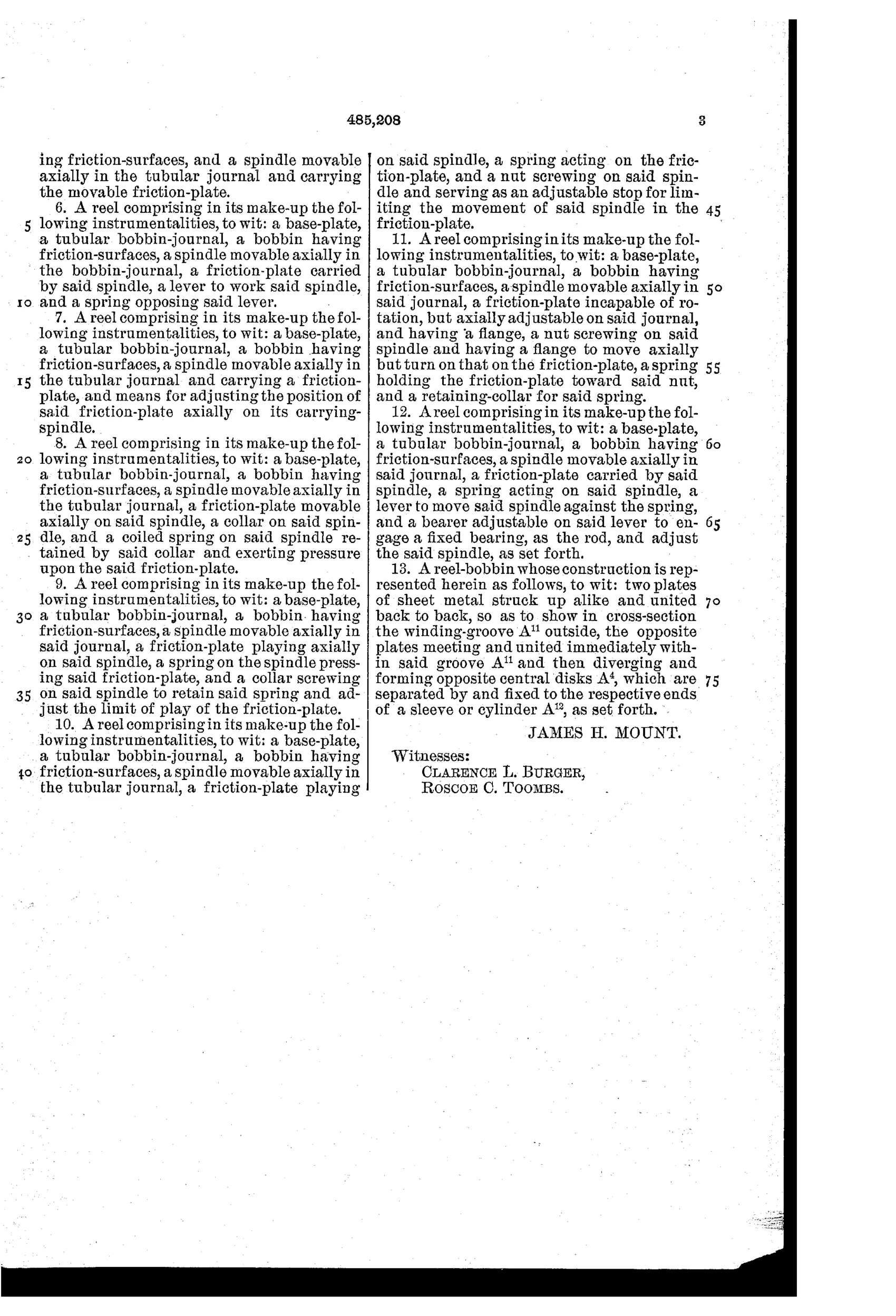
“1. In a fishing-reel, the combination of instrumentalities herein represented as follows, to wit: a base-plate, a tubular bobbin-journal projecting at substantially a right angle from the base-plate, a bobbin, a bobbin-governing device, including a spindle, working axially in said tubular journal, and an operating-lever pivoted to the base-plate to work in the plane of the axis of the rod and having an arm to engage and work said spindle, as set forth.”
In plain English: The reel combines a base plate, a right-angle tubular journal, a bobbin, a spindle-based braking device inside the journal, and a lever pivoted to work in line with the rod to operate the spindle.
↻ In the inventor’s words
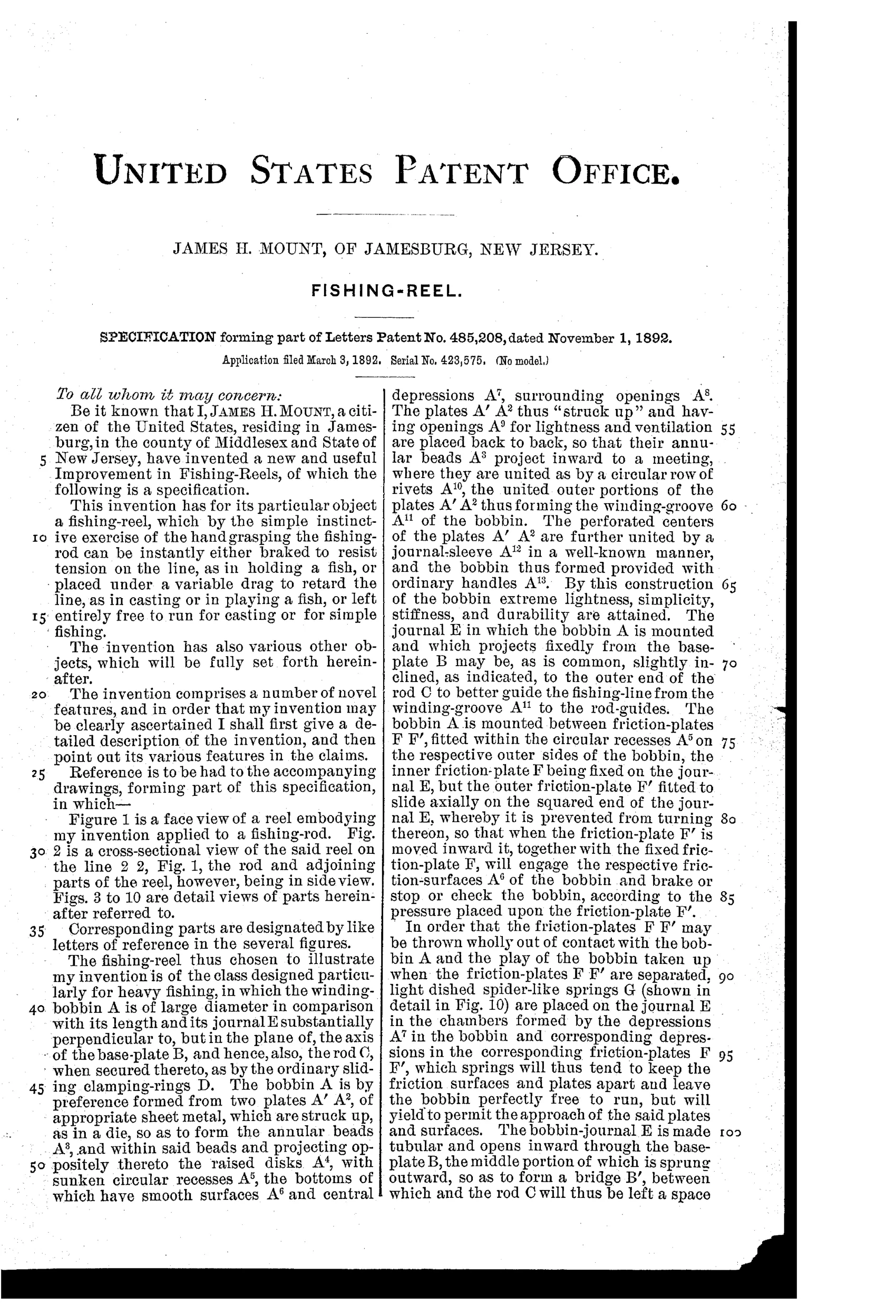
“This invention has for its particular object a fishing-reel, which by the simple instinctive exercise of the hand grasping the fishing-rod can be instantly either braked to resist tension on the line, as in holding a fish, or placed under a variable drag to retard the line, as in casting or in playing a fish, or left entirely free to run for casting or for simple fishing.”— James H. Mount, from the specification
Fate unknown
No manufactured example or maker association is documented; a surviving marked reel or trade-catalog listing would settle it.
↻ Commentary
Mount's idea is genuinely early for what became one of angling's great obsessions: putting drag control literally under the fingers of the hand holding the rod. His reel is a free-running bobbin — two struck-up sheet-metal plates joined back to back to form the line groove — riding between friction plates on a tubular journal. A lever lies along the rod; squeeze it and a spring-loaded spindle inside the journal presses the outer friction plate against the bobbin. Dished spider springs (Fig. 10, that little three-armed washer) push the plates apart the instant you let go, so the spool runs free again. A flanged nut lets you preset how hard the squeeze bites.
Look closely at Fig. 1 and you'll notice what's missing: a crank. This isn't a Kentucky multiplier at all — it's closer to a braked line-holder, the bobbin spun by pulling line or by hand. That puts it outside the mainstream that Meek, Milam, and vom Hofe were refining, and probably explains its obscurity. The concentric-friction-plate drag itself, though, is a legitimate ancestor of the star and lever drags that saltwater reels would standardize decades later.
The instinct — variable, instant, one-handed drag — was exactly right. The vehicle, a crankless bobbin on a right-angle journal, was a dead end. Good idea, wrong reel.
Commentary by Claude, The Fishing Reel Patent Archive’s resident enthusiast