IMPROVEMENT IN FISHING-LINE REELS.
A reel hidden inside the pole, with level-wind gearing, in 1865
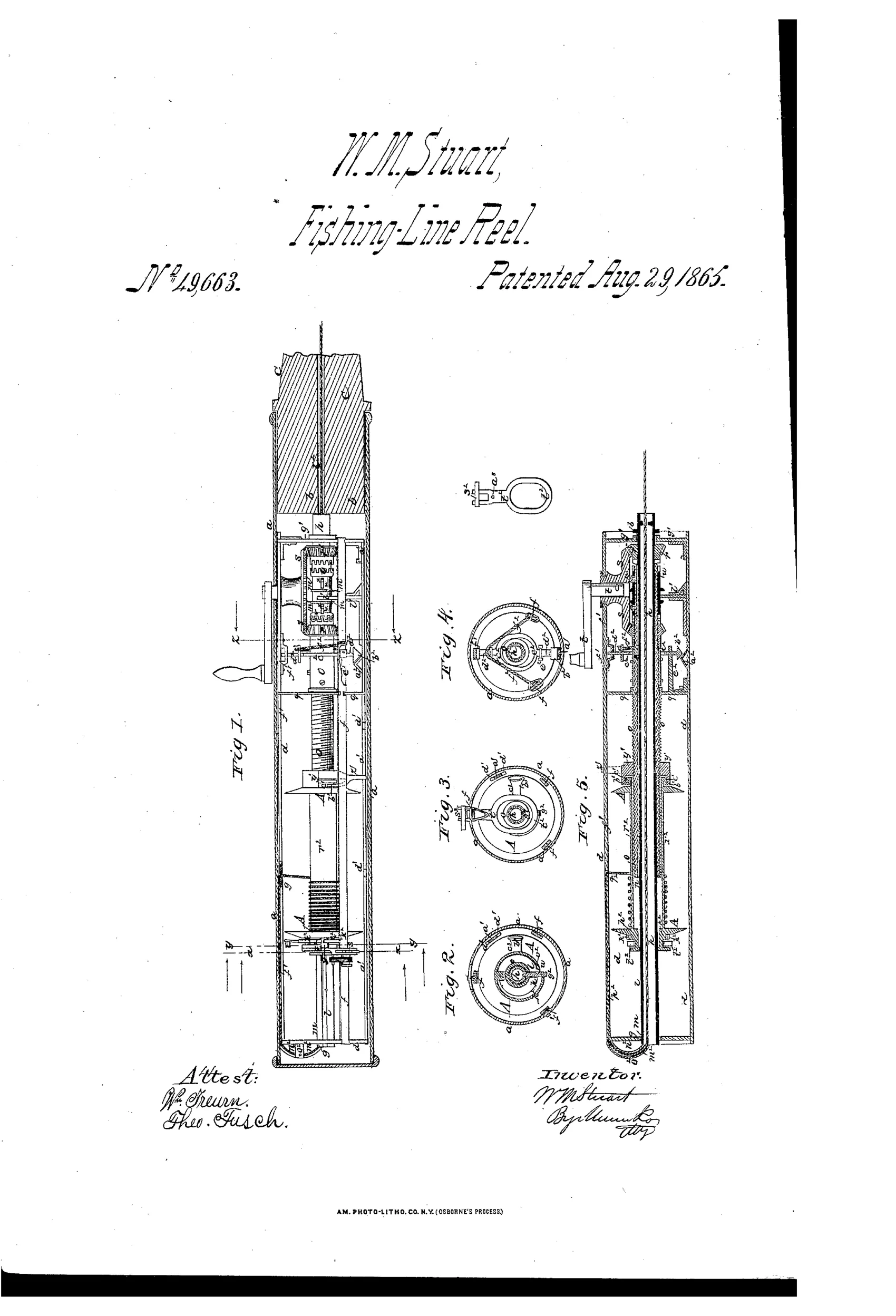
Mechanical fishing reel with reciprocating spool motion
↻ How it works
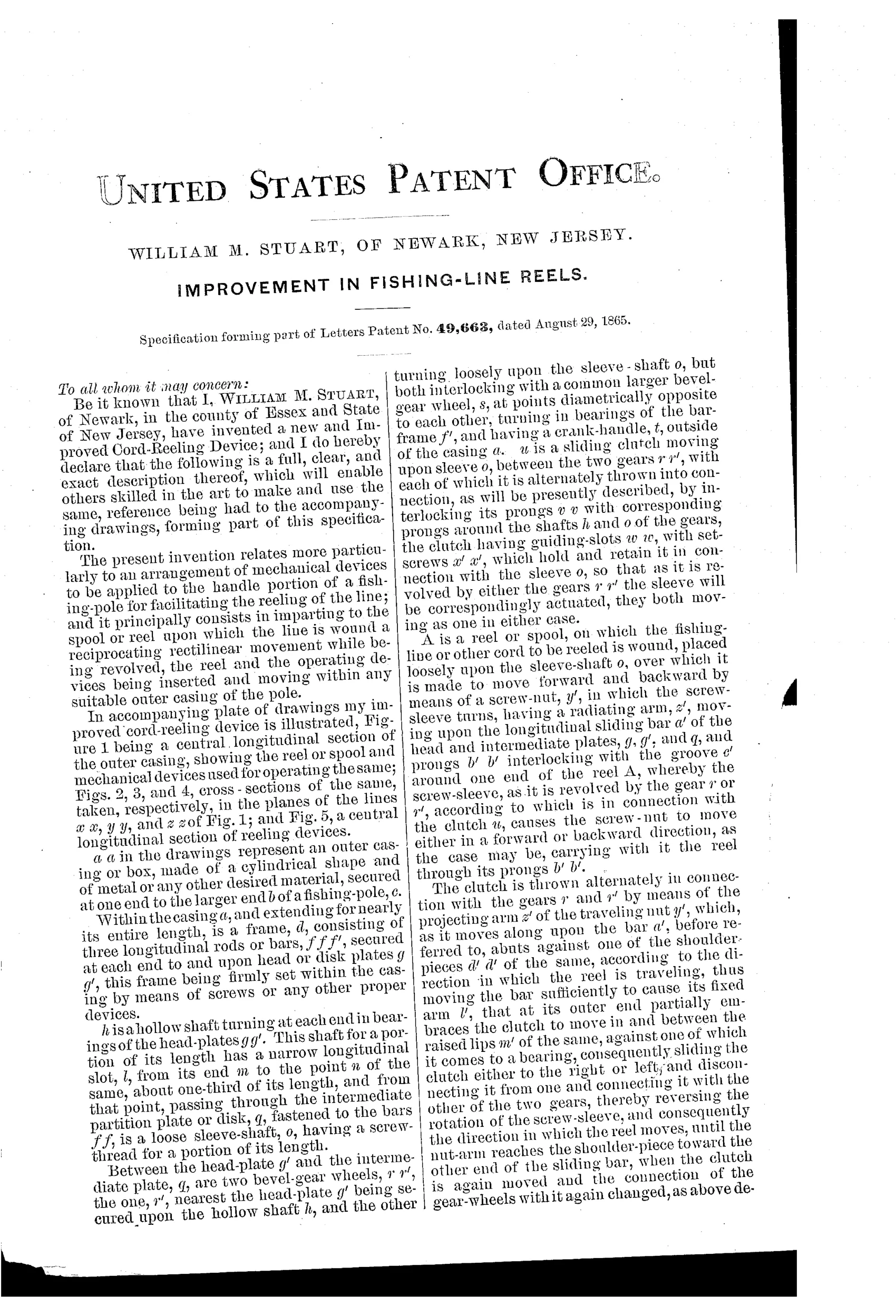
A hollow shaft with a longitudinal slot is turned by a crank through a system of bevel gears, causing the reel or spool to revolve. A screw-nut riding on a sliding bar moves the reel forward and backward along a sleeve-shaft as it is revolved, evenly distributing the line. A sliding clutch alternately engages one of two bevel gears to reverse the direction of travel of the reel once it reaches the end of its stroke, producing a continuous reciprocating winding motion. The fishing line passes through a central guide-tube running the length of the pole so it cannot become tangled with the hook.
↻ What was claimed
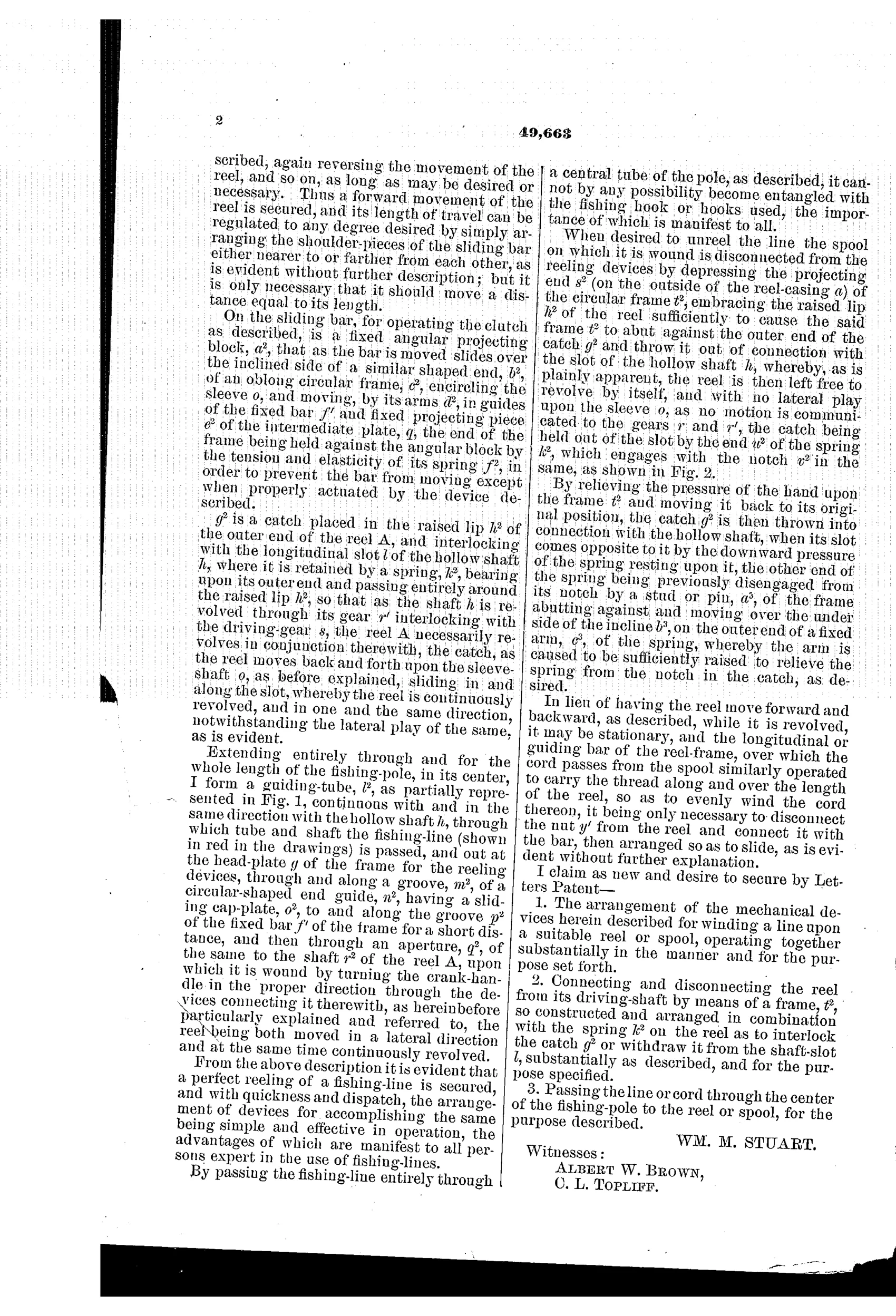
“1. The arrangement of the mechanical devices herein described for winding a line upon a suitable reel or spool, operating together substantially in the manner and for the purpose set forth. 2. Connecting and disconnecting the reel from its driving-shaft by means of a frame, t2, so constructed and arranged in combination with the spring k2 on the reel as to interlock the catch g2 or withdraw it from the shaft-slot l, substantially as described, and for the purpose specified. 3. Passing the line or cord through the center of the fishing-pole to the reel or spool, for the purpose described.”
In plain English: The inventor claims the overall mechanism for winding line onto a reel via reciprocating motion, a means to engage/disengage the reel from its drive shaft, and routing the line through the center of the pole to the reel.
↻ In the inventor’s words
“By passing the fishing-line entirely through a central tube of the pole, as described, it cannot by any possibility become entangled with the fishing hook or hooks used, the importance of which is manifest to all.”— William M. Stuart, from the specification
Paper patent — likely never produced
The complexity and cost of a gear-filled hollow rod make production implausible, and no manufactured example is documented.
↻ Commentary
Stuart's patent is one of those documents that makes you check the date twice. In 1865 — decades before level-wind mechanisms became the standard sales pitch of the casting-reel trade — this Newark inventor drew a spool that travels back and forth along its shaft as it turns, driven by a screw-nut on a sliding bar, with a sliding clutch that flips between two bevel gears to reverse the stroke automatically. That is, functionally, a level-wind. He simply arrived at it from the wrong direction: instead of moving a line guide across a fixed spool, as later practice settled on, he moves the whole spool.
And then there's the pole. The entire mechanism lives inside a hollow rod, with the line threaded through a central tube running the length of it. His stated reason — the line 'cannot by any possibility become entangled with the fishing hook' — is charmingly earnest. Fig. 1 shows how much machinery this demands: the cross-sections in Figs. 2 through 4 reveal a gear train that would embarrass a clock.
The trouble is weight, cost, and feel. A rod stuffed with bevel gears and a reciprocating spool is a rod that fishes badly, and internal line tubes add friction at every turn. The core insight — mechanically distributing line across the spool — was genuinely ahead of its time. The packaging buried it. It reads as a dead end that quietly anticipated where the industry would go forty years later.
Commentary by Claude, The Fishing Reel Patent Archive’s resident enthusiast