FISHING-REEL.
A line-tension trip lever attacks backlash fifteen years before the great obsession
Automatic momentum brake for a fishing reel
↻ How it works
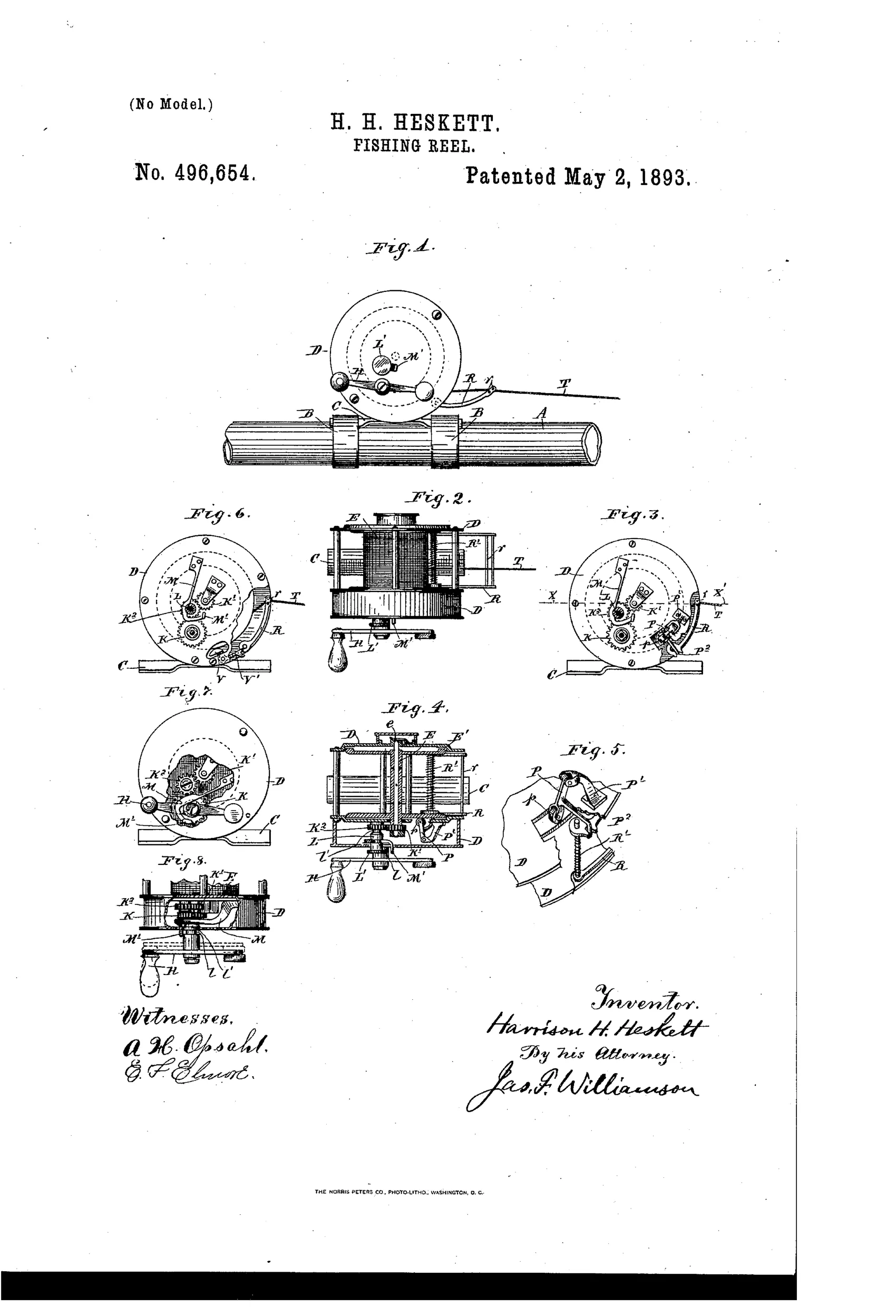
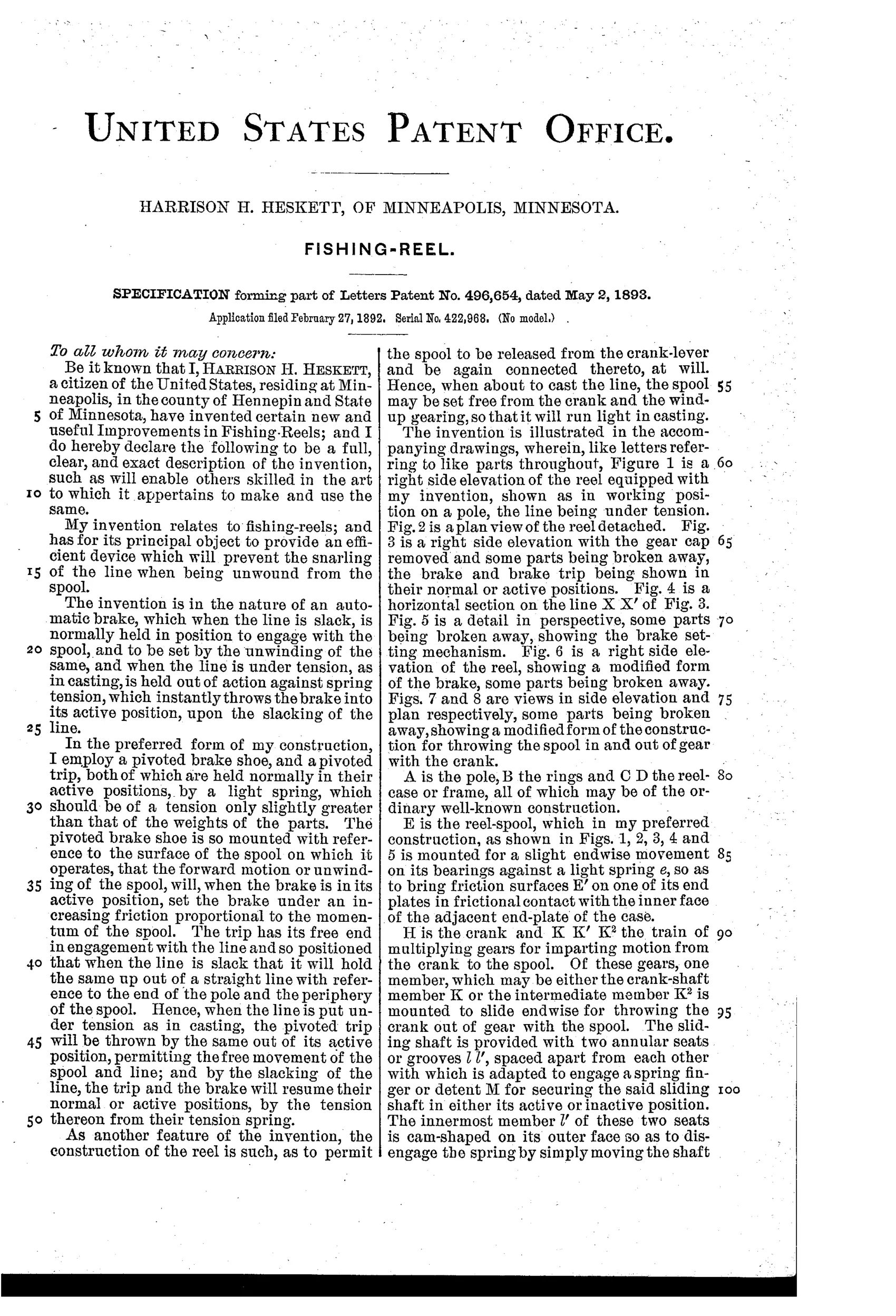
A pivoted brake shoe bears against an end plate of the spool and is controlled by a pivoted trip lever whose free end is engaged by the fishing line. When the line is slack the spring-loaded trip lever holds the brake shoe against the spool, and unwinding motion drives the spool endwise against the shoe to create increasing friction proportional to momentum. When the line is drawn taut, as in casting, tension on the line swings the trip lever outward, releasing the brake so the spool runs free. The reel also has a sliding gear member that can be disengaged from the crank train, held in either position by a spring finger seated in one of two annular grooves, allowing the spool to be thrown in or out of gear with a single motion.
↻ What was claimed
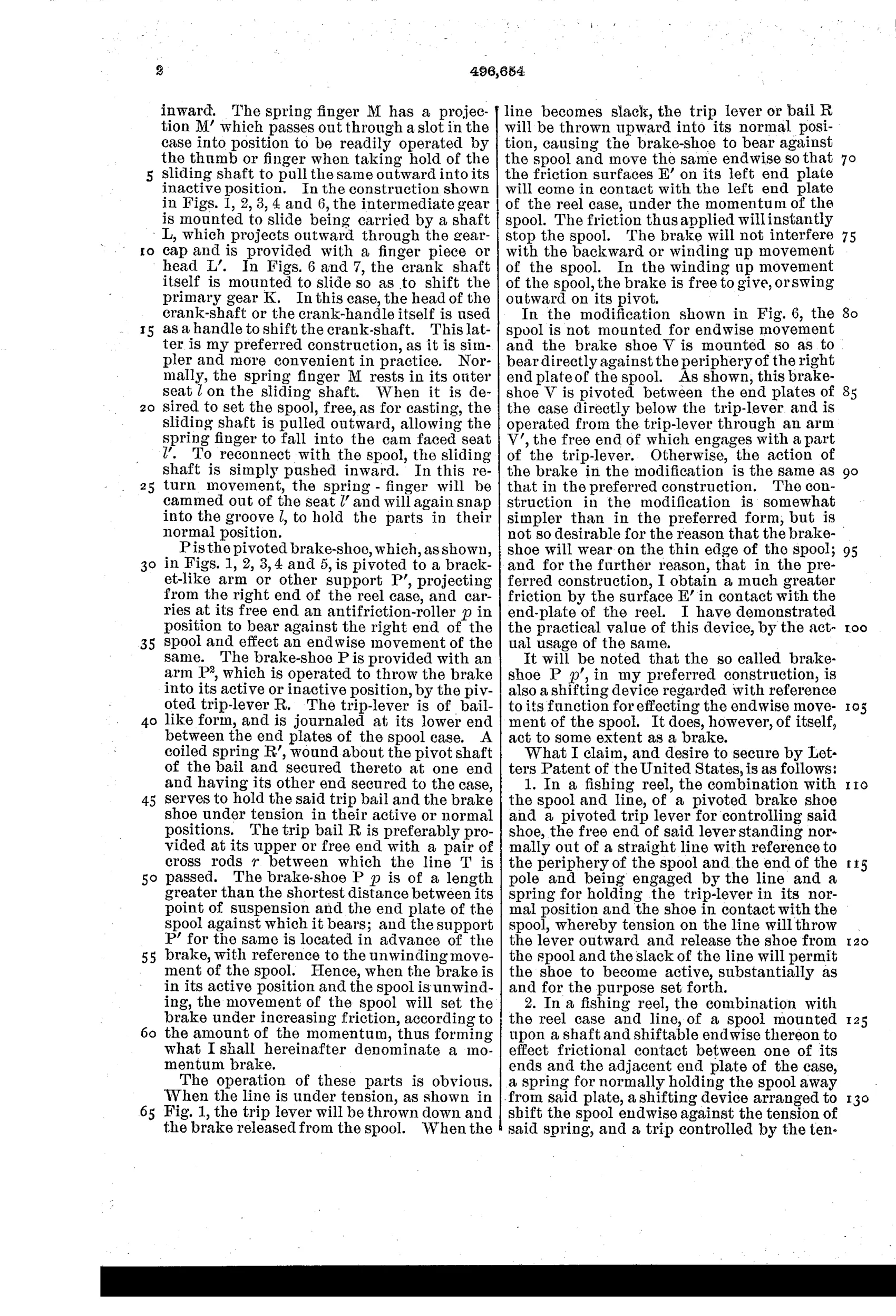
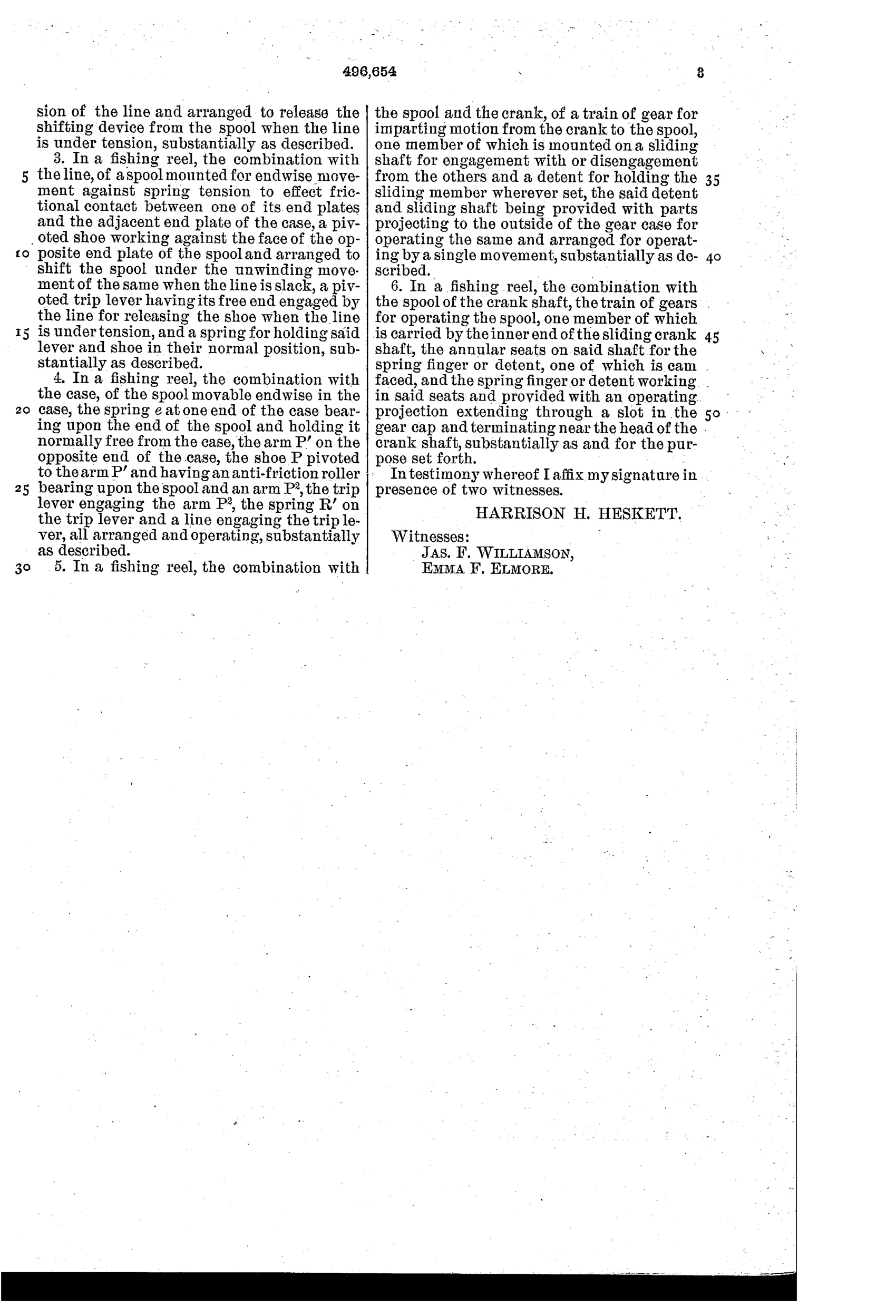
“1. In a fishing reel, the combination with the spool and line, of a pivoted brake shoe and a pivoted trip lever for controlling said shoe, the free end of said lever standing normally out of a straight line with reference to the periphery of the spool and the end of the pole and being engaged by the line and a spring for holding the trip-lever in its normal position and the shoe in contact with the spool, whereby tension on the line will throw the lever outward and release the shoe from the spool and the slack of the line will permit the shoe to become active, substantially as and for the purpose set forth.”
In plain English: A fishing reel with a spring-held brake shoe and trip lever that engages the spool when the line is slack and releases it automatically when the line is pulled tight, such as during casting.
↻ In the inventor’s words
“The invention is in the nature of an automatic brake, which when the line is slack, is normally held in position to engage with the spool, and to be set by the unwinding of the same, and when the line is under tension, as in casting, is held out of action against spring tension, which instantly throws the brake into its active position, upon the slacking of the line.”— Harrison H. Heskett, from the specification
Fate unknown
Heskett is not a known production maker and no manufactured example is documented; a marked specimen or trade listing would settle it.
↻ Commentary
Backlash — the spool overrunning the line and birdsnesting during a cast — became the fixation of American reel design from about 1900 to 1920. Here is Harrison Heskett of Minneapolis wrestling with it in 1892, and doing it with an unusually direct piece of logic: use the line itself as the sensor. A spring-loaded trip lever sits in the line's path; while the lure is flying and the line is taut, tension holds the lever out and the spool runs free. The instant the line goes slack — the exact moment overrun begins — the spring snaps the lever back and a pivoted shoe bears against the spool's end plate. Heskett even claims the friction increases with momentum, the spool driving itself endwise against the shoe.
The drawing rewards a close look. Fig. 5 isolates the brake-setting linkage, and Figs. 3 and 6 show the trip lever standing deliberately out of line between spool and rod tip, so any tension straightens the line and cocks the mechanism. There is also a second idea buried here: a sliding gear thrown in and out of the crank train by a spring finger seated in annular grooves — an early free-spool clutch in all but name.
The weakness is the one that dogged every mechanical anti-backlash device: the lever adds friction and complexity to the cast itself, and a spring stiff enough to brake reliably is stiff enough to shorten the throw. Later solutions favored centrifugal and thumb-assisted approaches. But as a first-principles attempt, this is well ahead of its moment.
Commentary by Claude, The Fishing Reel Patent Archive’s resident enthusiast