FISHING-REEL.
Remote-control drag: a cord along the rod lets the far hand brake tarpon
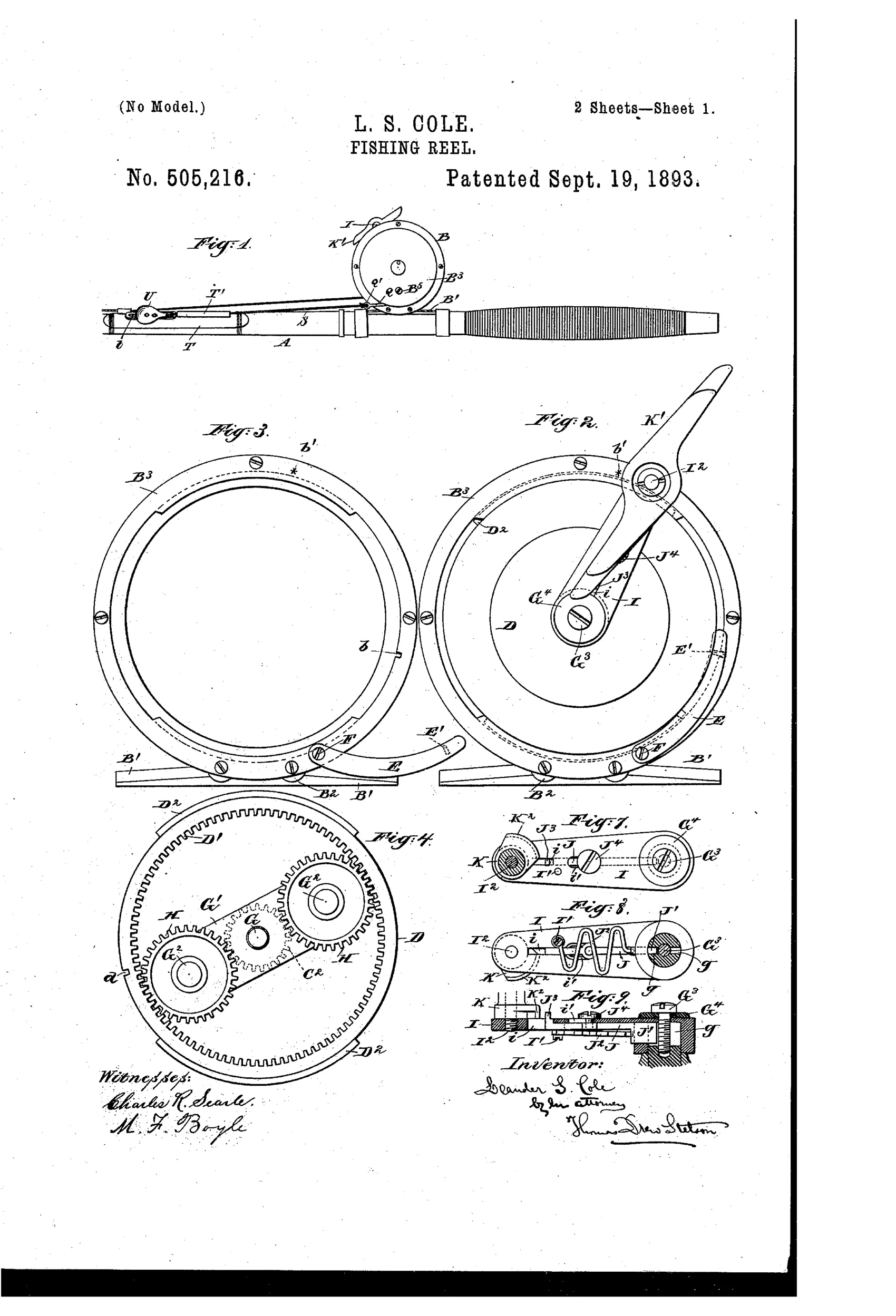
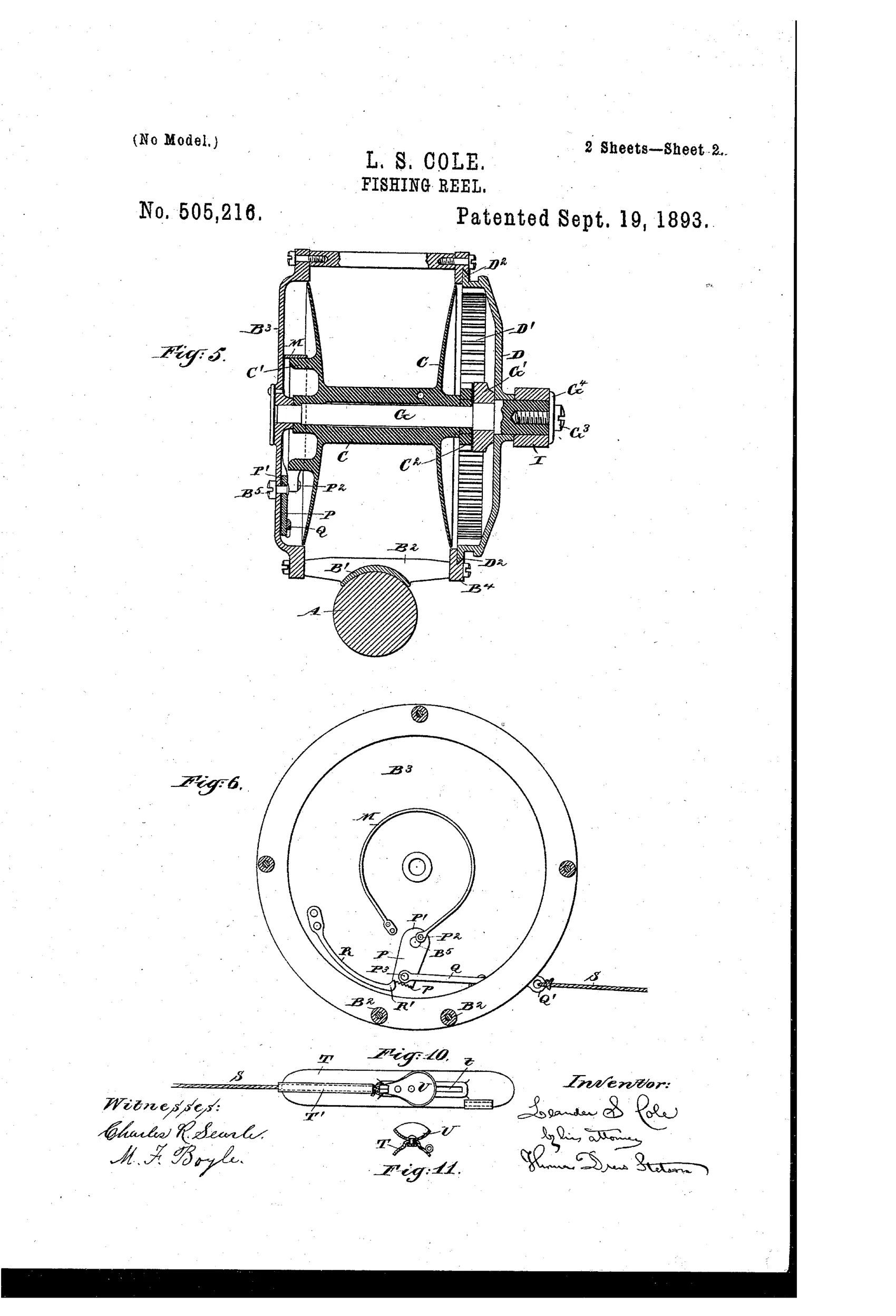
Large-game fishing reel with pole-mounted thumb brake.
↻ How it works
The reel's casing has a removable head secured by partial screw-threads and a spring-dog, allowing the entire spool to be inserted or removed axially through a large side aperture. A slender central shaft carries a cross-bar with planet gears that mesh with a fixed internal gear and the spool's pinion, multiplying crank motion into rapid spool rotation. A sliding dog on the crank, controlled by a rotating sleeve and lip segment, lets the crank be instantly engaged with or disengaged from the shaft. A brake band encircling a drum on the spool is tightened or released by a lever and link connected via a cord running along the pole to a thumb-piece, so the angler's free hand can apply variable drag or braking force, or let the same mechanism act automatically as a gentle drag.
↻ What was claimed
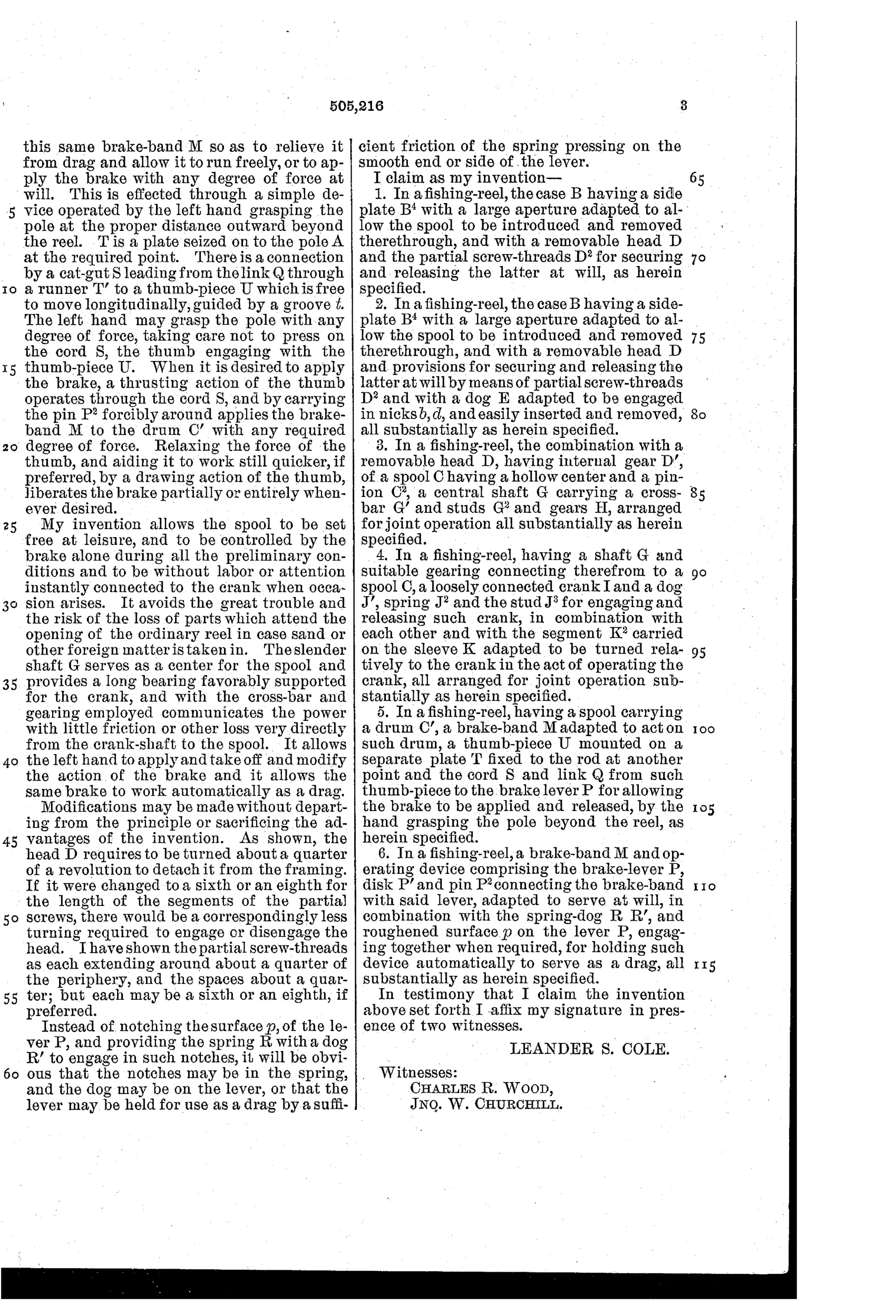
“In a fishing-reel, having a spool carrying a drum C', a brake-band M adapted to act on such drum, a thumb-piece U mounted on a separate plate T fixed to the rod at another point and the cord S and link Q from such thumb-piece to the brake lever P for allowing the brake to be applied and released, by the hand grasping the pole beyond the reel, as herein specified.”
In plain English: A fishing reel whose spool-mounted brake drum is squeezed by a band connected through a cord running along the rod to a separate thumb-piece, letting the angler's other hand apply or release the brake from a point beyond the reel.
↻ In the inventor’s words
“My improved reel is intended more particularly for tarpon and other fish which are not only gamy but of large size and require that the pole shall be grasped by one hand at a point considerably beyond the reel.”— Leander S. Cole, from the specification
Paper patent — likely never produced
No manufactured Cole reel is documented, and the rod-mounted cord-and-thumb-piece arrangement is fragile enough that production seems unlikely; a marked example would overturn this.
↻ Commentary
Cole's problem statement is unusually specific and worth quoting: tarpon and other large fish force the angler to grip the rod well beyond the reel, leaving no hand free to thumb the spool. His answer is to relocate the brake control. A band encircles a drum on the spool; a lever and link pull that band via a cord running along the rod to a thumb-piece mounted on its own plate farther up the grip. Squeeze the thumb-piece and you apply variable drag from exactly where your hand already is. In 1893, decades before star drags and lever drags matured on big-game reels, that is a genuinely forward-looking idea — the lever-drag reel's ancestor, executed with a string.
The rest of the reel is over-engineered in an endearing watchmaker's way. Fig. 4 shows planetary gearing: planet gears on a cross-bar mesh with a fixed internal ring gear and the spool pinion, giving multiplication on a compact central shaft. Figs. 7-9 detail a sliding dog in the crank that engages or frees the handle instantly — free-spool, in effect. And the whole head unscrews on partial threads with a spring-dog so the spool drops out axially for cleaning.
The weak point is the cord itself: exposed, stretch-prone, and dependent on a separate plate lashed to the rod. Later big-game makers put the drag control on the reel for good reason. But as a diagnosis of the problem, Cole was ahead of the field.
Commentary by Claude, The Fishing Reel Patent Archive’s resident enthusiast