AUTOMATIC REEL-GUIDE.
A single spool-tooth drives a swinging arm level-wind, years before Marhoff's worm gear
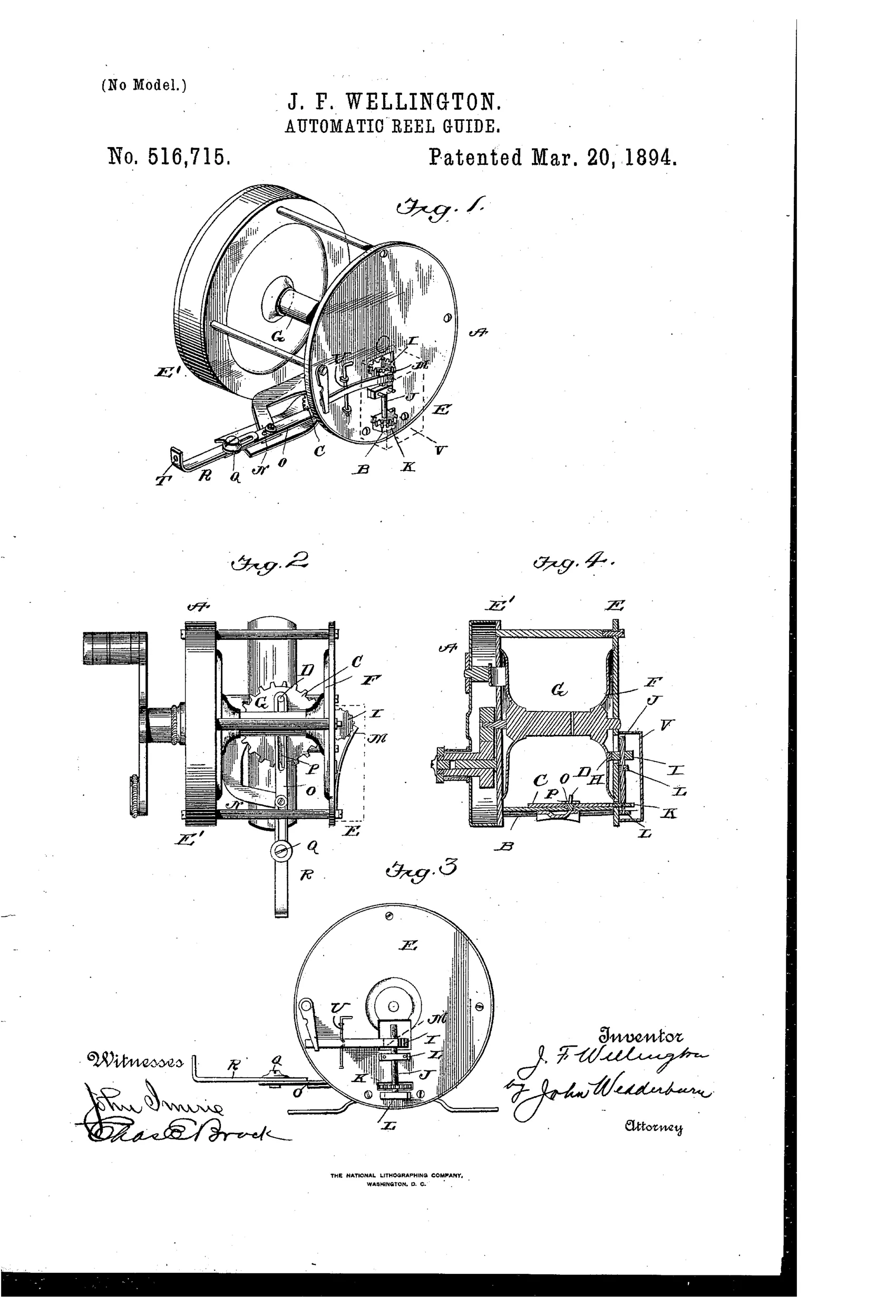
Automatic level-wind guide for fishing reels.
↻ How it works
A cog wheel fixed to the reel's cross brace engages a tooth on the spool flange as the spool revolves. This motion turns a shaft with gear wheels, which oscillates a pivoted lever and adjustable arm carrying the line. The oscillation guides the line back and forth so it winds evenly across the spool. A spring-pressed block prevents the shaft from over-rotating by inertia, and an eccentric lever can lift the block to disengage the mechanism when desired.
↻ What was claimed
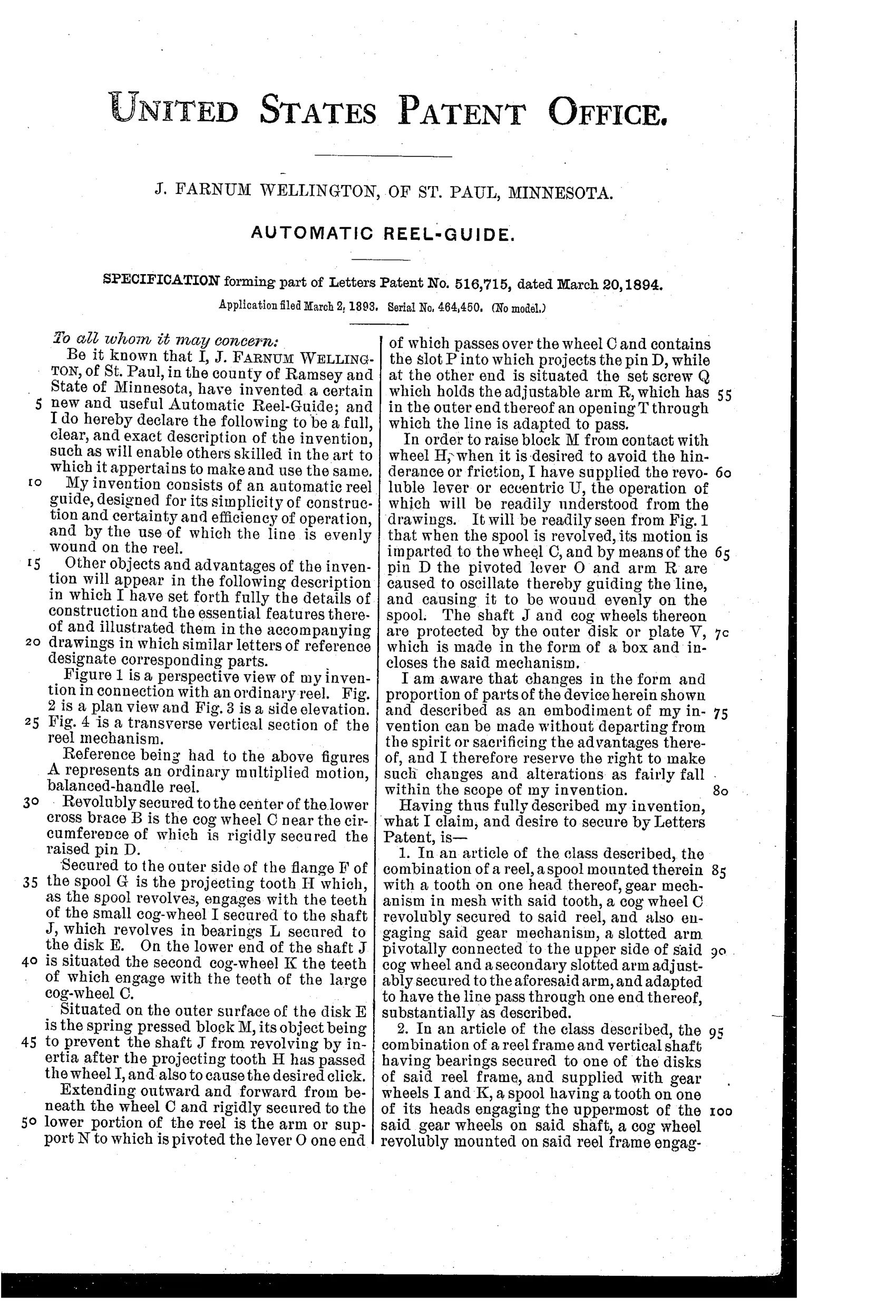
“In an article of the class described, the combination of a reel, a spool mounted therein with a tooth on one head thereof, gear mechanism in mesh with said tooth, a cog wheel C revolubly secured to said reel, and also engaging said gear mechanism, a slotted arm pivotally connected to the upper side of said cog wheel and a secondary slotted arm adjustably secured to the aforesaid arm, and adapted to have the line pass through one end thereof, substantially as described.”
In plain English: The reel's spool has a tooth that drives gears connected to a cog wheel, which moves a pivoting arm with an adjustable secondary arm that guides the fishing line through an opening as it winds.
↻ In the inventor’s words
“My invention consists of an automatic reel guide, designed for its simplicity of construction and certainty and efficiency of operation, and by the use of which the line is evenly wound on the reel.”— J. Farnum Wellington, from the specification
Paper patent — likely never produced
No manufactured example or maker connection is known, and the intermittent gear drive and arc-swept guide made it a poor rival to worm-gear designs; a marked specimen would force a rethink.
↻ Commentary
The level-wind problem — laying line evenly across the spool so it doesn't bunch and bind — was mostly solved after 1900 by the worm-gear carriage that Shakespeare and the Marhoff patent made standard. Wellington got at it in 1893 from a different direction entirely: instead of a continuously traversing carriage, he uses an oscillating arm. A single tooth on the spool flange ticks a gear train once per revolution, and that train rocks a pivoted, slotted arm back and forth across the spool face, with the line threaded through an adjustable secondary arm riding on it.
The drawing rewards a close look. Fig. 4's section shows how much gearing is packed against the tail plate — cog wheel, shaft, and the spring-pressed block Wellington added to keep the shaft from coasting past its mark on a fast retrieve. That block is the tell of an inventor who actually thought about inertia, not just kinematics. The eccentric lever to disengage the whole works for casting is another practical touch; a fixed guide arm would have murdered casting distance.
Still, the swinging-arm approach has a built-in flaw: an arc lays line unevenly at the ends of its sweep compared to a straight-line traverse, and the intermittent single-tooth drive means jerky indexing. History chose the worm gear for good reasons. This is an honest, thoughtful dead end — an early Midwestern entry in a race the big Eastern and Michigan makers would finish.
Commentary by Claude, The Fishing Reel Patent Archive’s resident enthusiast