FISHING-REEL.
One milled cam dials the reel through casting, fishing, and winding modes
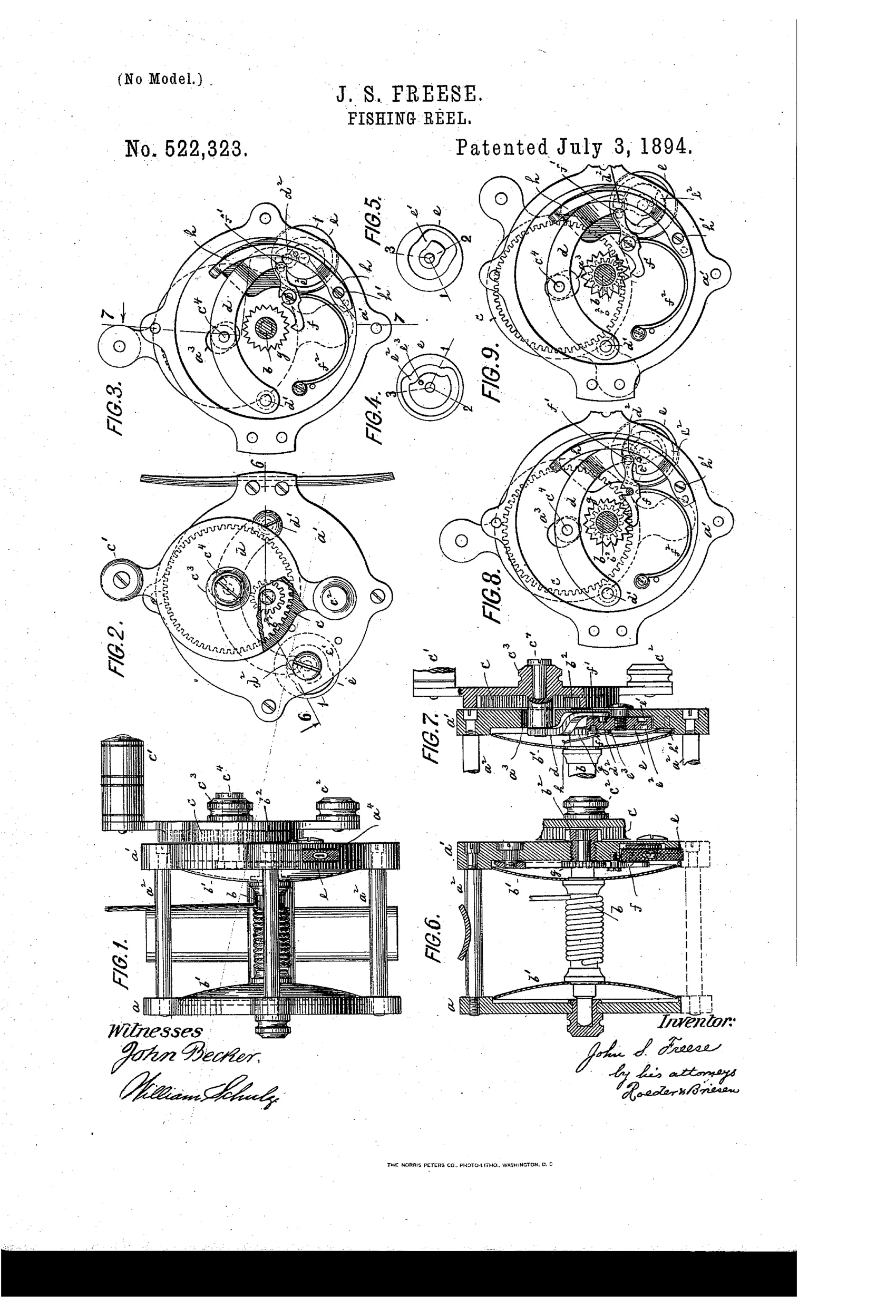

Fishing reel with switchable casting/fishing/winding mechanism
↻ How it works
A revolving cam with a milled edge exposed through a slot in the head engages a pivoted lever, which shifts an internally geared wheel into or out of engagement with a cog wheel on the reel shaft. The same cam operates a spring-loaded click that engages or disengages a ratchet wheel on the shaft, and a drag or spring brake that bears against a disk on the shaft. By revolving the cam to one of three marked positions (1, 2, 3), the angler sets the reel for casting (click off, drag on), fishing (click on, drag off), or winding up (click and drag both off, gear wheel engaged with cog wheel via lever).
↻ What was claimed
“The combination in a fishing reel of a shaft with a cog wheel mounted thereon, a lever, a revolving cam engaging the same, an internally geared wheel secured to the lever, and a handle secured to the internally geared wheel, substantially as specified.”
In plain English: The reel combines a shaft with a cog wheel, a lever moved by a rotating cam, a geared wheel attached to the lever, and a crank handle attached to that geared wheel.
↻ In the inventor’s words
“My improved reel will be found to be very convenient in use, as it can be accurately set to its various functions.”— John S. Freese, from the specification
Fate unknown
No production example of this three-position cam reel is documented to my knowledge; a marked specimen or trade-catalog listing would settle it.
↻ Commentary
Most reels of 1894 made the angler fumble with separate sliding buttons — one for the click, one for the drag, sometimes a third for free-spool. Freese's idea was to consolidate all of it into a single revolving cam, its milled edge peeking through a slot in the head plate, with three marked positions. Turn to 1 and you get drag on, click off, for casting; turn to 2 for click on, drag off, for still fishing; turn to 3 and a pivoted lever swings an internally geared wheel into mesh with the shaft's cog so you can wind. It is, in effect, a mode selector — a genuinely modern control philosophy on a Brooklyn reel of the 1890s.
The internally geared wheel is the clever part and the risky part. Figures 3, 8, and 9 show the same head in the three states, and you can trace how one cam edge simultaneously governs the spring click, the friction brake on the shaft disk, and the gear engagement. That's elegant on paper. In practice, a gear that swings in and out of mesh on a lever must engage cleanly under load every time, and any wear at the pivot means chattering teeth.
Brooklyn was vom Hofe territory, and Freese's disengaging-gear thinking points toward the free-spool feature that later casting reels made standard. This patent reads like an early, ambitious stab at that convenience — probably too fiddly to build cheaply, but aimed exactly where the trade was headed.
Commentary by Claude, The Fishing Reel Patent Archive’s resident enthusiast