EXTENSION-CRANK.
A telescoping bicycle crank that wandered into the fishing tackle files — and a lesson in cranks
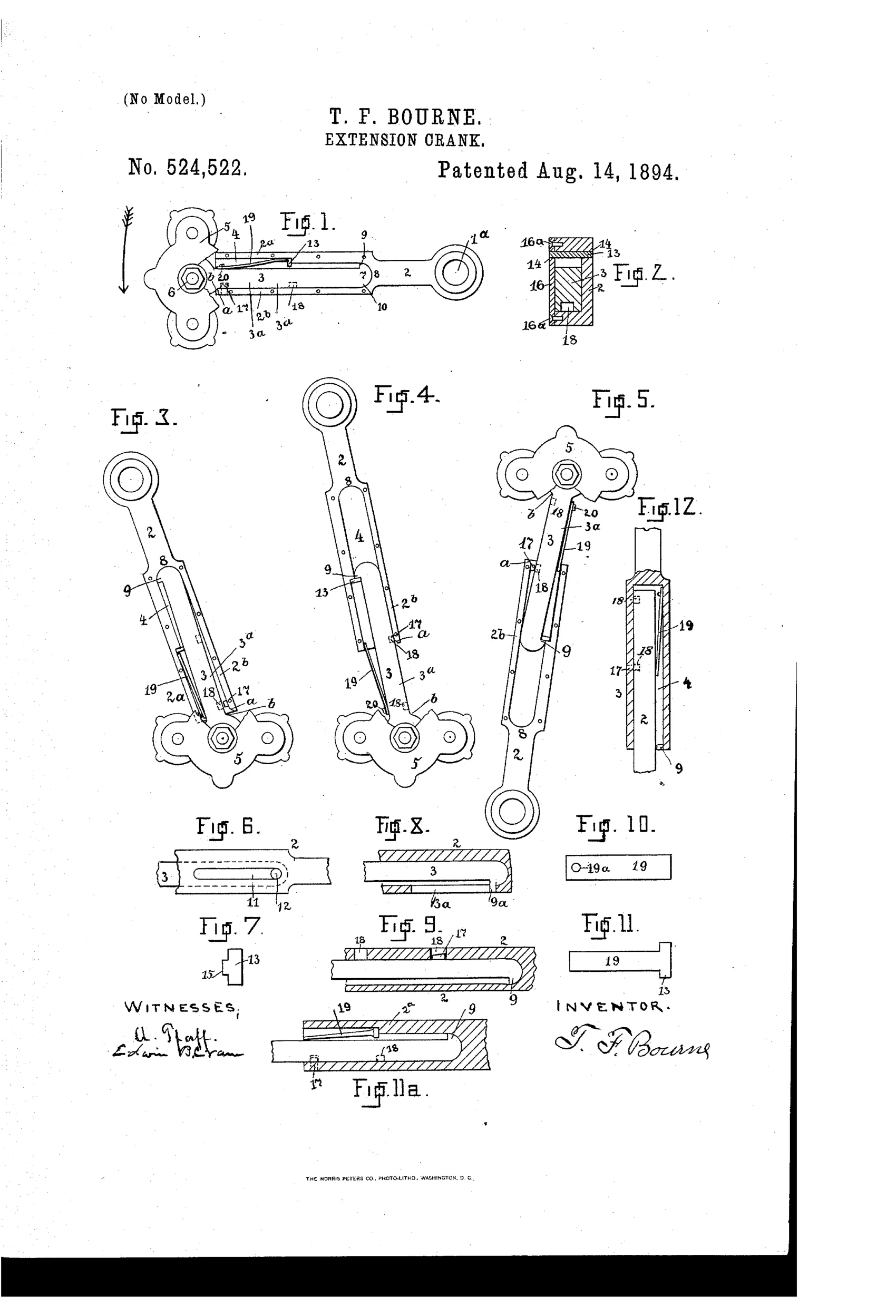
Extensible bicycle crank with locking pin mechanism
↻ How it works
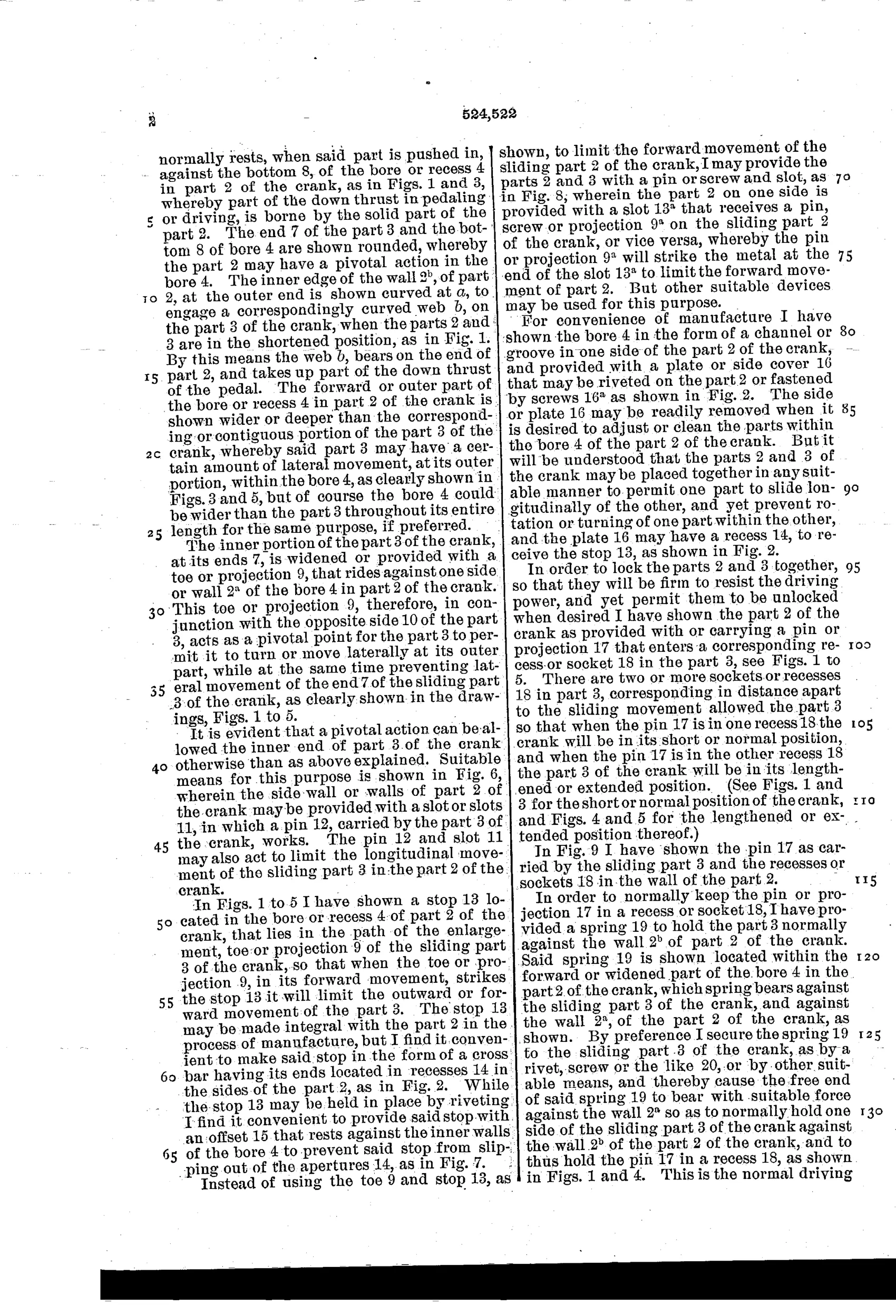
The crank is made in two telescoping parts, part 3 sliding longitudinally within a bore in part 2. A spring-loaded pin or projection engages one of two recesses in the sliding part to lock the crank at either a normal short length or an extended length. Applying extra downward pedal pressure at the proper angle tilts the sliding part sideways within the bore, releasing the pin from its socket so the crank can slide to the other locked position. A rectangular cross-section between the parts prevents rotation of one part within the other under torsional pedaling strain.
↻ What was claimed
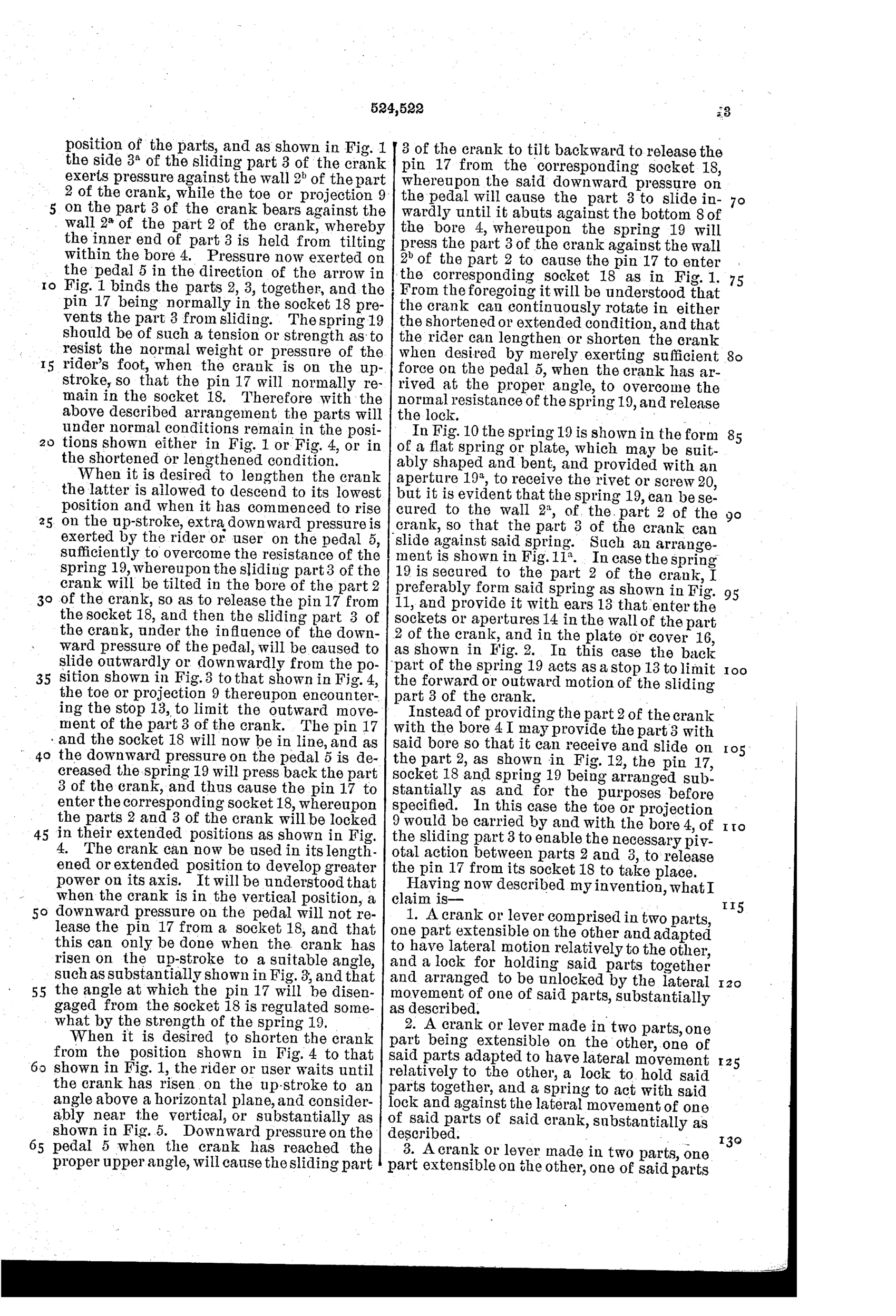
“A crank or lever comprised in two parts, one part extensible on the other and adapted to have lateral motion relatively to the other, and a lock for holding said parts together and arranged to be unlocked by the lateral movement of one of said parts, substantially as described.”
In plain English: A two-part telescoping crank where one part can shift sideways slightly to release a lock, allowing it to slide and change length.
↻ In the inventor’s words
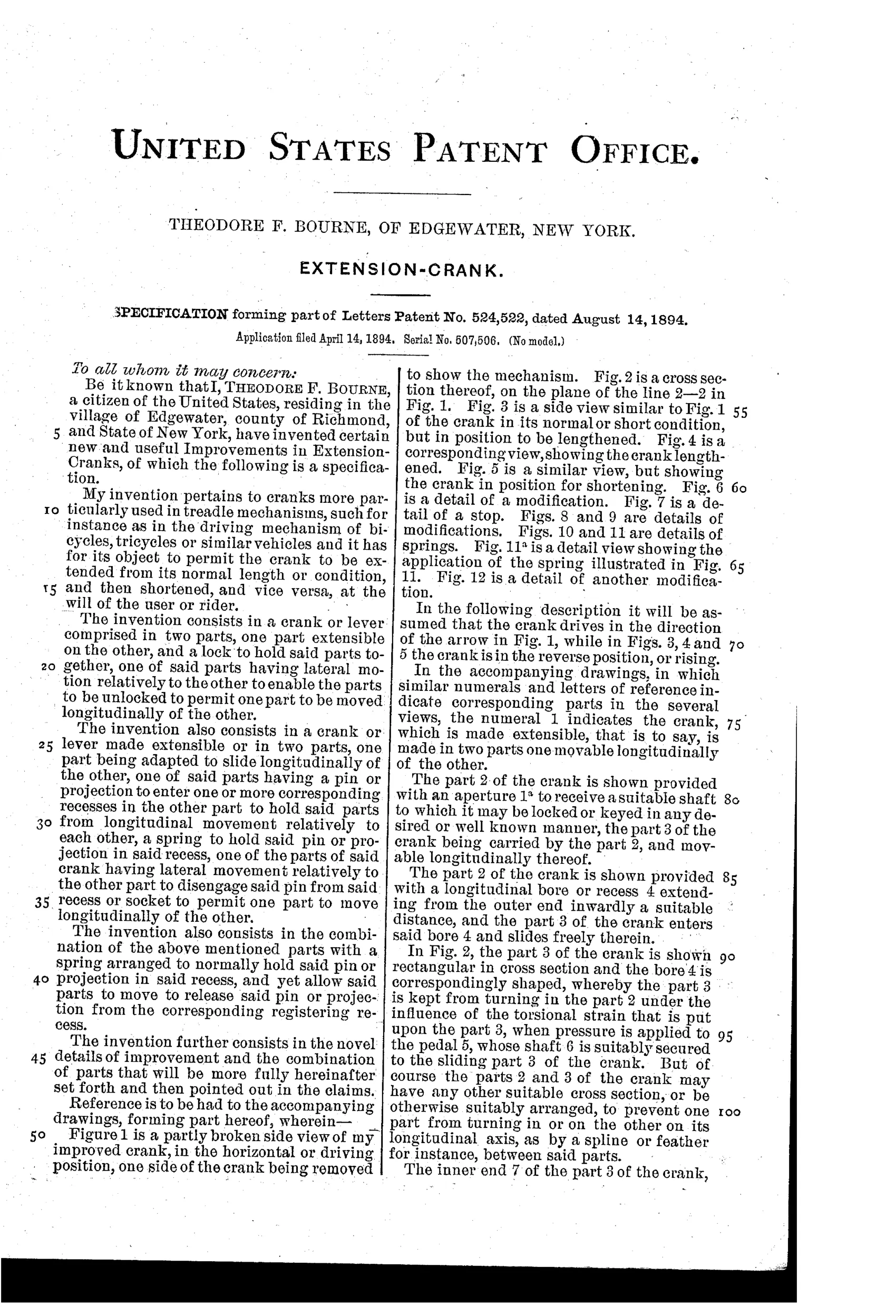
“My invention pertains to cranks more particularly used in treadle mechanisms, such for instance as in the driving mechanism of bicycles, tricycles or similar vehicles and it has for its object to permit the crank to be extended from its normal length or condition, and then shortened, and vice versa, at the will of the user or rider.”— Theodore F. Bourne, from the specification
Fate unknown
No manufactured example or licensee is documented; a surviving marked crank or trade-catalog listing would settle it.
↻ Commentary
Let's be honest up front: this is not a fishing reel. Theodore Bourne of Edgewater filed an extension crank for bicycles and treadle machines, and it lands in our archive only because a crank is a crank and patent classification of the 1890s was a loose net. Still, anyone who has turned a reel handle should find the mechanism worth two minutes.
The idea is a crank in two telescoping parts, locked at either of two lengths by a spring-loaded pin dropping into a recess. The clever bit — and the whole first claim — is the release. You don't fumble with a screw or a button. You lean on the pedal at the right point in the stroke, the sliding member tilts sideways in its bore, the pin pops free, and the crank slides to its other locked length. Figs. 3 through 5 walk you through the sequence. The rectangular cross-section shown in Fig. 2 keeps pedaling torque from twisting the two halves apart, which is the detail a casual reader misses and the one that makes the thing plausible at all.
Whether a rider wants a lock that releases under hard pedal pressure is another question — the exact force that climbs a hill is the force that unlocks the crank. Adjustable-length cranks were a genuine 1890s bicycle obsession, and most, like this one, left no trace beyond the drawings. For reel readers, it's a neighborly reminder: the crank arm was contested territory everywhere in that decade.
Commentary by Claude, The Fishing Reel Patent Archive’s resident enthusiast