FISHING-REEL.
A centrifugal clutch turns a watch spring into push-button line retrieval, 1895
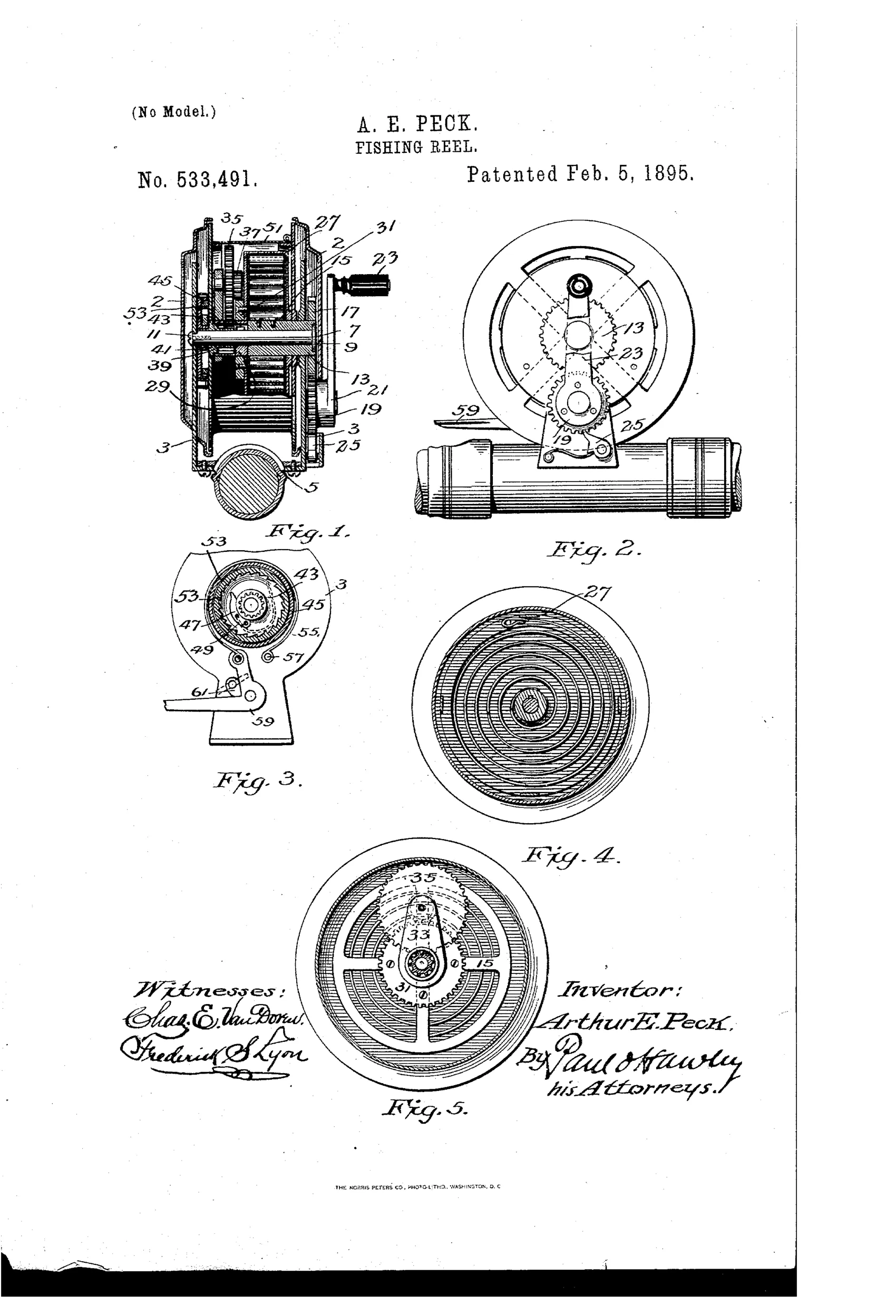
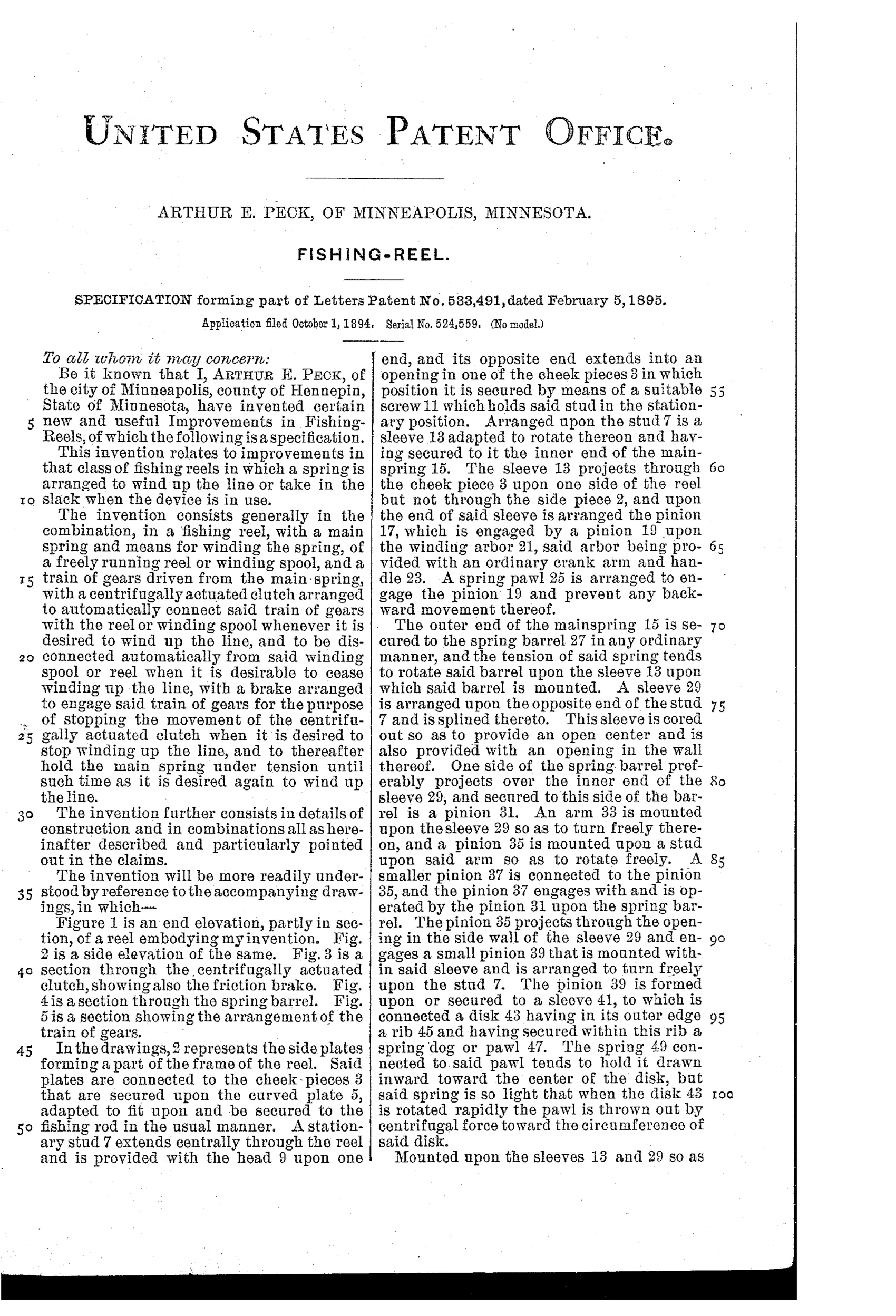
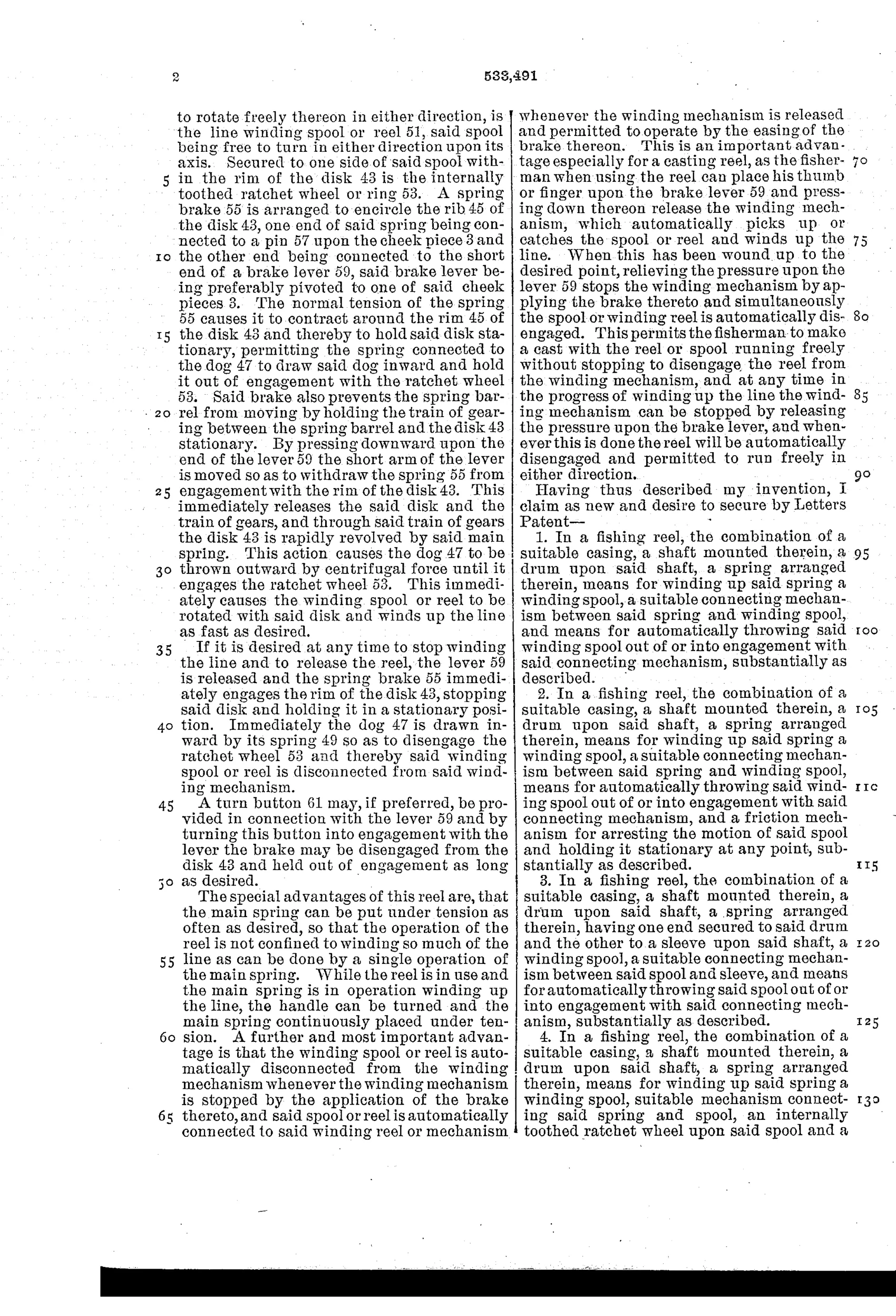
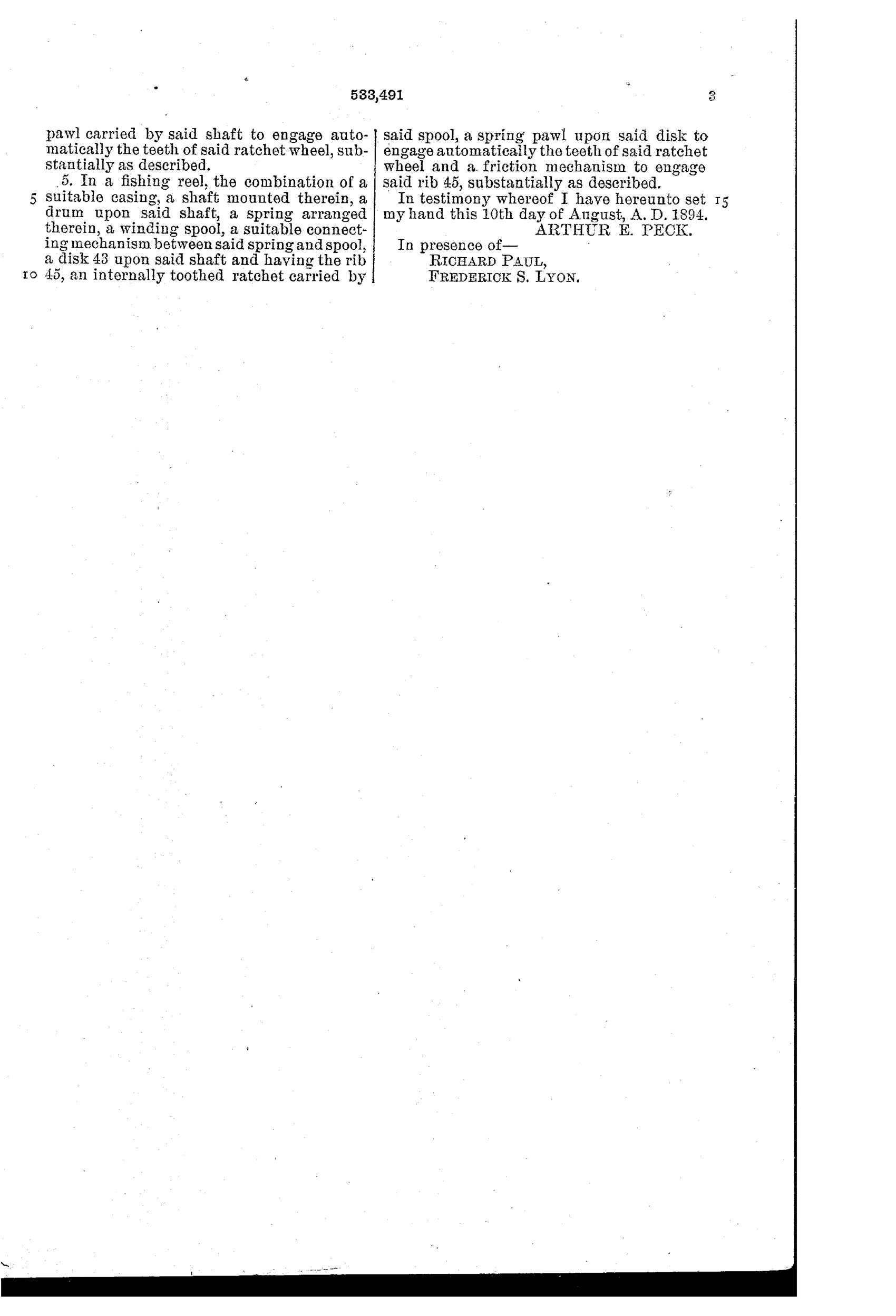
Spring-driven, centrifugal clutch-engaged automatic fishing line winder
↻ How it works
A mainspring housed in a spring barrel drives a train of gears mounted on a stationary central stud within the reel casing. A disk fitted with a spring-loaded pawl spins with this gear train, and centrifugal force throws the pawl outward to engage an internally toothed ratchet wheel fixed to the winding spool, coupling the spool to the spring drive. A spring brake normally clamps a rib on the disk to hold it stationary and keep the pawl retracted; pressing a pivoted lever withdraws the brake, releasing the disk so it spins and the pawl engages the ratchet to wind the spool. Releasing the lever reapplies the brake, instantly stopping the disk and disengaging the pawl so the spool again runs freely in either direction, while the mainspring can still be wound independently via a separate arbor, pinion, and crank handle.
↻ What was claimed
“1. In a fishing reel, the combination of a suitable casing, a shaft mounted therein, a drum upon said shaft, a spring arranged therein, means for winding up said spring a winding spool, a suitable connecting mechanism between said spring and winding spool, and means for automatically throwing said winding spool out of or into engagement with said connecting mechanism, substantially as described.”
In plain English: The reel combines a spring-driven drum, a separate winding spool, gearing linking them, and an automatic mechanism that engages or disengages the spool from the spring drive.
↻ In the inventor’s words
“This immediately releases the said disk and the train of gears, and through said train of gears the disk 43 is rapidly revolved by said main spring.”— Arthur E. Peck, from the specification
Fate unknown
No production example attributed to Peck or a Minneapolis maker is documented; a marked specimen or trade listing would settle it.
↻ Commentary
Peck's reel is a spring-driven automatic, and by 1895 that idea already had a pedigree — Yawman & Erbe's automatic fly reel dated back to the 1880s. What sets this one apart is how the spring hands off power to the spool. Most automatics couple the spring more or less directly and use the trigger as a brake on the whole works. Peck interposes a centrifugal clutch: a disk in the gear train carries a spring-loaded pawl that only flies outward to engage the spool's internal ratchet when the disk is actually spinning. At rest, a friction brake pinches a rib on the disk and the pawl stays tucked in, leaving the spool completely free to run in either direction.
That's the clever part, visible in Fig. 3 if you know to look: engagement is automatic and self-releasing. Press the lever, the brake lets go, the mainspring spins the disk, centrifugal force throws the pawl into the ratchet, and line winds in. Release, and the brake stops the disk dead — the pawl drops out and the spool is instantly free again. No positive clutch to fumble, no drag on the cast.
The cost is complexity. Five figures of gears, a spring barrel wound by its own separate crank and arbor, and a clutch that depends on friction-brake timing — all in a package that had to compete with reels made by watchmakers who kept things simple. Mechanically sound on paper, expensive in practice, and the automatic-reel market stayed small.
Commentary by Claude, The Fishing Reel Patent Archive’s resident enthusiast