FISHING-REEL.
A Kentucky automatic that promises free casting — the one thing automatics couldn't do
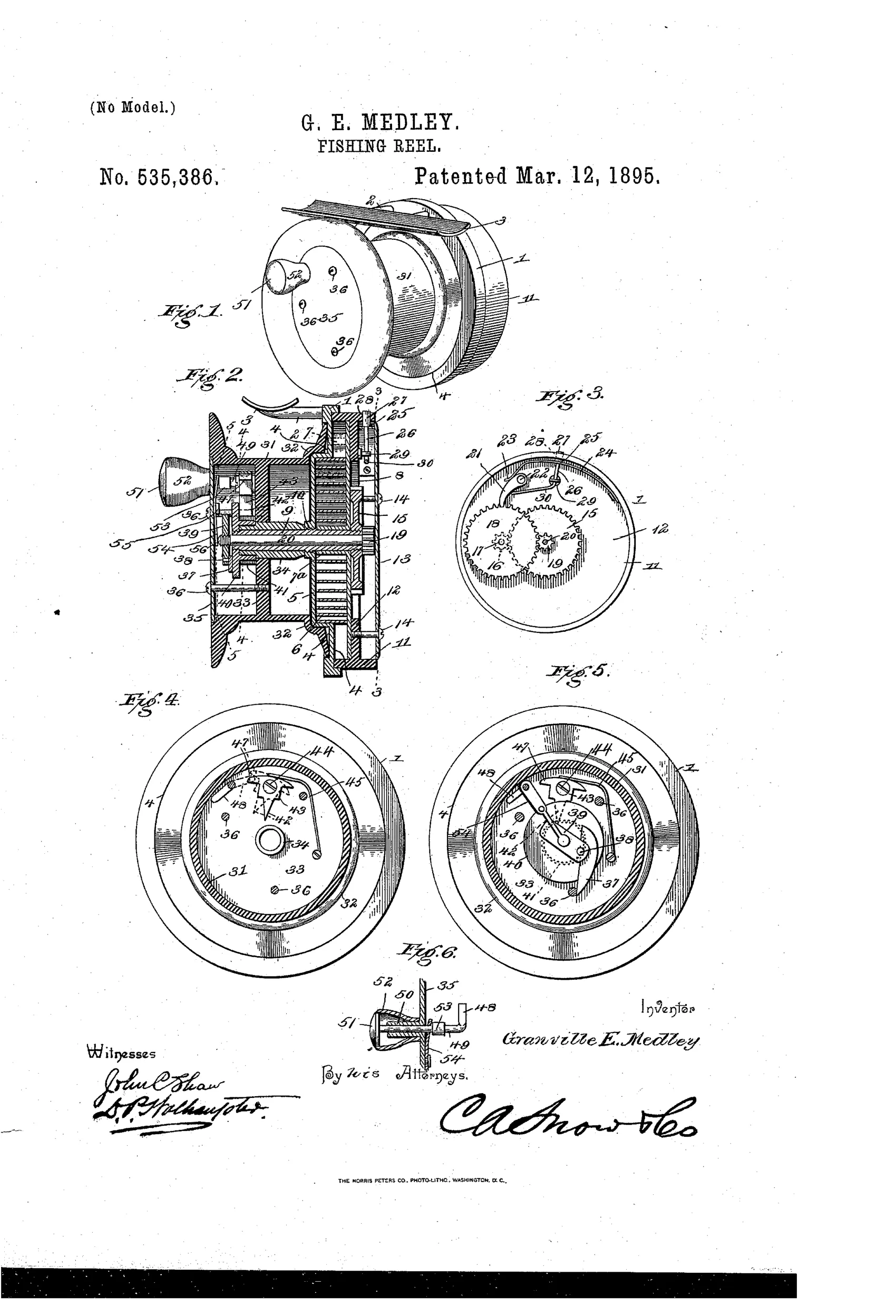
Automatic spring-wound fishing reel with manual option
↻ How it works
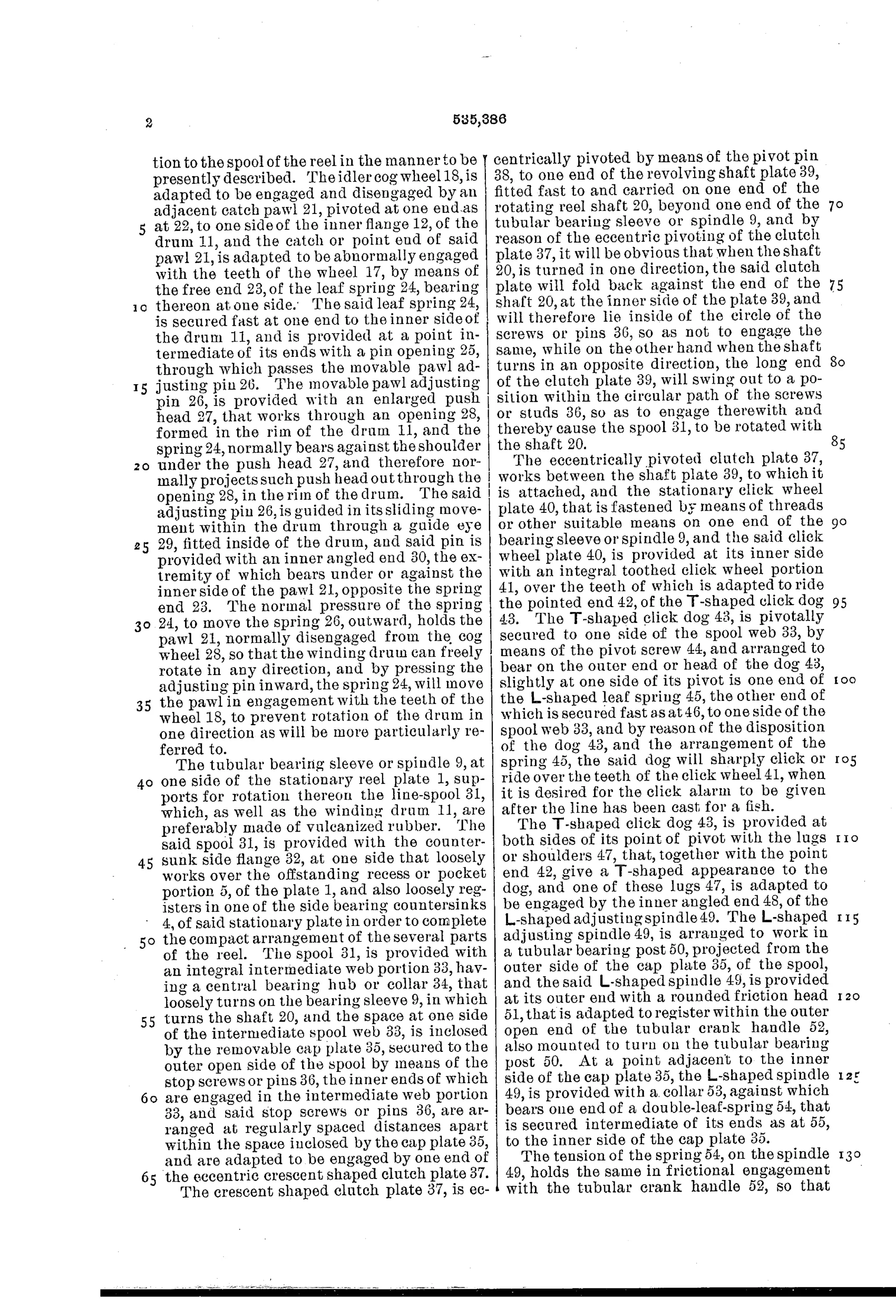
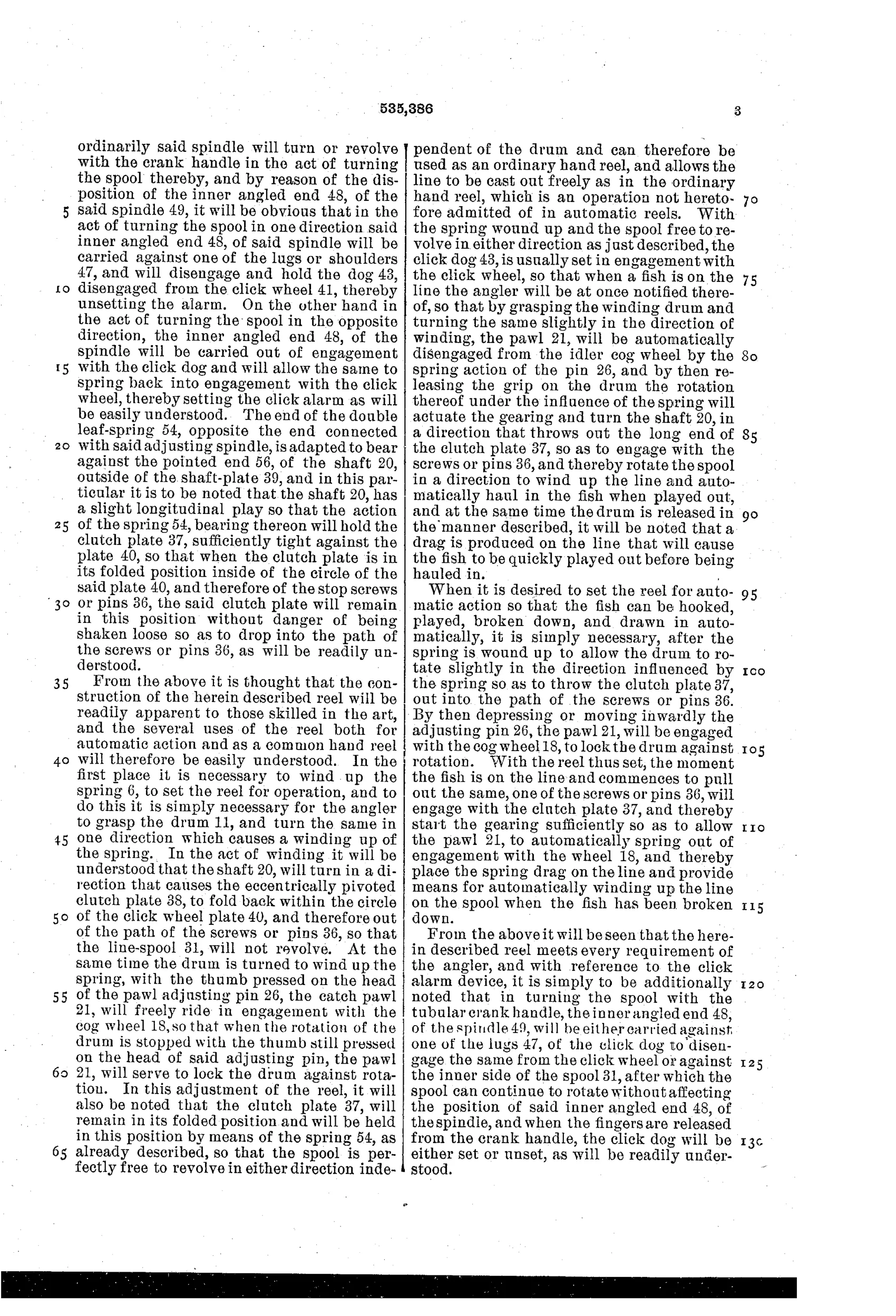
A stationary reel plate carries a spiral actuating spring housed in a circular pocket, one end fixed to the plate and the other connected to a revolving winding drum, so that turning the drum winds the spring for automatic operation. A line-spool turns loosely on the same bearing sleeve and is engaged or released from the drum's power through an eccentrically pivoted crescent-shaped clutch plate that folds in or throws out depending on which way the shaft turns. A pawl-and-cog gear catch (pawl 21 engaging idler cog 18, controlled by a spring-loaded adjusting pin 26) locks or frees the drum, while a separate T-shaped spring-loaded click dog riding a toothed click wheel provides an audible alarm and drag that is automatically set or unset by turning the crank-mounted spool.
↻ What was claimed
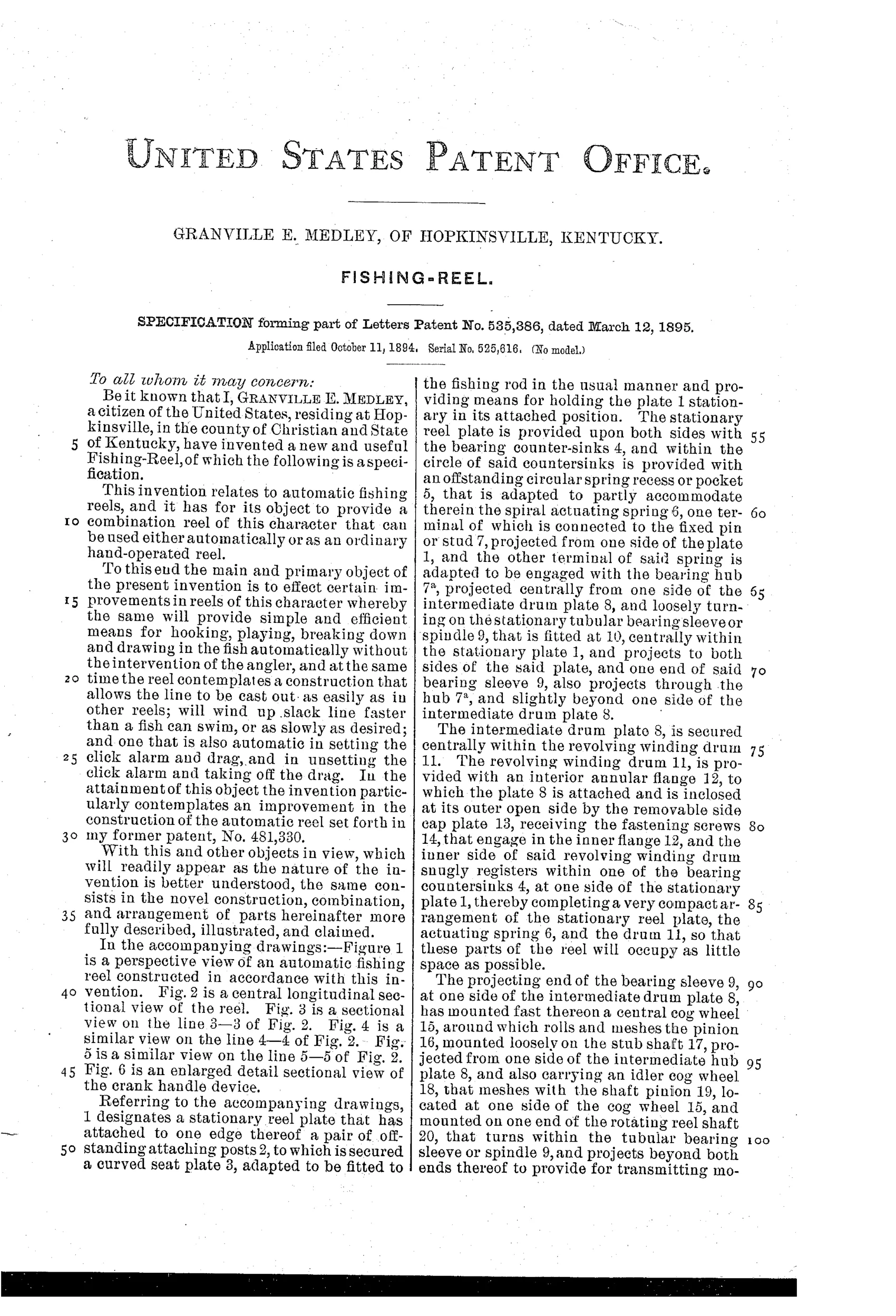
“1. In a fishing reel, a stationary reel plate provided with an offstanding circular spring recess or pocket, a stationary bearing sleeve fitted to said plate and projecting to both sides thereof, a revolving winding drum mounted on the sleeve at one side of the reel plate, a spring seated within said spring recess or pocket, and connected at one end to the reel plate and at its other end to the winding drum, a line spool mounted to revolve on the sleeve at one side of the reel plate and provided with a countersunk side flange loosely embracing the offstanding recess or pocket portion of the reel plate, a reel shaft arranged within said sleeve, an automatic clutch connection between one end of the reel shaft and the spool, a gearing connection between the opposite end of the shaft and the drum, and an automatic gear catch for said gear connection, substantially as set forth.”
In plain English: The reel combines a stationary plate with a spring-loaded winding drum, a free-turning line spool, and an internal shaft linking them through an automatic clutch and gear catch so the whole assembly winds and releases itself.
↻ In the inventor’s words
“and allows the line to be cast out freely as in the ordinary hand reel, which is an operation not heretofore admitted of in automatic reels.”— Granville E. Medley, from the specification
Fate unknown
No Medley automatic is documented among known makers or collections; a marked surviving example would settle it, and the mechanism's complexity makes production doubtful.
↻ Commentary
Automatic reels were a small but real trade by 1895 — Yawman & Erbe's spring-driven fly reels were already on the market — but they all shared one limitation: the spring was always coupled to the spool, so you could not cast freely against it. Medley's own specification names the prize: his reel "allows the line to be cast out freely as in the ordinary hand reel, which is an operation not heretofore admitted of in automatic reels." That is a genuinely good problem to attack, and he attacks it in the most Kentucky way possible, with watchmaker's parts.
The cutaway in Fig. 2 is the whole story. A spiral spring sits in a pocket on the stationary plate, driving a winding drum; the line spool rides loose on the same sleeve and is joined to the drum's power only through a crescent-shaped clutch plate pivoted eccentrically (visible in Fig. 5) that folds in or throws out depending on rotation direction — a one-way clutch, in effect. Add a pawl-and-cog catch to hold the wound spring, and a separate T-shaped click dog for alarm and drag, and you have four interacting escapement-like mechanisms in a package the size of a pocket watch.
That is the trouble. Each element is plausible; the assembly is a lot of small spring-loaded parts to keep working with wet line, sand, and a thrashing fish. The idea points forward — free-spool clutches became standard — but this execution looks like a machinist's proof rather than a product.
Commentary by Claude, The Fishing Reel Patent Archive’s resident enthusiast