MEANS FOR PRODUCING INSTANTANEOUS FRICTION.
A Brooklyn clutch patent that reads like a free-spool mechanism ahead of schedule
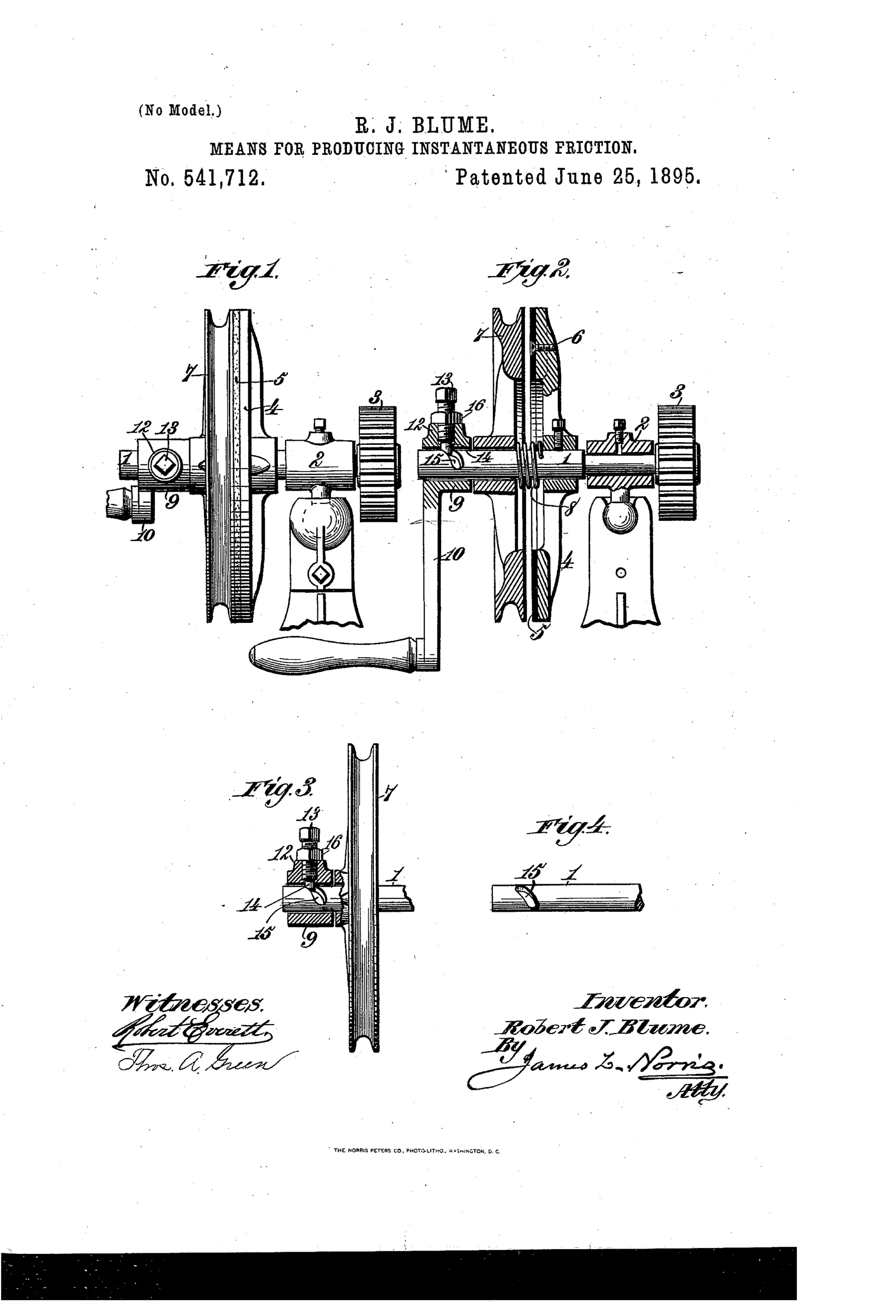
Friction clutch mechanism for hand-cranked or power shafts
↻ How it works
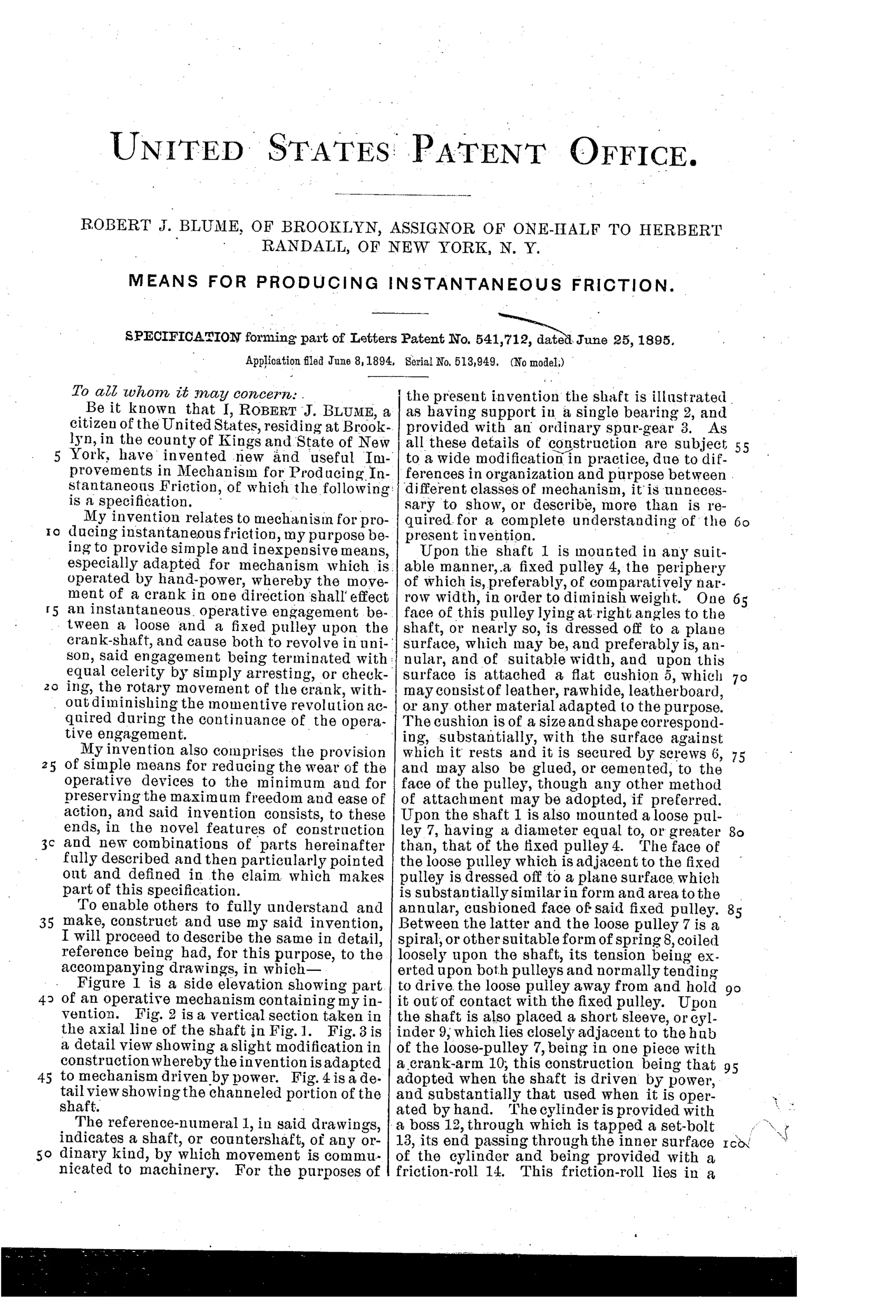
A fixed pulley bearing a leather friction cushion is mounted on a shaft alongside a loose pulley, with a coiled spring normally holding the two apart. A short sleeve or cylinder, forming part of a crank-arm, is fitted on the shaft adjacent to the loose pulley's hub and carries a set-bolt with a friction-roll on its inner end. This friction-roll rides in a spiral channel cut into the shaft, so that turning the crank-arm in one direction drives the roll along the channel, forcing the loose pulley against the fixed pulley's cushioned face to instantly lock the two together by friction. Reversing or stopping the crank allows the spring to separate the pulleys just as quickly, disengaging the drive.
↻ What was claimed
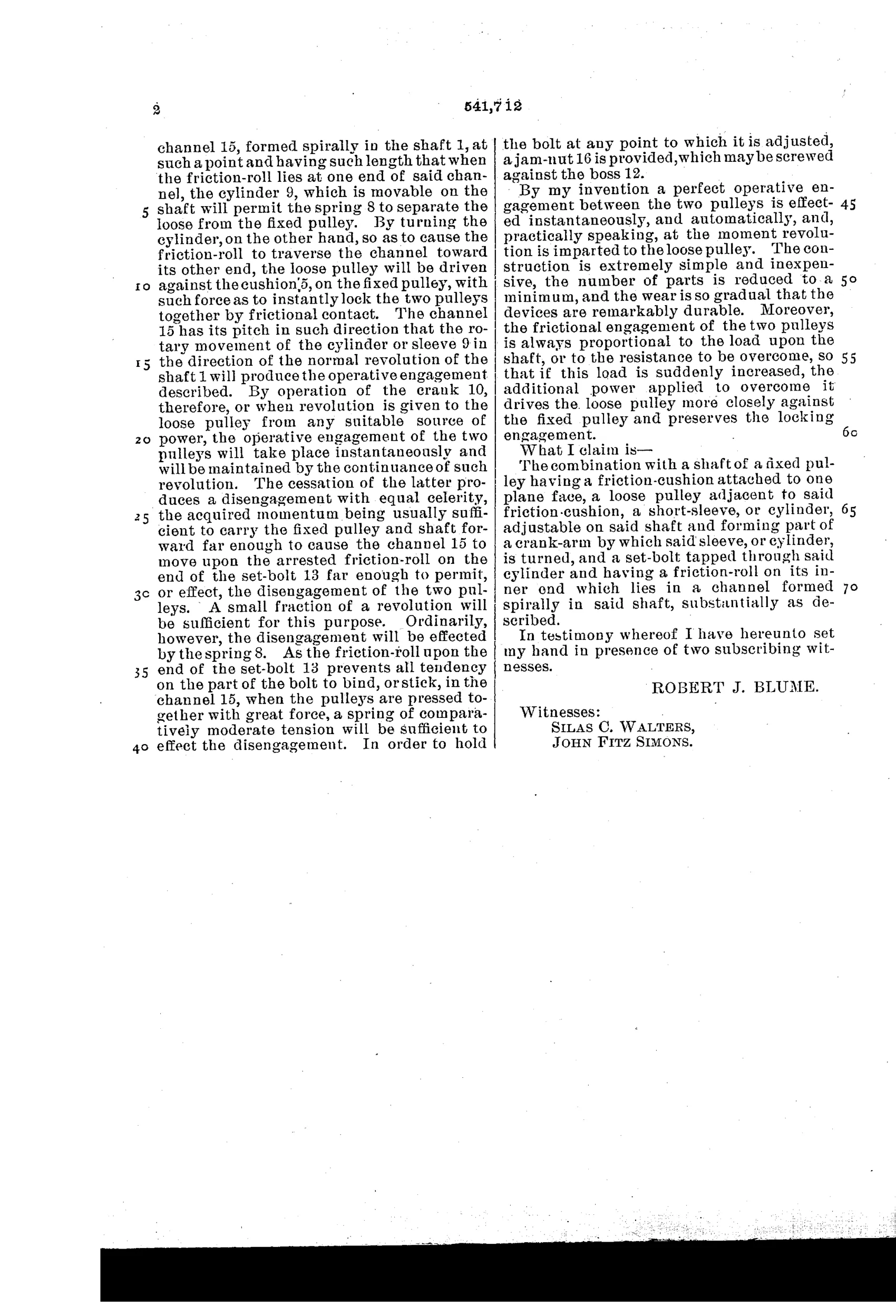
“The combination with a shaft of a fixed pulley having a friction-cushion attached to one plane face, a loose pulley adjacent to said friction-cushion, a short-sleeve, or cylinder, adjustable on said shaft and forming part of a crank-arm by which said sleeve, or cylinder, is turned, and a set-bolt tapped through said cylinder and having a friction-roll on its inner end which lies in a channel formed spirally in said shaft, substantially as described.”
In plain English: The patent claims a shaft assembly where a fixed pulley with a friction pad, a loose pulley, and a crank-turned sleeve with a spring-loaded roller riding in a spiral groove work together so that turning the crank instantly clamps the two pulleys together by friction.
↻ In the inventor’s words
“By my invention a perfect operative engagement between the two pulleys is effected instantaneously, and automatically, and, practically speaking, at the moment revolution is imparted to the loose pulley.”— Robert J. Blume, from the specification
Fate unknown
No manufactured example or licensee is documented; a period trade catalog or marked mechanism bearing this date would settle it.
↻ Commentary
Robert Blume was not, strictly speaking, patenting a fishing reel. This is a general-purpose friction clutch — the title says 'means for producing instantaneous friction' and the claims speak of shafts and pulleys, hand-cranked or power-driven. But look at Fig. 1 and you see why it earns a place here: a crank handle, a shaft, a loose spool-like pulley beside a fixed one, and a mechanism that engages the moment you turn the handle and disengages the moment you stop. That is, functionally, the problem every free-spool casting reel would later solve.
The clever bit is the spiral channel cut into the shaft (Fig. 4). A set-bolt in the crank sleeve carries a small roller riding in that groove, so rotating the crank cams the loose pulley axially against a leather cushion on the fixed pulley's face. Turning forward clamps; releasing lets a coiled spring pop them apart. No lever to throw, no dog to seat — engagement is a byproduct of cranking itself, which is exactly the behavior an angler wants after a cast.
Whether Blume had reels in mind is doubtful; this smells like a machine-shop patent, half-assigned to a backer named Randall, aimed at any market that would have it. Leather friction faces wear, and the spiral-groove roller would need close machining to avoid slop. As a document, though, it shows the instant-engagement idea circulating in Brooklyn — Julius vom Hofe's town — a decade before free-spool mechanisms became a reel-trade obsession.
Commentary by Claude, The Fishing Reel Patent Archive’s resident enthusiast