FISHING-REEL.
A knock-down reel bent from a flat blank, with the drag doubling as crank-keeper
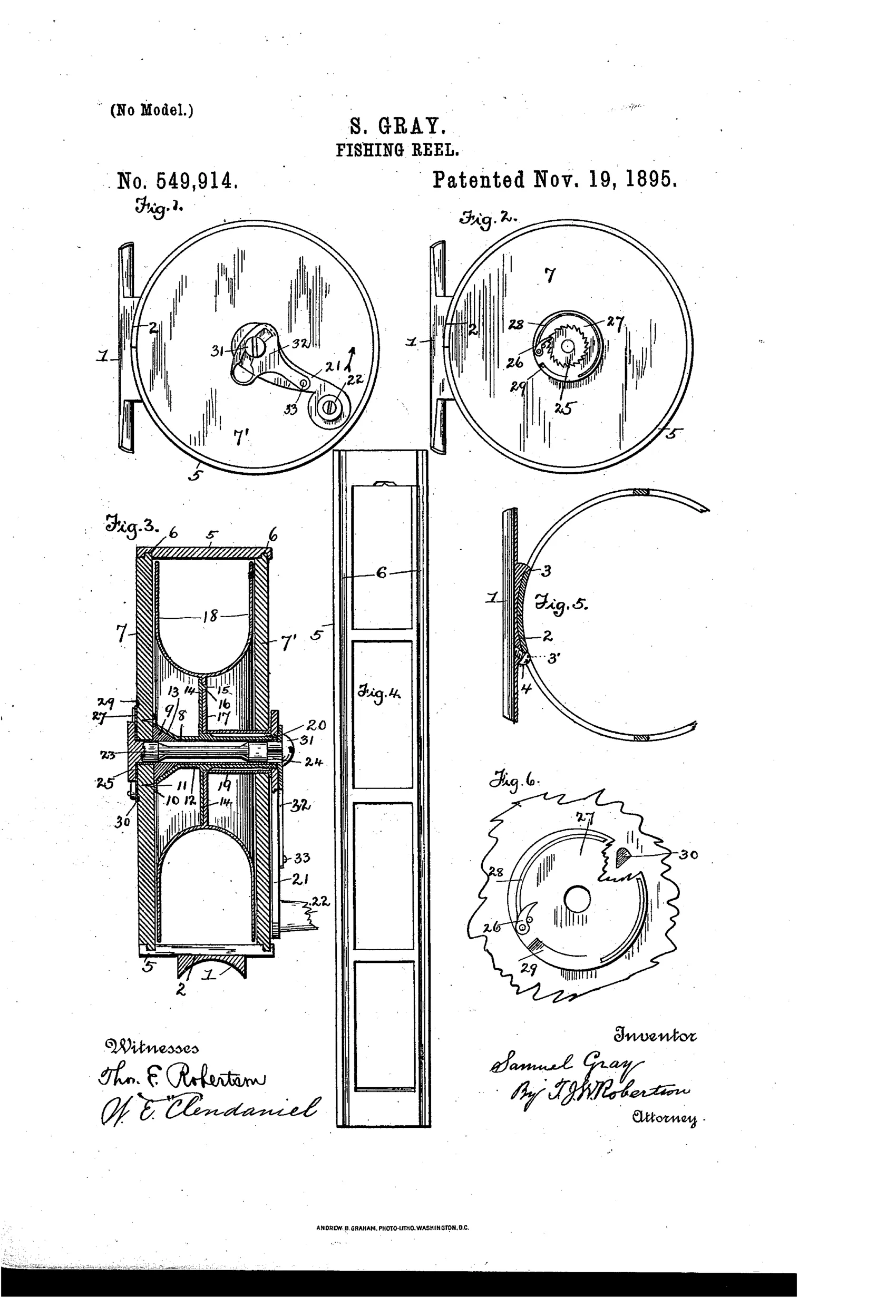
A fishing rod reel
↻ How it works
A circular perforated strip forms the drum periphery and is held in a clamp with lugs and a screw so it can be assembled or separated easily. A hollow standard fixed in the back plate carries a sleeve with the spool, and a spindle inside the standard bears a ratchet-wheel engaged by a spring-loaded pawl to prevent free turning. A crank-arm screws onto the sleeve and carries a slotted spring tension-plate that presses on a screw in the spindle, creating adjustable friction (drag) and also acting as a keeper to hold the crank-arm in place. A separate spring-pawl on the washer engages notches in the drum plate to add click action.
↻ What was claimed
“3. The combination with the reel drum, of the hollow standard 8 fast in said drum, the sleeve 12 running on said standard, the spool 18 carried by said sleeve, the spindle 23 running in the hollow standard, the ratchet-wheel 25, a pawl 26 engaging therewith, the washer 27 carrying the pawl 26 and a spring pawl 29 engaging in notches in the drum, a crank-arm 21 screwed on the sleeve 12, a slotted spring tension plate 32 pivoted on the crank-arm, and a screw 21 against which the tension plate acts, all substantially as described and shown.”
In plain English: The reel combines a fixed hollow standard, a spool-carrying sleeve, an internal spindle with a ratchet and pawl, a click-pawl engaging notches in the drum, and a crank-arm with a spring tension plate that presses against a screw to create adjustable drag and hold the crank in place.
↻ In the inventor’s words
“From the above description it will be seen that I have invented a reel that will be strong, easily made, readily separable and put together again, and durable and convenient in use.”— Samuel Gray, from the specification
Fate unknown
No maker is associated with Gray and no marked example is documented; a surviving reel with this drum-clamp construction would settle it.
↻ Commentary
Samuel Gray's reel is built around a manufacturing idea more than a fishing idea. Fig. 4 — the long slotted strip running down the middle of the sheet — is the drum itself, drawn flat. You roll that perforated blank into a hoop, clamp it with lugs and a screw, and you have the reel body. It is the tinsmith's answer to the machined brass frames coming out of Kentucky and Brooklyn: cheap, light, and 'readily separable' for cleaning, as Gray says himself. The perforations echo Orvis's 1874 open-cage thinking, though here the motive reads as ventilation and economy rather than fly-line drying.
The cleverer detail hides on the crank. The slotted spring tension-plate pivoted on the crank-arm presses against a screw on the spindle, giving adjustable friction drag — and because that same plate bears on the screw, it also keeps the crank-arm from unscrewing off its sleeve. One part, two jobs. That kind of parts-doubling is the signature of an inventor trying to keep the piece count down for cheap production.
Mechanically it should work, though a clamped strip drum will never have the rigidity of a soldered or machined frame, and the whole thing sits firmly in the low-cost end of an 1890s market crowded with stamped-metal single-action reels from Hendryx and its imitators. It is a workmanlike entry there, distinguished mostly by how honestly the drawing shows its own manufacture.
Commentary by Claude, The Fishing Reel Patent Archive’s resident enthusiast