FISHING-REEL.
A slide-out gear arm turns one reel into multiplier or free-runner
Fishing reel with disengageable multiplying gear and click
↻ How it works
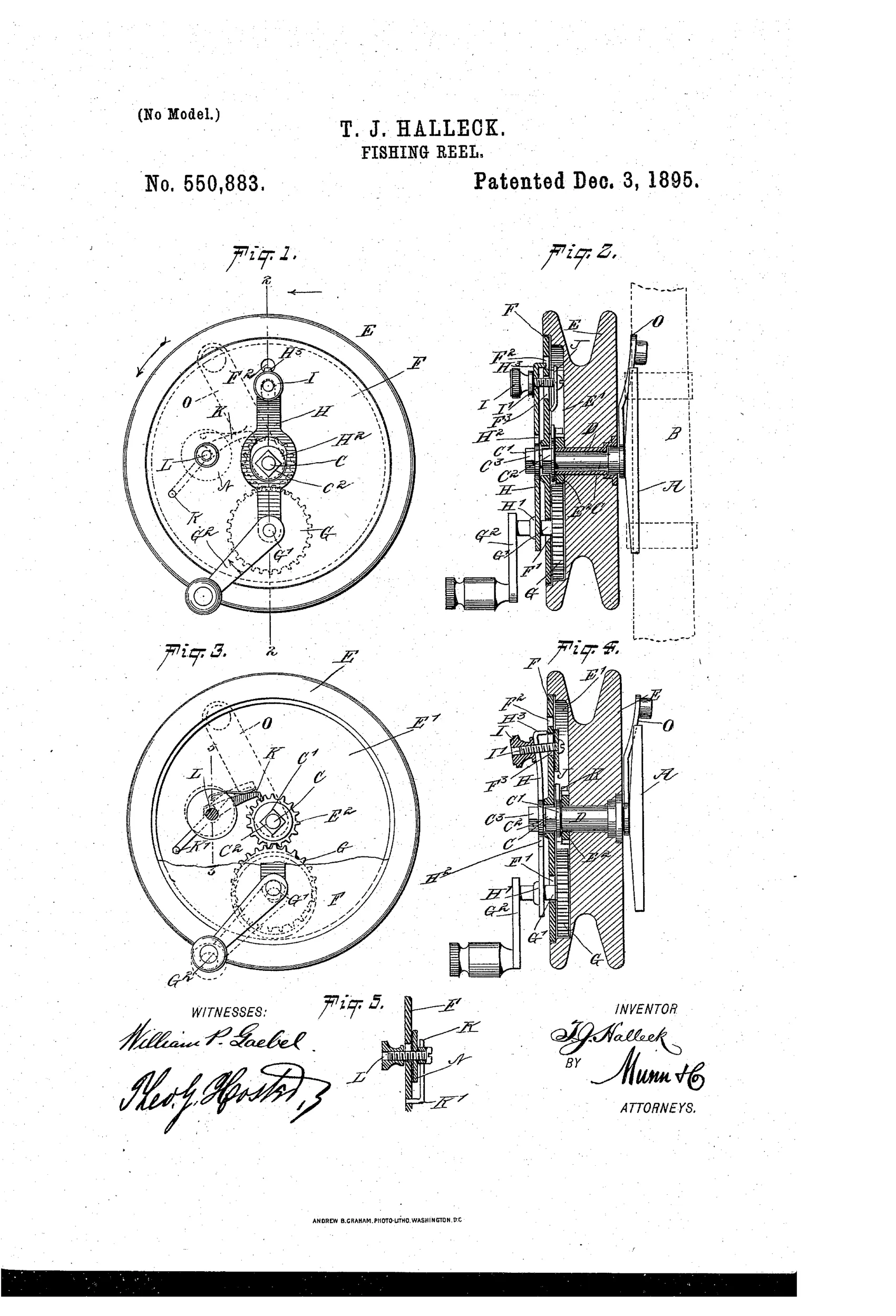
A pulley E is mounted loosely on a fixed pivot C and carries a pinion E2 in a recessed face closed by a cover disk F. A gear-wheel G, mounted on an arm H that is adjustable and can slide diametrically on the disk F, can be moved into or out of mesh with the pinion to engage or disengage the multiplying gear train for winding. A spring-disk J holds the arm H in either the engaged (in-gear) or disengaged (out-of-gear) position via a projection H3 that seats in openings F2 or F3. A spring-pressed pawl K, adjustable via a clamping screw L and washer N, can be swung into mesh with the pinion E2 to act as a click or alarm that retards or signals rotation without fully stopping the pulley, while a separate spring brake-arm O bears on the rear face of the pulley to brake it during casting.
↻ What was claimed
“1. A fishing reel, comprising a fixed pivot, a pulley mounted thereon and having a recessed face, a pinion secured on the said pulley in the recessed face, a gear wheel adapted to move in or out of mesh with the said pinion, a cover disk supported on the said pivot, and adapted to cover the recessed face of the pulley, and an arm carrying the shaft for the said gear wheel and held adjustable on the said cover disk, substantially as shown and described.”
In plain English: The reel has a pulley on a fixed pivot with a hidden pinion, covered by a disk, and a gear wheel on an adjustable arm that can be slid into or out of mesh with the pinion to engage or disengage the winding gear.
↻ In the inventor’s words
“The retarding-pawl K, when in mesh with the pinion E2, prevents the pulley from rotating and the line from accidentally unwinding; but in case of a bite the pull on the line will rotate the pulley and the pawl will click on the pinion E2, thus giving an alarm.”— Thomas J. Halleck, from the specification
Fate unknown
Halleck is not a recorded reel maker and no production example is documented; a marked specimen or trade listing would settle it.
↻ Commentary
Halleck's core idea is a switchable multiplier: the pinion sits in a recessed face of the spool, hidden under a cover disk, and the driving gear rides on an arm that slides diametrically across that disk. Push the arm one way and the gears mesh for geared retrieve; slide it the other way and the spool runs free of the whole train. A spring disk with two detent openings snaps the arm into either position. This is the same problem Kentucky makers were circling — a multiplying reel whose gearing fights you during the cast — but Halleck attacks it by physically pulling the gear out of mesh rather than clutching the pinion off the spindle, which is the route the trade eventually took.
The sections in Figs. 2 and 4 repay a close look: the whole reel is built around a fixed pivot, not a rotating spool shaft, so the spool is really a loose pulley on a dead axle. That simplifies bearings but means every function — click, brake, gearing — has to act on the spool rim or the buried pinion. Hence the separate spring brake-arm O for casting and the swing-in pawl K that clicks on the pinion teeth as a bite alarm.
It would work, but sliding a gear radially into mesh invites tooth-clash and wear, and the recessed-face construction is fussy to machine. A clever paper answer to a real question, superseded by cleaner clutch designs.
Commentary by Claude, The Fishing Reel Patent Archive’s resident enthusiast