IMPROVEMENT IN FISHING-REELS.
Stamping Billinghurst's birdcage from sheet metal: a manufacturing patent in disguise
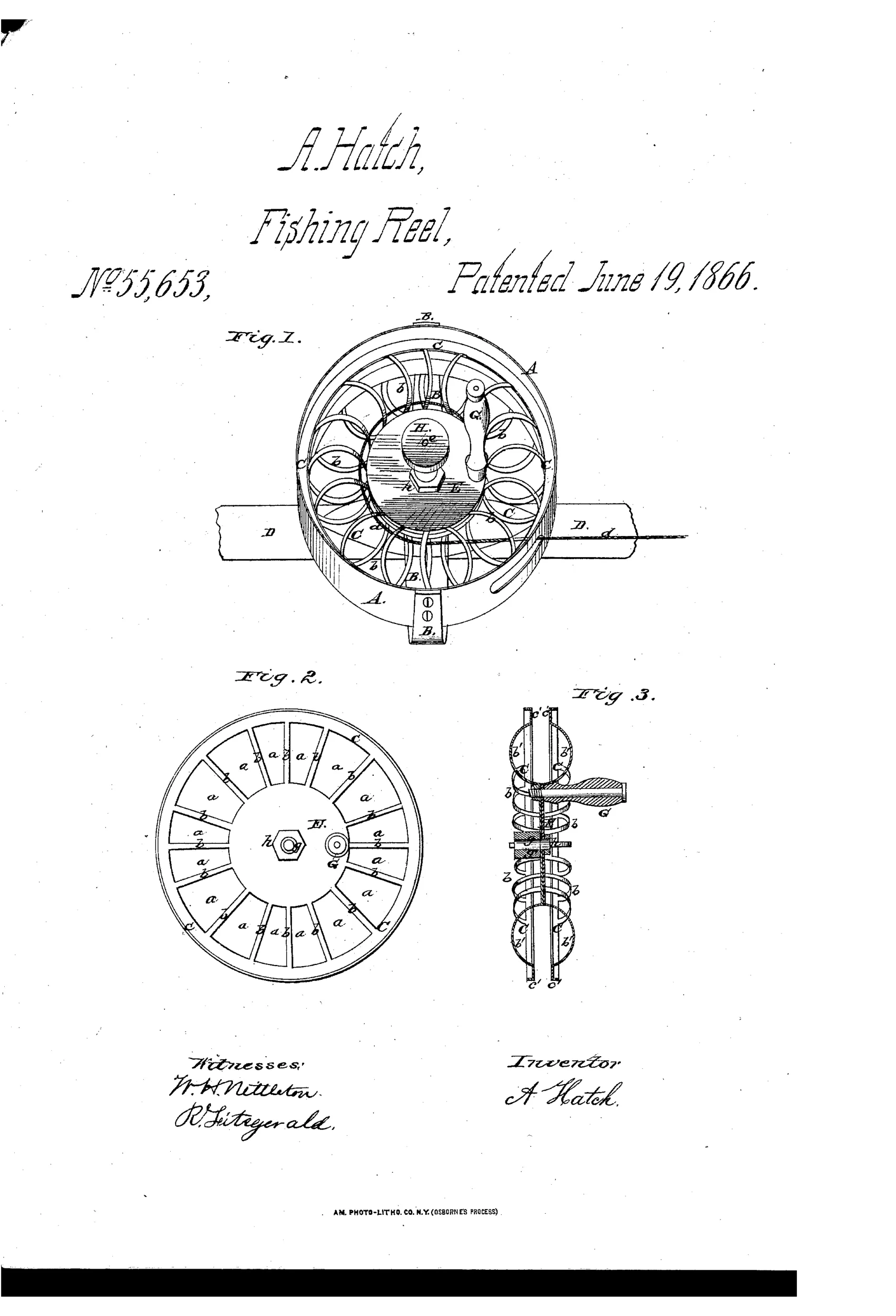
Sheet-metal skeleton-spool fishing reel improvement
↻ How it works
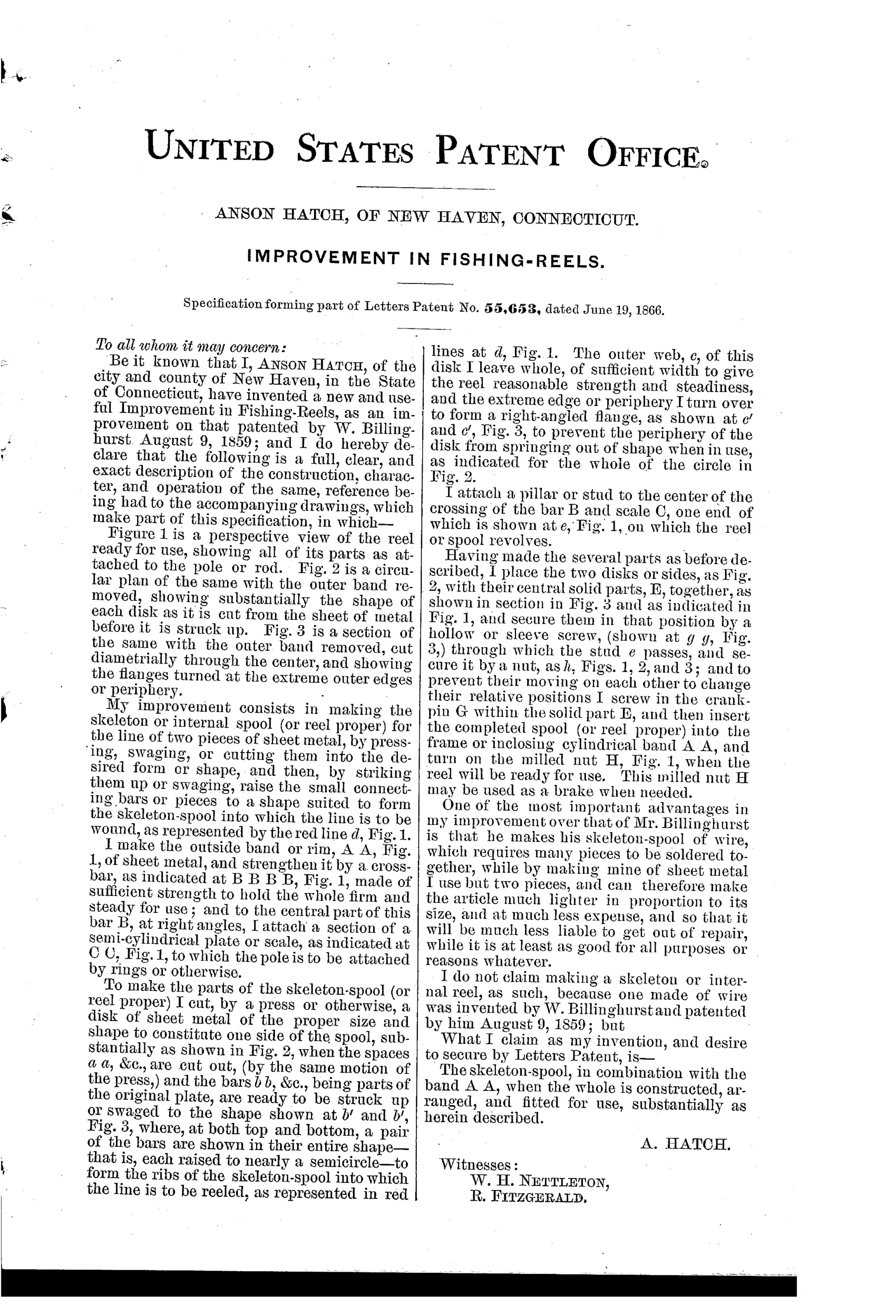
The reel's internal skeleton-spool is formed from two pieces of sheet metal instead of many soldered wire pieces. Each disk is cut with spaces removed and small connecting bars are struck up or swaged into raised ribs to form the spool onto which the line winds. The two disks are joined at their solid central parts by a hollow sleeve screw and stud, secured with a nut, and the crank pin is screwed into the solid part to fix their relative position. The completed spool is inserted into an outer cylindrical band strengthened by a crossbar, and a milled nut allows tightening as a brake.
↻ What was claimed
“The skeleton-spool, in combination with the band A A, when the whole is constructed, arranged, and fitted for use, substantially as herein described.”
In plain English: The claim covers the sheet-metal skeleton spool combined with the outer band, built and arranged as described.
↻ In the inventor’s words
“I do not claim making a skeleton or internal reel, as such, because one made of wire was invented by W. Billinghurst and patented by him August 9, 1859; but What I claim as my invention...”— Anson Hatch, from the specification
Fate unknown
Billinghurst's original was certainly manufactured, but I know of no well-documented production run of Hatch's stamped version; a marked surviving specimen would settle it.
↻ Commentary
Hatch is refreshingly honest about what this is. Right in the specification he disclaims the skeleton reel itself, crediting William Billinghurst's famous 1859 wire 'birdcage' fly reel. What he claims instead is a better way to build one: instead of dozens of wire pieces individually bent and soldered, each side of the spool is punched from a single sheet of metal, with the connecting bars struck up into raised ribs by a die. Two stampings, a sleeve screw, a nut, and you have a spool. This is a production-engineering patent, not a fishing patent — and that makes it an early sign of where American reel making was headed, away from the watchmaker's bench and toward the press room.
Fig. 2 is the tell. It shows the flat disk before forming, with the slots and lettered tabs laid out like a blanking die pattern — you are literally looking at the tooling drawing. Fig. 3 shows how the swaged ribs stack and interlock when the two halves come together, with the crank pin doubling as the fixture that locks their rotational alignment. That's tidy thinking: one screw does two jobs.
The milled nut acting as a friction brake against the outer band is crude but workable — a poor man's drag, a decade before such things were common. As a fishing tool it's a ventilated, fast-drying fly reel in the Billinghurst mold; as a document, it's about making that reel cheaply.
Commentary by Claude, The Fishing Reel Patent Archive’s resident enthusiast