FISHING-REEL
Vom Hofe's drag that steps aside the moment you start reeling in
Fishing reel with automatic tension-releasing brake mechanism
↻ How it works
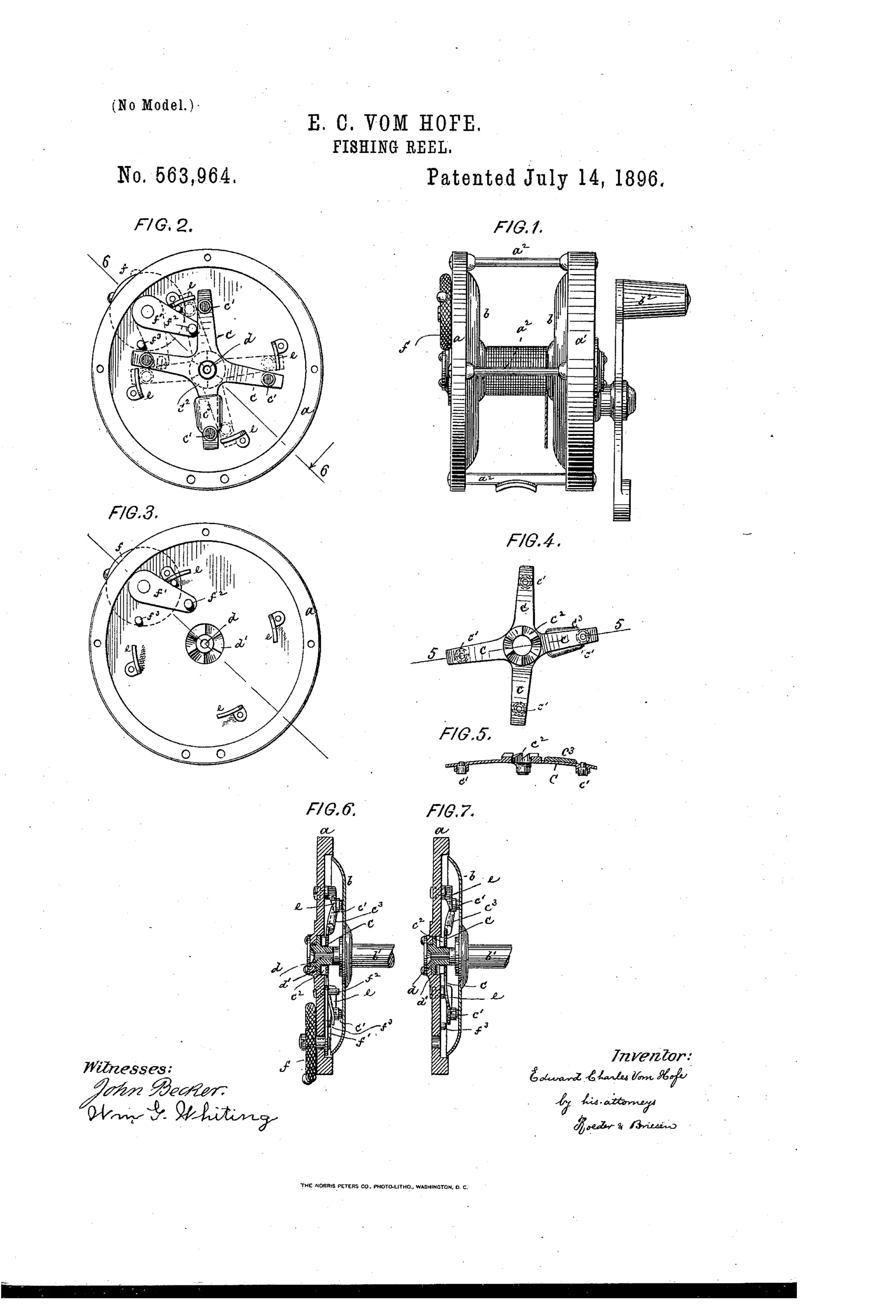
A resilient slotted brake or spider (c) is centered on a boss (d) between the reel head and the adjoining disk, with arms carrying brake-shoes (c') that contact the disk. While fishing, the brake is bodily moved toward the disk to create frictional drag, but when the line is hauled in the disk's rotation causes cooperating inclined-plane clutch-jaws (c2 and d') to ride up on one another, forcing the brake-shoes away from the disk and automatically removing tension. A hand-wheel (f) with a pin (f2) engages the brake arms to rotate the brake against catches or hooks (e) on the head, allowing the tension to be disengaged entirely for casting. A weighted arm (c3) on the brake causes it to rotate slightly upon release, re-engaging the drag teeth.
↻ What was claimed
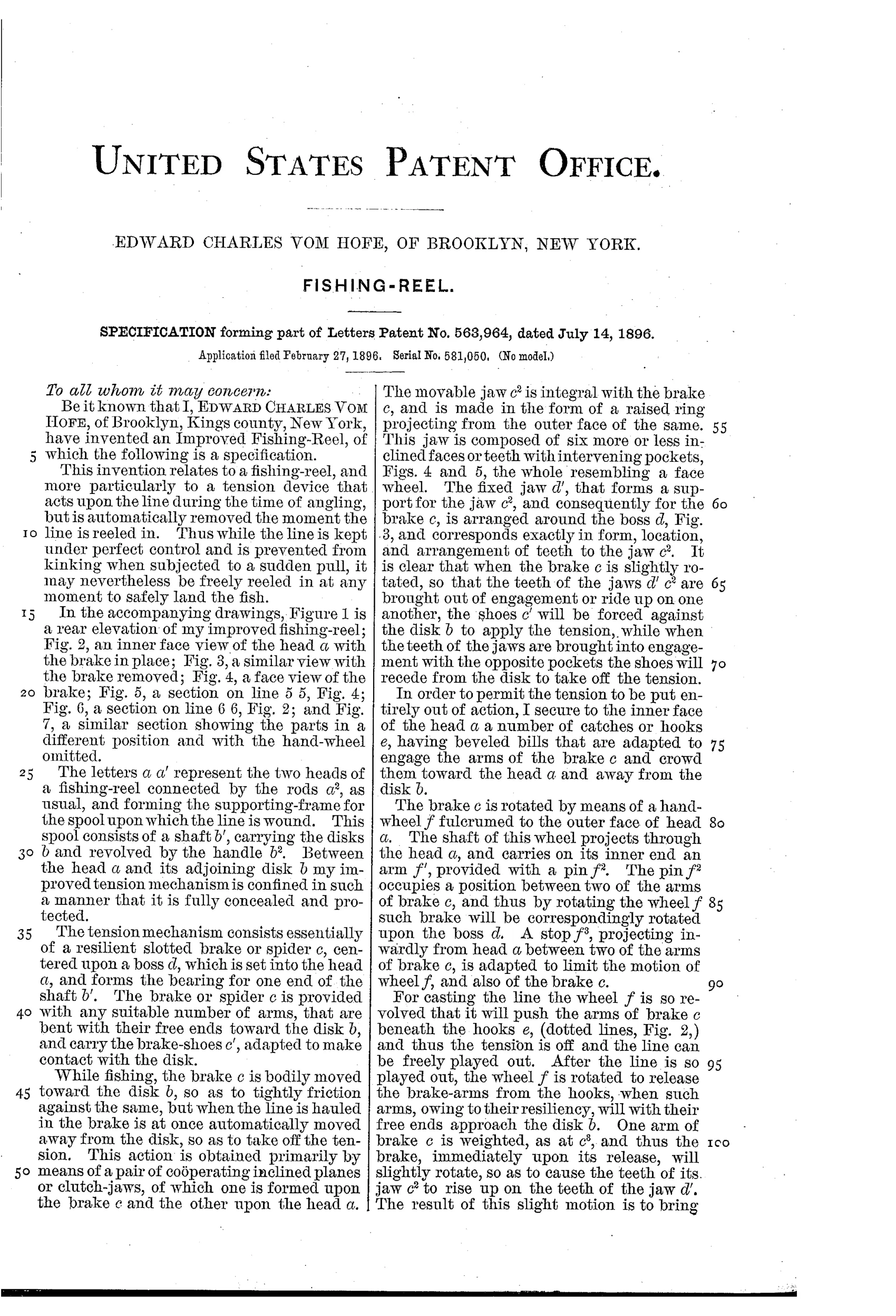
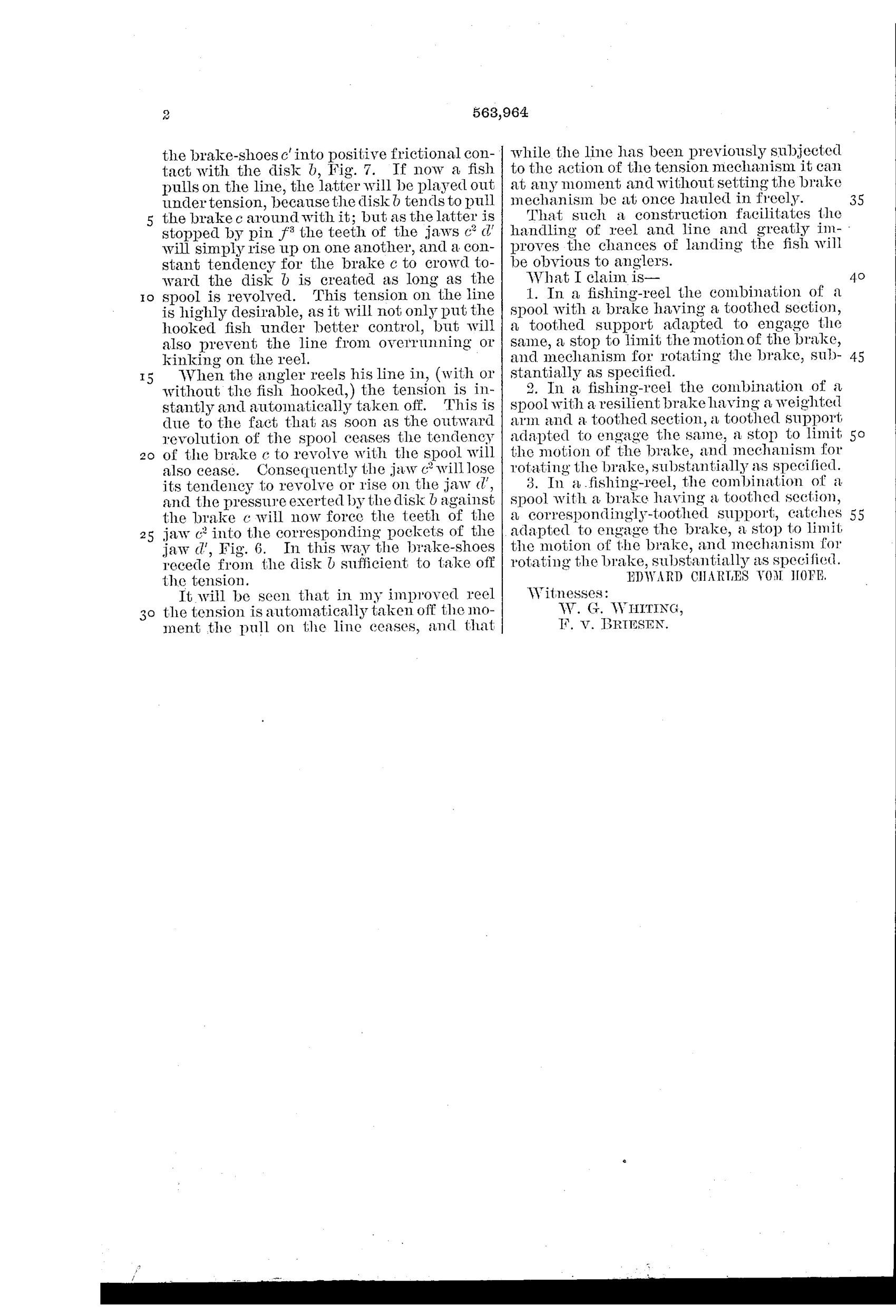
“In a fishing-reel the combination of a spool with a brake having a toothed section, a toothed support adapted to engage the same, a stop to limit the motion of the brake, and mechanism for rotating the brake, substantially as specified.”
In plain English: The reel combines a spool with a toothed brake, a matching toothed support, a stop to limit brake movement, and a mechanism to rotate the brake.
↻ In the inventor’s words
“Thus while the line is kept under perfect control and is prevented from kinking when subjected to a sudden pull, it may nevertheless be freely reeled in at any moment to safely land the fish.”— Edward Charles Vom Hofe, from the specification
Fate unknown
Edward vom Hofe manufactured prolifically, but I know of no documented reel carrying this specific automatic-release brake; a specimen marked with the July 14, 1896 date would settle it.
↻ Commentary
The problem Edward vom Hofe is chewing on here is real and specific: a drag heavy enough to stop a running fish is a nuisance the instant you want to crank line back. His answer is a slotted spring spider (Fig. 4) whose arms carry brake shoes pressing against a disk on the spool. Between spider and disk sit little inclined-plane clutch jaws. When the fish pulls, the drag bites; when you reel in, the disk turns the other way, the ramps ride up on each other, and the shoes are pushed clear of the disk automatically. The drag disengages itself every time you gain line, then a small weighted arm rotates the spider back into engagement when you stop.
Look at Figs. 6 and 7 side by side — same section, two positions — and you can see the whole trick: the spider bodily shifting along the boss as the ramps do their work. There's also a hand wheel with a pin to rotate the spider onto catches and kill the tension entirely for casting, so the angler gets both an automatic and a manual free-spool.
This is Edward (not brother Julius) working in the Brooklyn shop, six years before his celebrated star drag. Seen from there, this ramp-and-spider arrangement reads as an intermediate experiment — mechanically sound, probably a bit fussy in salt spray, and pointing directly at the simpler adjustable drags that made his big-game reels the standard.
Commentary by Claude, The Fishing Reel Patent Archive’s resident enthusiast