BALL-BEARING FISHING-REEL.
The Meisselbach brothers borrow the bicycle's cone-and-ball bearing for a wooden reel.
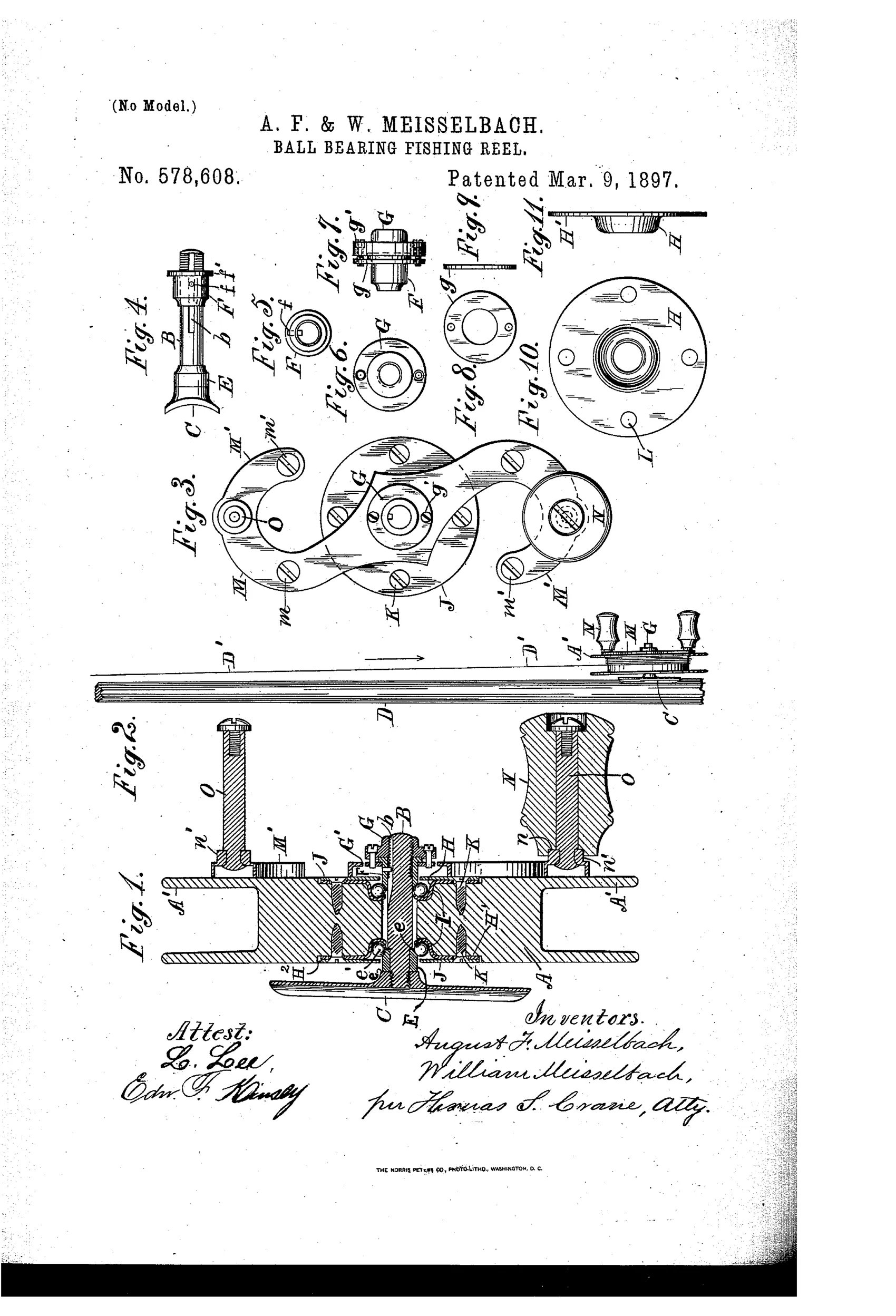
Ball-bearing fishing reel with adjustable cones
↻ How it works
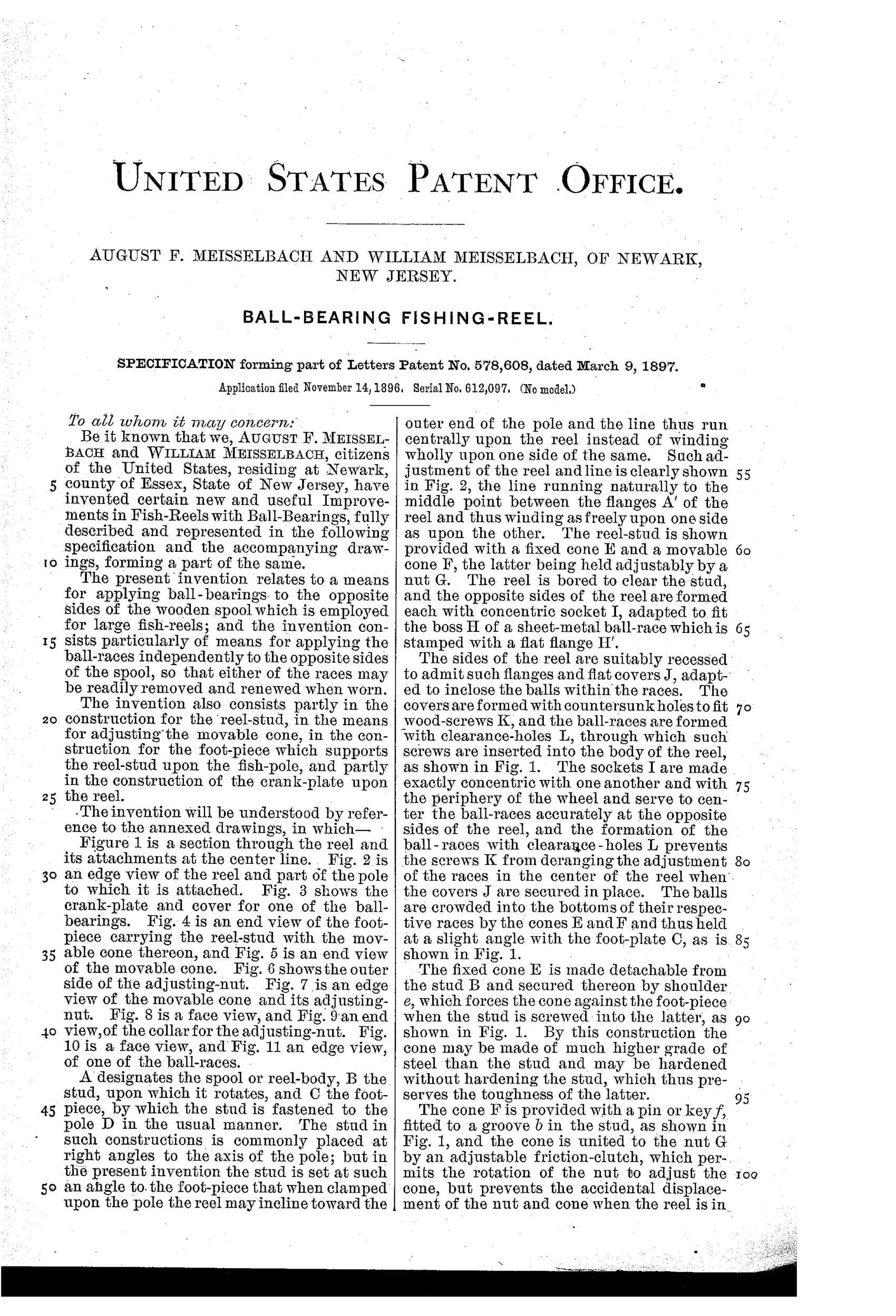
A fishing reel body rotates on a stud fitted with a fixed cone at its base and a movable, adjustable cone held by a friction-clutch nut, so the bearing preload can be set and locked without accidental loosening. Sheet-metal ball-races with hubs and flanges are fitted into concentric sockets on each side of the wooden spool so the races self-center and can be removed and renewed independently when worn. Covers with clearance holes are screwed over the race flanges so the wood screws cannot disturb the centering of the races. A double crank-plate carries the handles on crank-pins and is extended with an inwardly curved arm secured by a second screw near the pin to keep the light plate from bending if the handle is struck.
↻ What was claimed
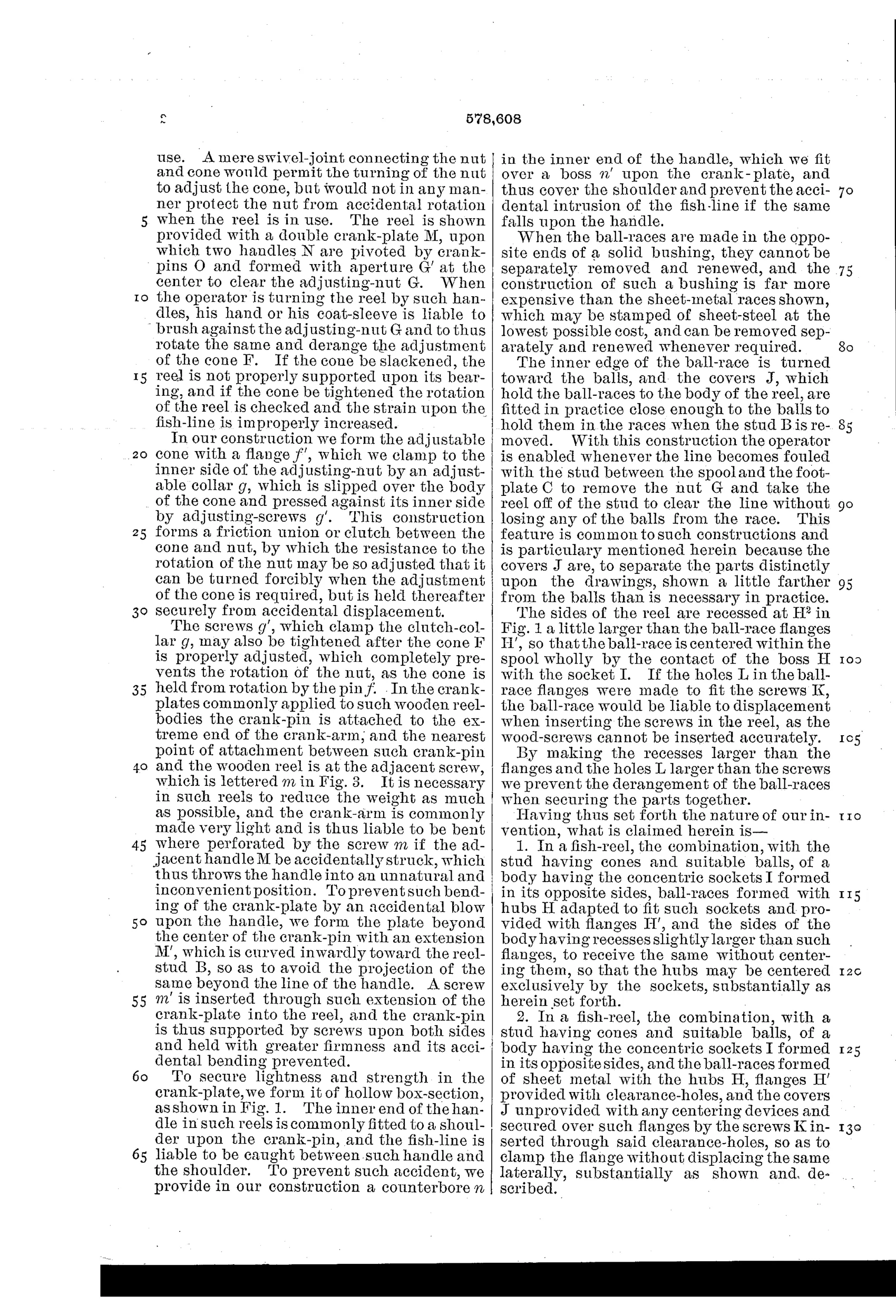
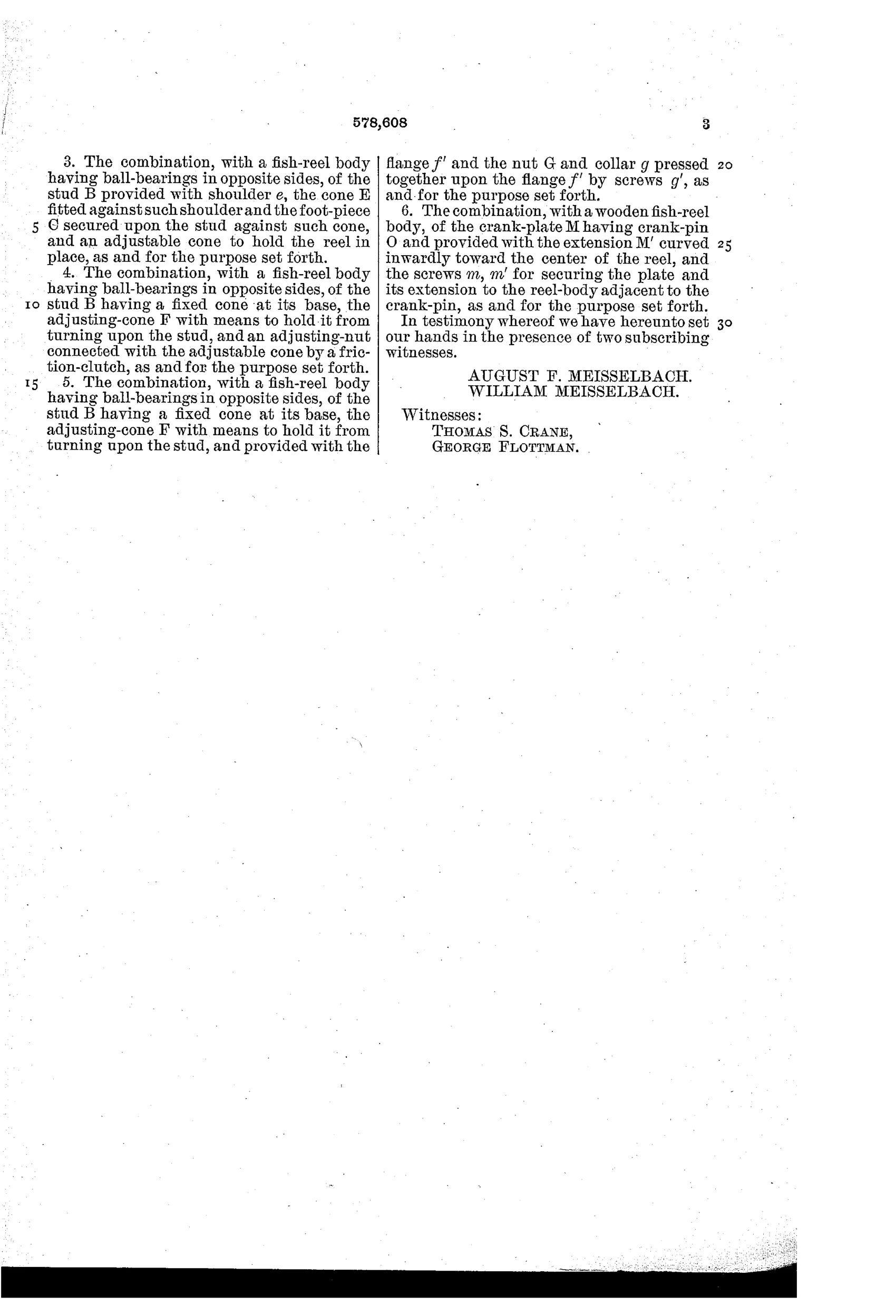
“In a fish-reel, the combination, with the stud having cones and suitable balls, of a body having the concentric sockets I formed in its opposite sides, ball-races formed with hubs H adapted to fit such sockets and provided with flanges H', and the sides of the body having recesses slightly larger than such flanges, to receive the same without centering them, so that the hubs may be centered exclusively by the sockets, substantially as herein set forth.”
In plain English: The reel body has sockets on each side sized to center the ball-race hubs precisely, while the surrounding recesses for the race flanges are made deliberately oversized so they don't interfere with that centering.
↻ In the inventor’s words
“To prevent such bending of the crank-plate by an accidental blow upon the handle, we form the plate beyond the center of the crank-pin with an extension M', which is curved inwardly toward the reel-stud B, so as to avoid the projection of the same beyond the line of the handle.”— August F. Meisselbach, William Meisselbach, from the specification
Fate unknown
Meisselbach was a genuine and prolific manufacturer, but whether this specific wooden-spool cone-bearing design reached production is undocumented; a surviving marked example would settle it.
↻ Commentary
This is 1896, the height of the bicycle boom, and it shows. The adjustable cone bearing on a fixed stud — with a friction-clutch nut so the preload stays where you set it — is straight out of a bicycle hub, transplanted onto a fishing reel by two Newark brothers who would soon become one of the most prolific reel-making firms in America. The whole reel body spins on balls around a stationary stud instead of a spool turning inside a frame, which is a genuinely different architecture from the Kentucky multiplier tradition.
The part a casual reader will skim past is the key claim, and it's the smartest thing here. The stamped sheet-metal ball races have hubs that seat in machined sockets in the wooden body, while the recesses for the race flanges are made deliberately oversized. That means the socket alone centers the race — the flange and its wood screws can't fight it. Anyone who has driven a screw into wood knows it pulls things off-center; the Meisselbachs designed that error out. Worn races simply unscrew and swap.
Even the crank-plate gets careful thought: an inward-curved extension with a second screw so a knock on the handle can't bend the light stamped plate. It's manufacturing-minded engineering throughout — stamped parts, renewable wear surfaces, no jeweled pivots. That cheap-but-serviceable philosophy is exactly what the firm rode to success with the Expert and Takapart lines.
Commentary by Claude, The Fishing Reel Patent Archive’s resident enthusiast