FISHING-REEL.
A two-speed gearbox, level-wind, and ball bearings crammed into one 1897 reel
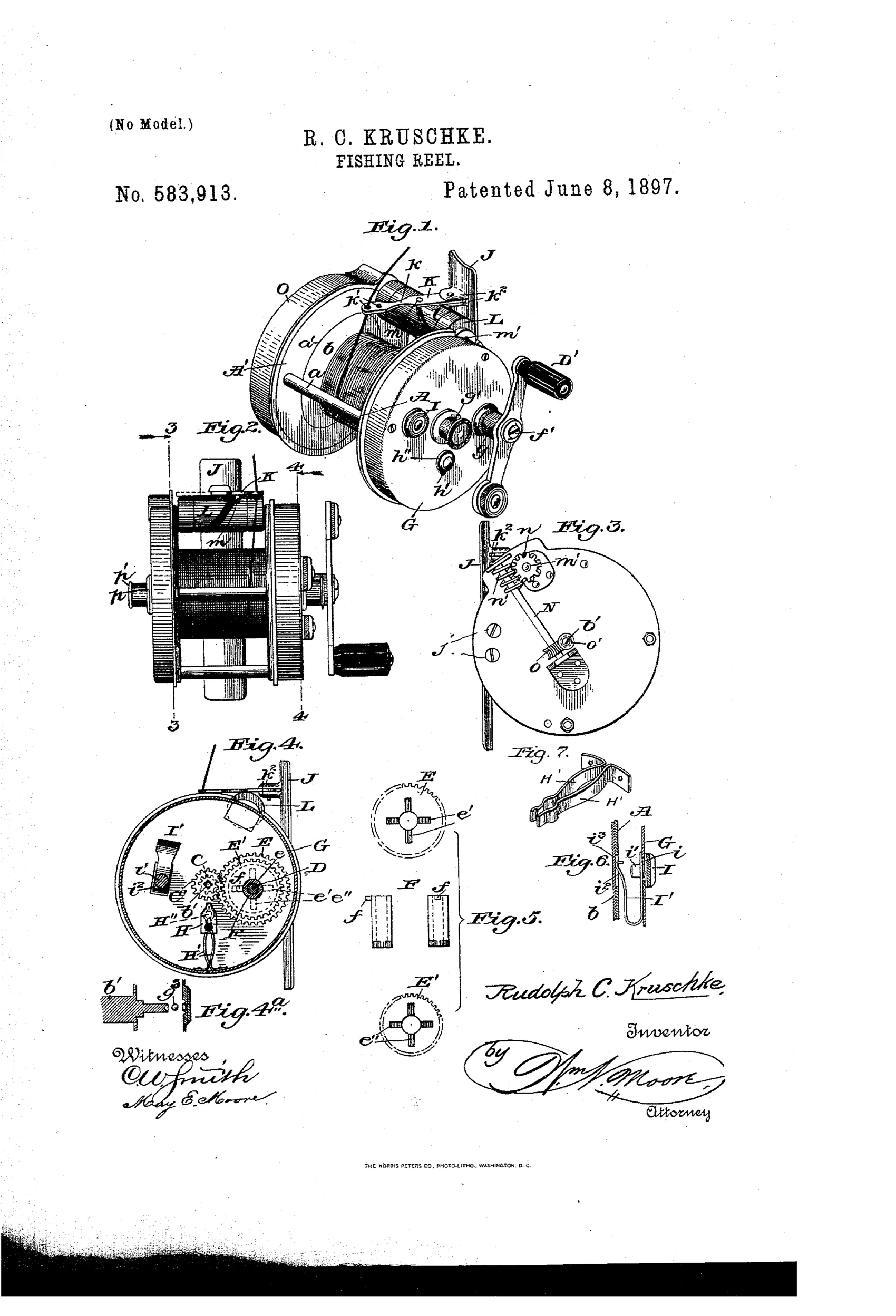
Multi-speed fishing reel with level-wind and brake
↻ How it works
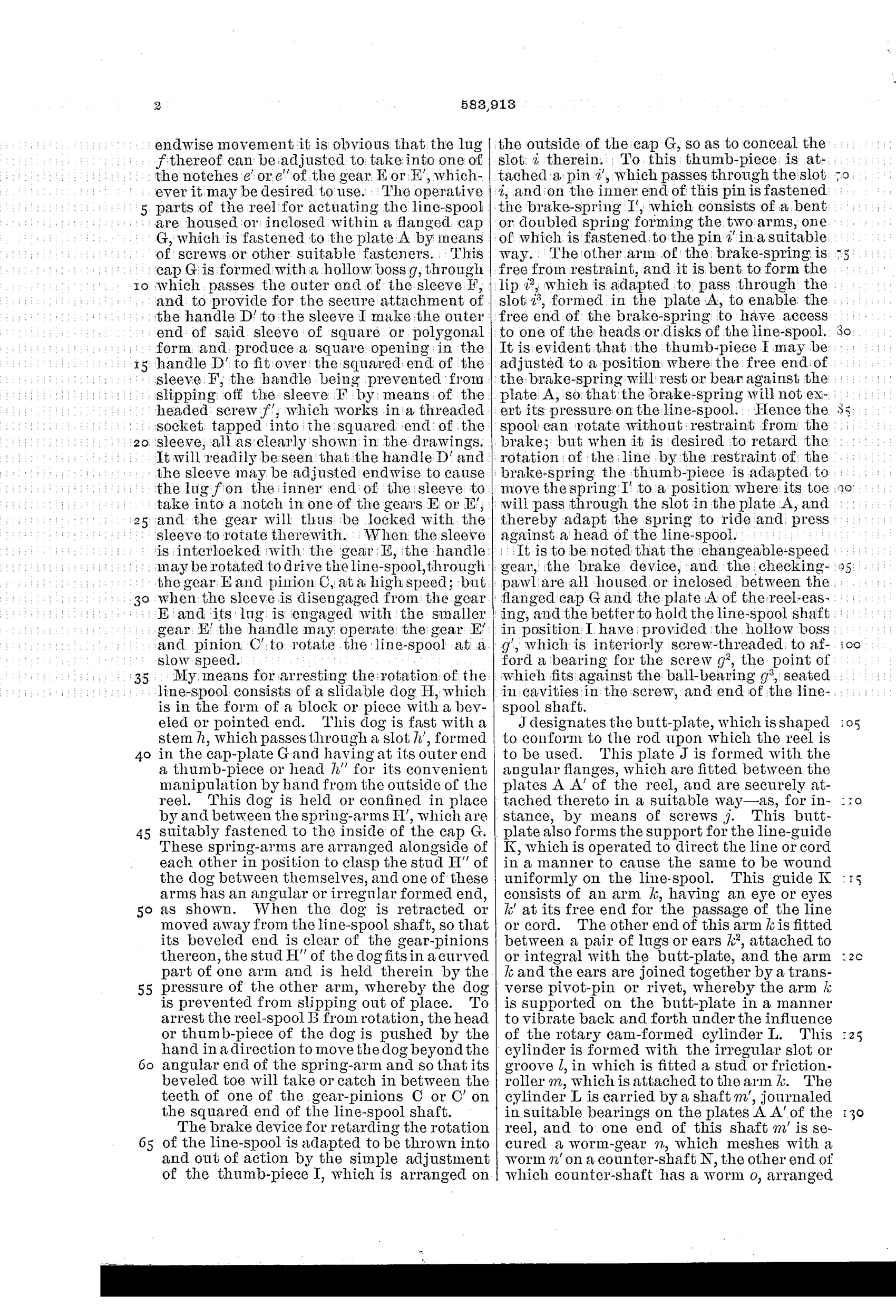
The line-spool shaft carries two differently sized pinions that mesh with two gears loosely fitted on a fixed spindle, and a sliding sleeve locks onto either gear to select high or low speed via the handle. A slidable dog with a beveled toe engages the pinion teeth to act as a click/stop, held by dual spring-arms. A separate thumb-operated brake spring can be moved to press against a spool head to retard rotation. A cam-formed cylinder, driven off the spool shaft through worm gearing on a counter-shaft, oscillates a pivoted guide-arm to level-wind the line evenly across the spool.
↻ What was claimed
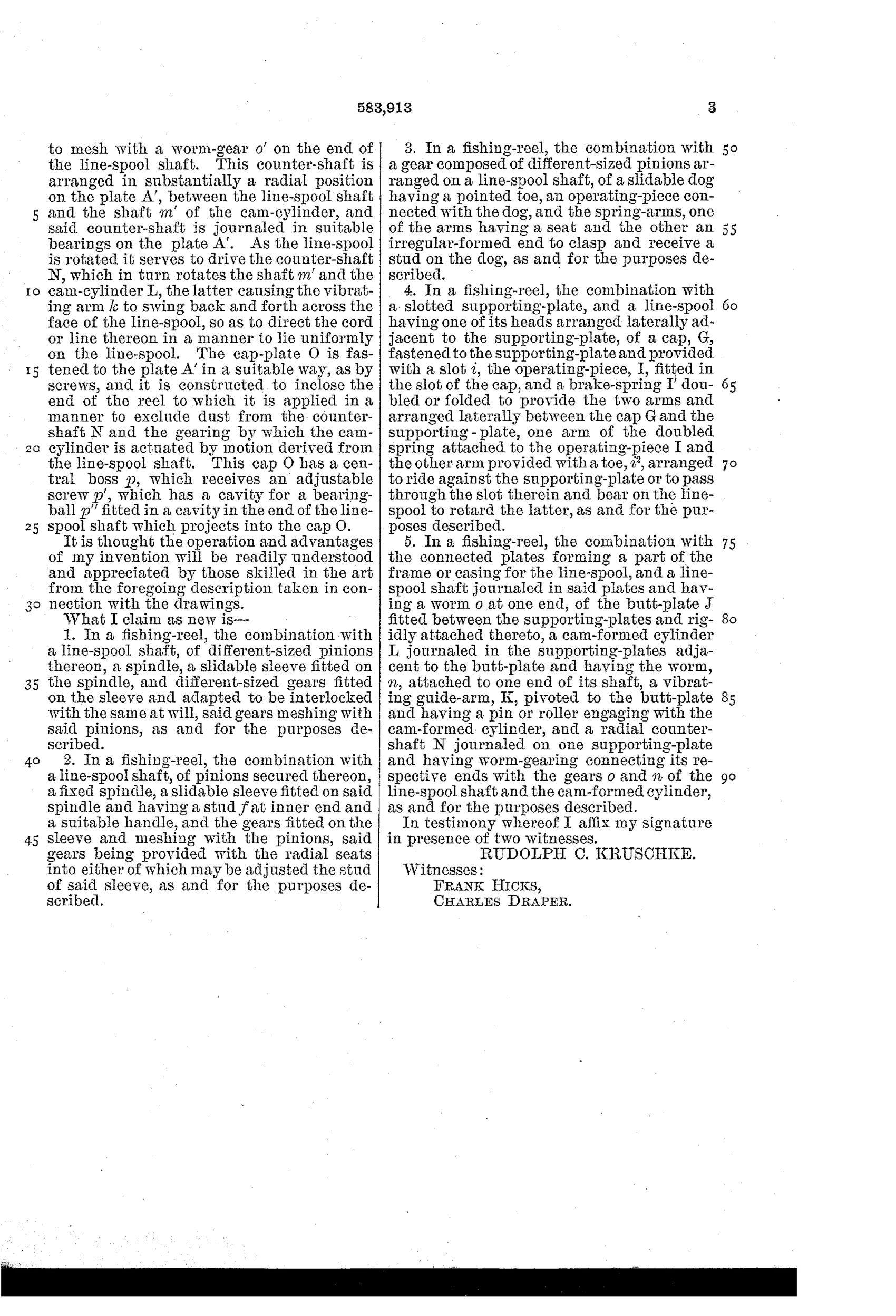
“1. In a fishing-reel, the combination with a line-spool shaft, of different-sized pinions thereon, a spindle, a slidable sleeve fitted on the spindle, and different-sized gears fitted on the sleeve and adapted to be interlocked with the same at will, said gears meshing with said pinions, as and for the purposes described.”
In plain English: A fishing reel where a sliding sleeve can lock onto either of two different-sized gears on a spindle, each meshing with a corresponding pinion on the spool shaft, allowing the user to choose between two speeds.
↻ In the inventor’s words
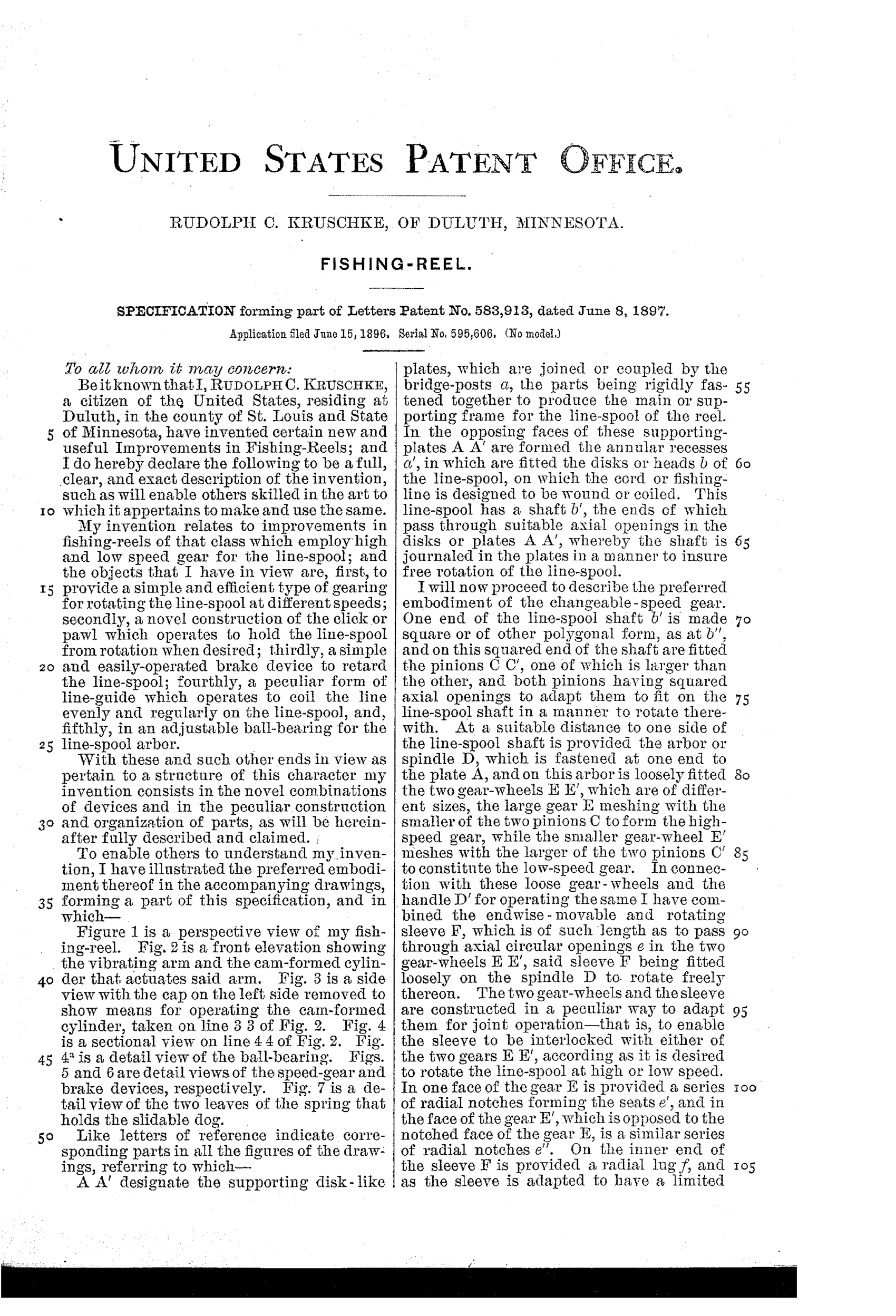
“My invention relates to improvements in fishing-reels of that class which employ high and low speed gear for the line-spool; and the objects that I have in view are, first, to provide a simple and efficient type of gearing for rotating the line-spool at different speeds; secondly, a novel construction of the click or pawl which operates to hold the line-spool from rotation when desired; thirdly, a simple and easily-operated brake device to retard the line-spool; fourthly, a peculiar form of line-guide which operates to coil the line evenly and regularly on the line-spool, and, fifthly, in an adjustable ball-bearing for the line-spool arbor.”— Rudolph C. Kruschke, from the specification
Fate unknown
Kruschke was a genuine Duluth reel maker, but I can't confirm this specific two-speed level-wind design reached production; a surviving marked example would settle it.
↻ Commentary
Kruschke didn't pick one improvement — he filed five at once. The heart of the patent is the two-speed transmission: two pinions of different diameter on the spool shaft, meshing with two loose gears on a fixed spindle, and a sliding sleeve that locks onto whichever gear you want. Slide the sleeve one way and the crank drives the spool fast for retrieving slack; slide it the other and you get low gear for cranking against a fish. That is essentially the shiftable two-speed mechanism that big-game reel makers would still be selling a century later, drawn out in 1896 by a man in Duluth.
Look closely at Fig. 2 and Fig. 3 and you'll find the second surprise: a cam-grooved cylinder driven off the spool shaft through worm gearing, oscillating a pivoted arm to lay line evenly. This is a genuine level-wind, patented well before the mechanism became the standard fixture of the 1900s baitcaster. Add the adjustable ball-bearing arbor in Fig. 4a and the thumb-shifted brake spring, and you have a reel specification that reads like a checklist of where the trade was headed over the next twenty years.
The honest caveat is complexity. Every one of these features adds parts, weight, and cost, and combining them all in a small frame is a machinist's headache. As a bundle it was ahead of the market; as individual ideas, nearly every one of them eventually won.
Commentary by Claude, The Fishing Reel Patent Archive’s resident enthusiast