FISH-LINE REEL.
The 1897 level-wind that started Shakespeare of Kalamazoo — twin grooved spindles, oblong eye.
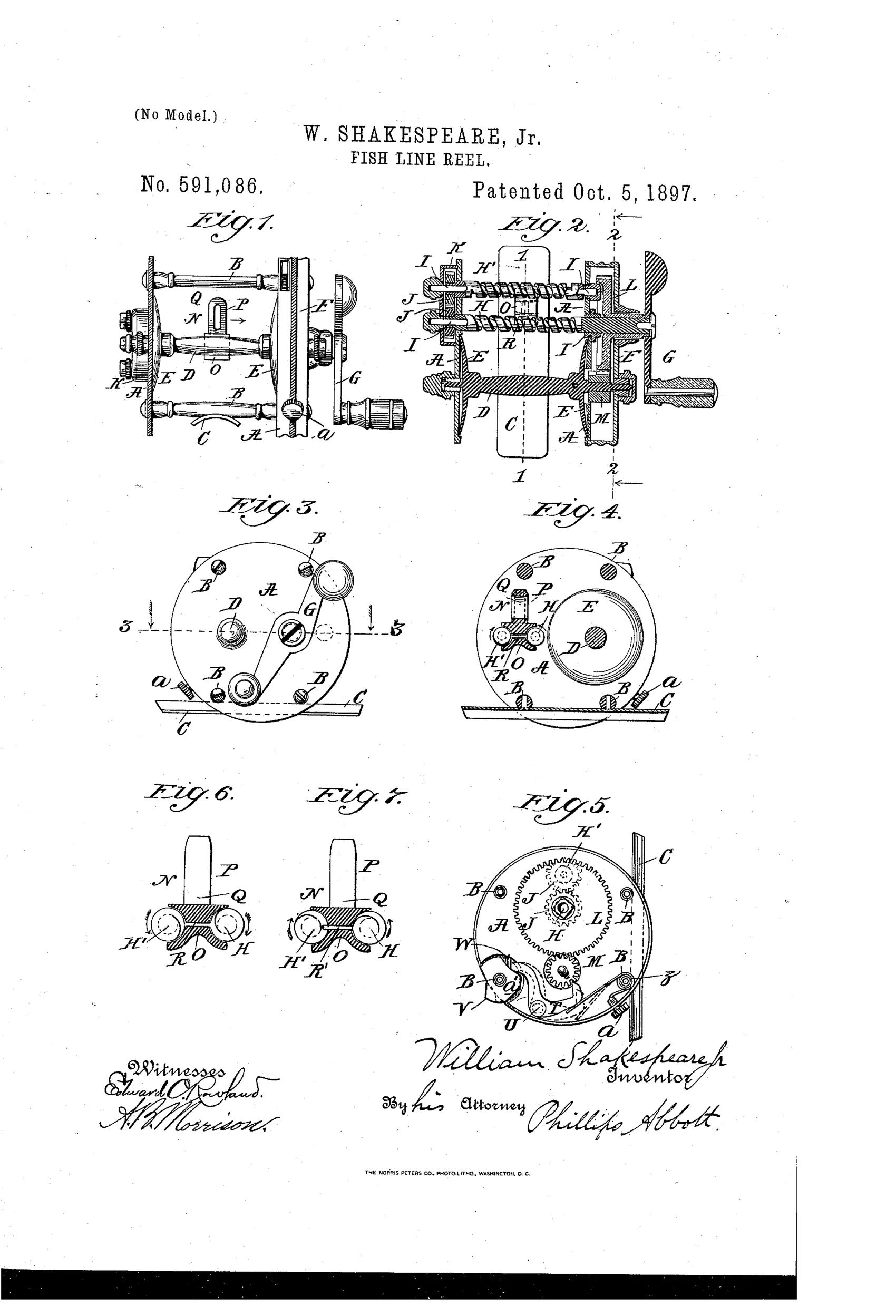
Level-wind fish-line reel with grooved-spindle guide
↻ How it works
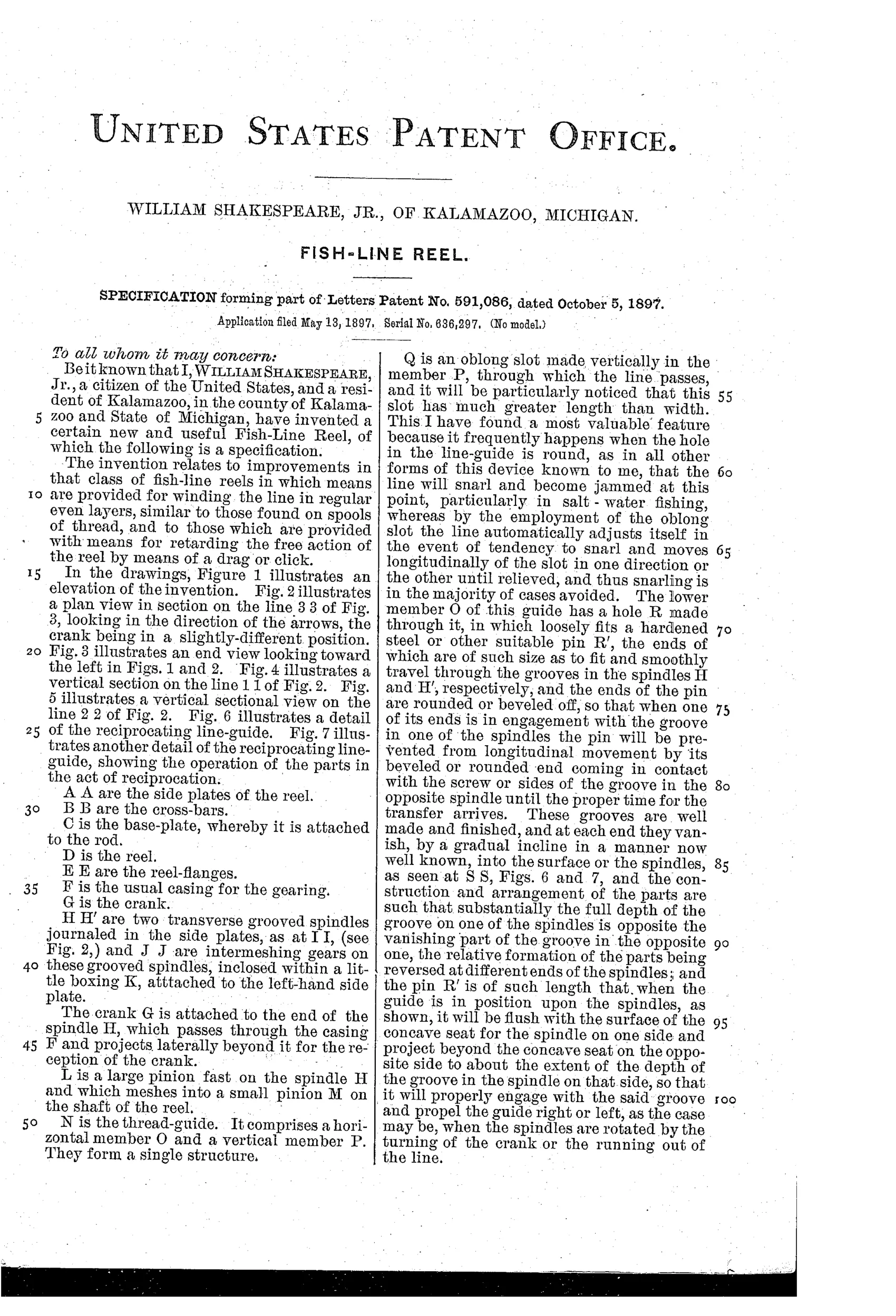
Two parallel grooved spindles are geared together and rotated by a crank, one carrying a large gear meshing into a small gear on the winding-cylinder shaft. A guide-block, having an oblong slot through which the line passes, rides upon these spindles and carries a transversely-movable pin that engages the grooves in the spindles. As the spindles turn, the pin follows the groove of one spindle then, at the vanishing end of that groove, shifts to engage the groove of the opposite spindle, reversing the direction of travel of the guide-block so that the line is laid evenly back and forth across the reel without crossing or snarling. A pivoted click-and-tension device, adjustable by a thumb-screw, engages the teeth of the pinion to retard the free rotation of the reel and can be disengaged by rocking an oscillatory dog.
↻ What was claimed
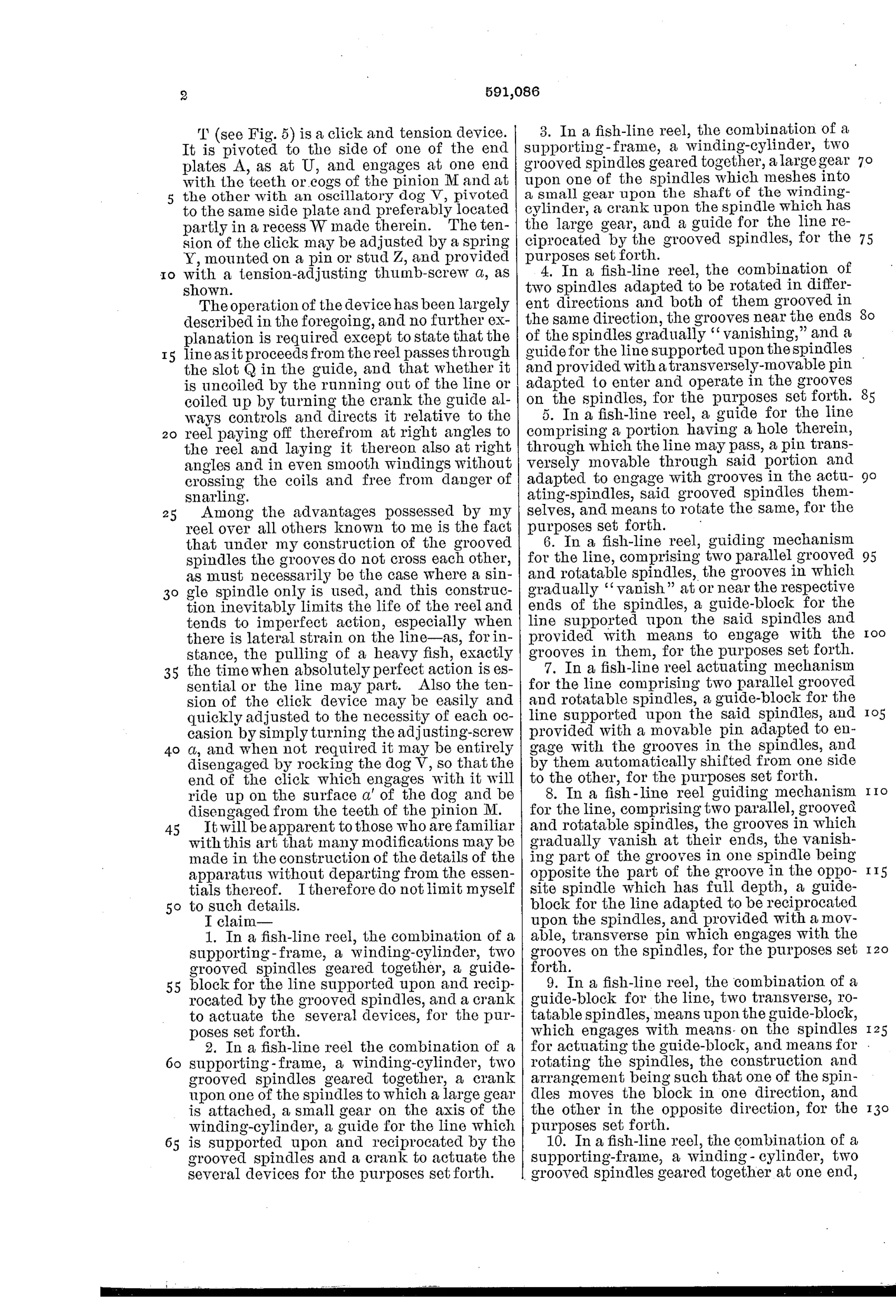
“1. In a fish-line reel, the combination of a supporting-frame, a winding-cylinder, two grooved spindles geared together, a guide-block for the line supported upon and reciprocated by the grooved spindles, and a crank to actuate the several devices, for the purposes set forth.”
In plain English: The reel combines a frame, a winding spool, two geared grooved spindles that move a line-guide block back and forth, and a crank that drives everything.
↻ In the inventor’s words
“This I have found a most valuable feature because it frequently happens when the hole in the line-guide is round, as in all other forms of this device known to me, that the line will snarl and become jammed at this point, particularly in salt-water fishing.”— William Shakespeare, Jr., from the specification
Manufactured and sold
Shakespeare manufactured level-wind reels on this and his follow-on patents from the late 1890s onward, launching the Shakespeare company; early examples are documented by collectors.
↻ Commentary
This is the founding document of one of the great American tackle houses. William Shakespeare, Jr. was a Kalamazoo druggist's son who wanted a reel that laid line evenly by itself, and this patent is his answer: a guide-block riding on two parallel grooved spindles, geared together and driven off the crank. A small pin in the block follows the groove of one spindle until that groove runs out, then shifts across to the opposite spindle and travels back the other way. It is essentially a two-shaft version of what would later be done with a single double-helix worm gear — more parts, but the reversal logic is easy to see in Figs. 6 and 7.
The detail Shakespeare himself was proudest of is easy to skip past: the line-guide's eye is an oblong slot, not a round hole. He says flatly that round-eyed guides snarl and jam, especially in salt water. That's a fisherman's observation, not an engineer's, and it's the kind of thing that separates patents written at a desk from patents written on the water.
Within a few years the two-spindle arrangement gave way to the simpler single worm-shaft level-wind, so mechanically this is a first draft rather than the final form. But the idea — line laid automatically, evenly, every cast — became the defining feature of the twentieth-century casting reel, and the company built on this patent put the mechanism in front of ordinary anglers.
Commentary by Claude, The Fishing Reel Patent Archive’s resident enthusiast