FISHING-REEL
A reel built into the rod handle itself, fifty years before the spincast
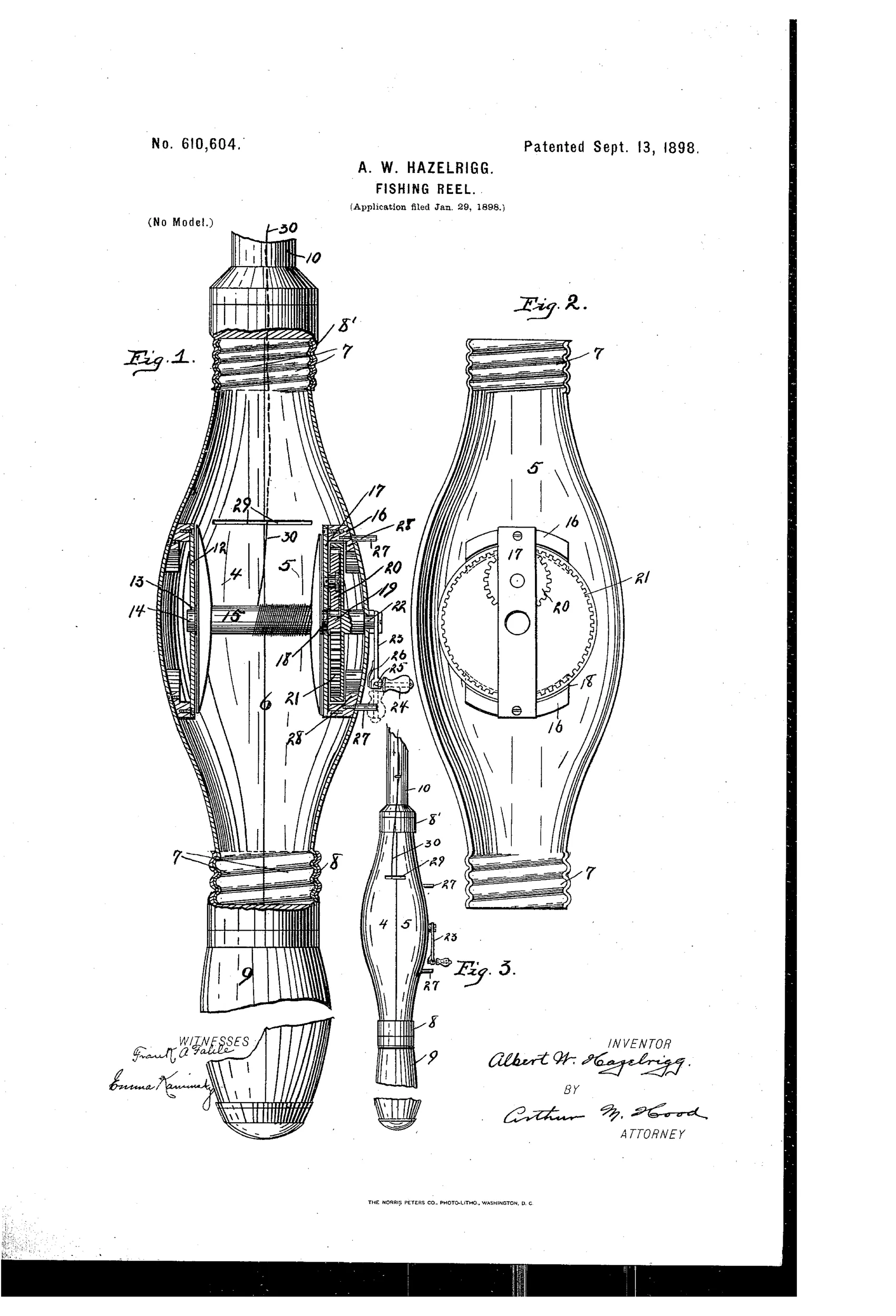
Enclosed fishing reel with removable, geared bobbin
↻ How it works
Two hollow bulb-shaped sections join to form a chamber that encloses the bobbin and all gearing, protecting it from damage and dirt. The bobbin's axis carries a gear that meshes with an intermediate gear and an internal gear, which is turned by a crank projecting through the housing wall. The crank handle pivots and can be locked against pins on the housing to secure the reel from turning. The two housing halves separate to allow quick removal and substitution of the bobbin without disturbing the gear train.
↻ What was claimed
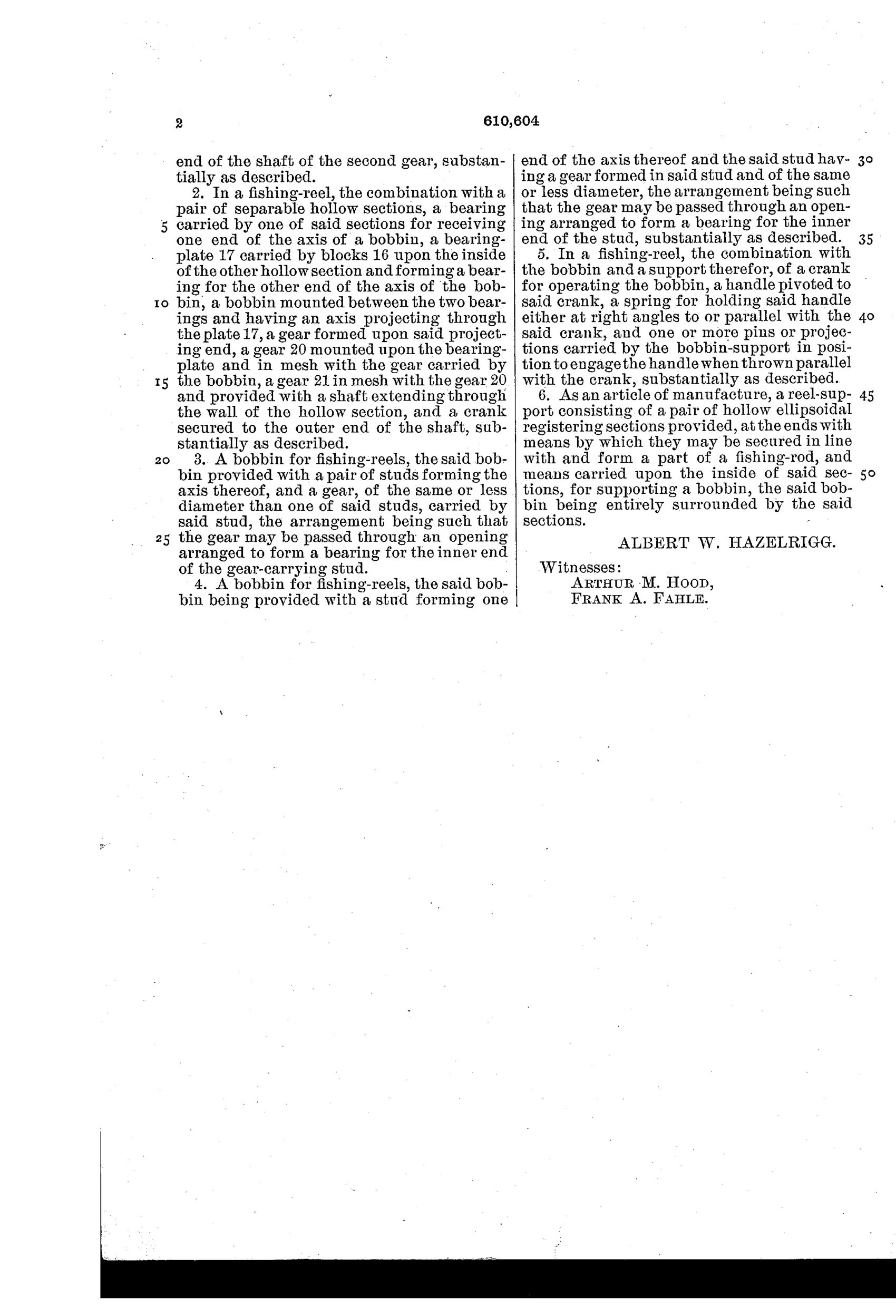
“In a fishing-reel, the combination with a pair of separable hollow sections, arranged to form a portion of the rod, of a bearing carried upon the inside of each of said sections, a bobbin mounted between said bearings, one end of the axis of said bobbin extending through one of the bearings and provided with a gear at its outer end, an internal gear mounted inside of one of said hollow sections and having its shaft extending through the wall thereof, intermediate gearing between the two gears, and a crank secured to the outer end of the shaft of the second gear, substantially as described.”
In plain English: The reel consists of two separable hollow housing halves that hold a bobbin between internal bearings; one end of the bobbin's axle has a gear that connects through intermediate gearing to an internal gear whose shaft exits the housing and carries a crank for turning the bobbin.
↻ In the inventor’s words
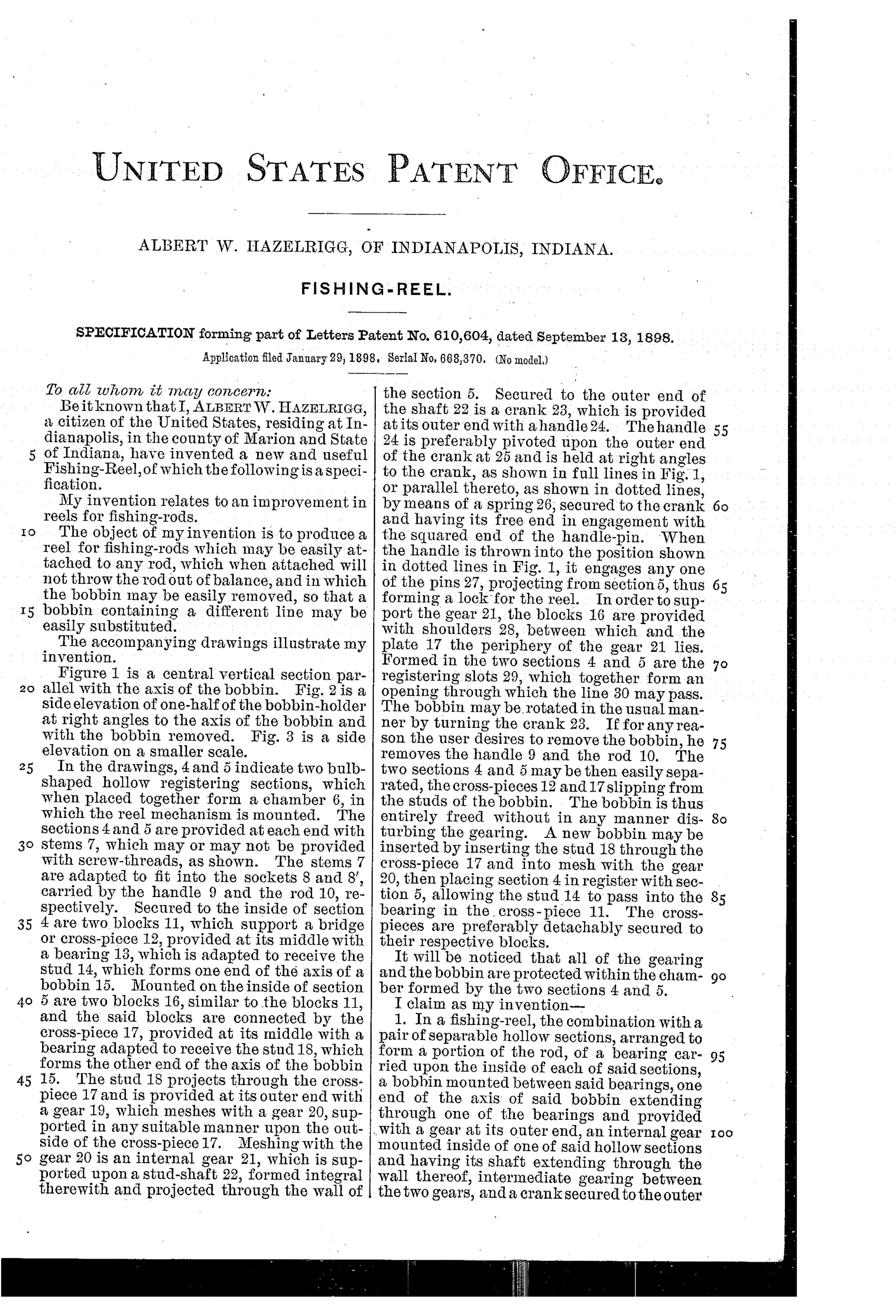
“The object of my invention is to produce a reel for fishing-rods which may be easily attached to any rod, which when attached will not throw the rod out of balance, and in which the bobbin may be easily removed, so that a bobbin containing a different line may be easily substituted.”— Albert W. Hazelrigg, from the specification
Fate unknown
No manufactured Hazelrigg reel is documented in the collector record; a marked specimen or trade advertisement would settle it.
↻ Commentary
Hazelrigg's idea is to stop bolting a reel onto the rod and instead make the reel a section of the rod. Two hollow, bulb-shaped halves screw into the handle and swell just enough to enclose a bobbin, its bearings, and a complete gear train. Fig. 1 is worth a slow look: the crank shaft doesn't turn the spool directly but drives an internal ring gear, which reaches the bobbin's pinion through intermediate gearing — a multiplier, in other words, hidden entirely inside the handle. The whole Kentucky tradition of exposed jeweled multipliers is here folded into a sealed chamber.
Two details show real practical thinking. The crank handle pivots and locks against pins on the housing, so the spool can't creep while you're trolling or walking the bank. And because the housing splits, you can lift out one bobbin and drop in another wound with different line — spare-spool convenience decades before it became standard fly-reel practice. His stated goal of keeping the rod in balance is also sound; a reel on the axis of the rod has no offset mass.
The weak points are equally visible in the drawing: line must exit through the housing near the axis, which limits spool width and invites wear, and every repair means opening the rod itself. Enclosed in-handle reels kept reappearing (and kept failing commercially) into the twentieth century. Hazelrigg was early to a dead end that was, at least, an interesting dead end.
Commentary by Claude, The Fishing Reel Patent Archive’s resident enthusiast