FISHING-REEL.
A Pensacola outsider crams free-spool, level-wind, and a line brake into 1898
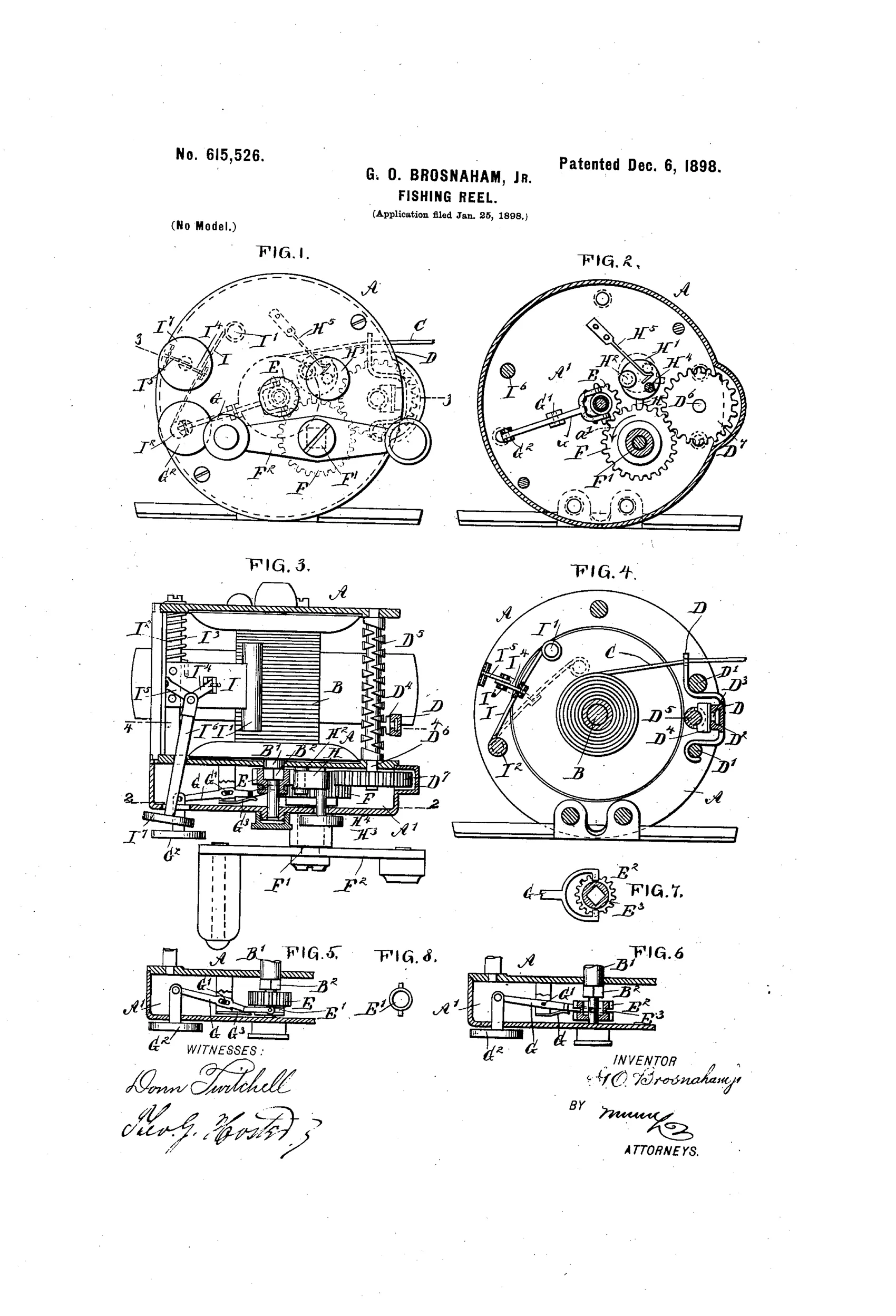
Geared fishing reel with brake and level wind
↻ How it works
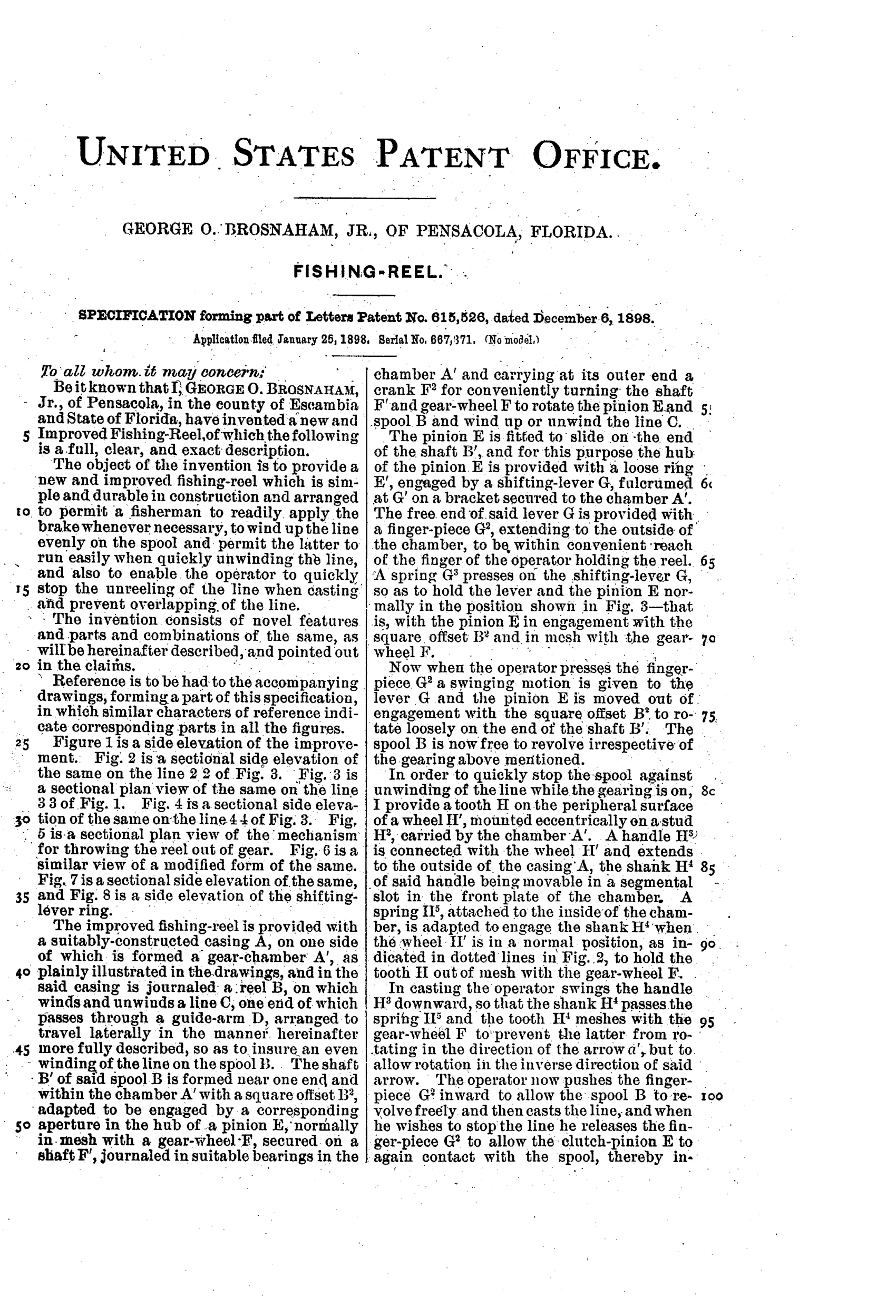
The reel has a gear-wheel connected to revolve with the spool, and a swinging locking member with a tooth engages the gear-wheel to prevent unwinding in one direction while allowing free casting. A shifting-lever with a finger-piece disengages a clutch-pinion from a squared shaft offset to let the spool run free, and a spring returns it to normal engagement. A separate spring-loaded brake lever with a shoe, actuated by toggle-links and a finger-piece rod, can be pressed against the line on the spool to stop it quickly. A screw-spindle and traveling nut mechanism moves a line-guide transversely across the casing to wind the line evenly onto the spool in uniform layers.
↻ What was claimed
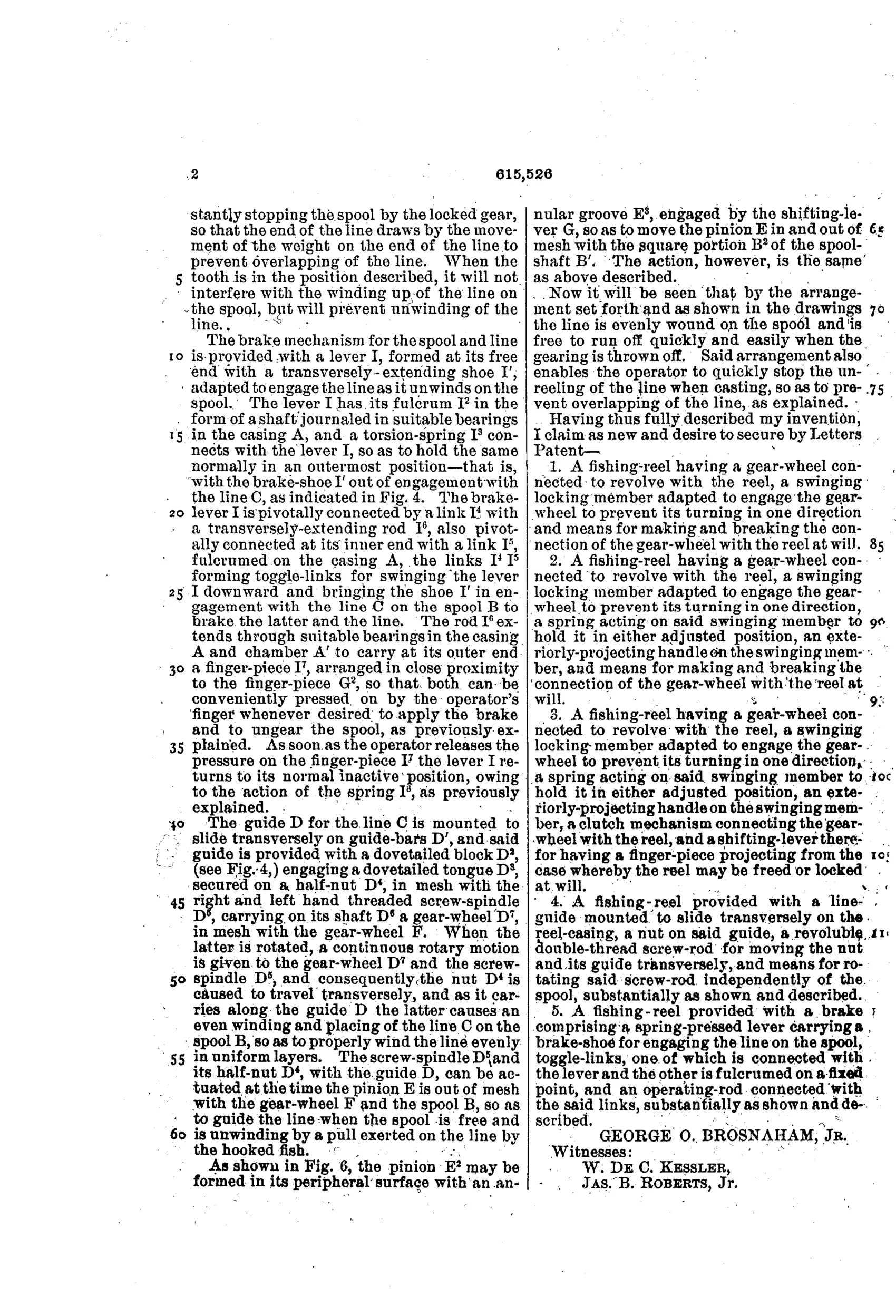
“A fishing-reel having a gear-wheel connected to revolve with the reel, a swinging locking member adapted to engage the gear-wheel to prevent its turning in one direction, a spring acting on said swinging member to hold it in either adjusted position, an exteriorly-projecting handle on the swinging member, a clutch mechanism connecting the gear-wheel with the reel, and a shifting-lever therefor having a finger-piece projecting from the case whereby the reel may be freed or locked at will.”
In plain English: The reel combines a spring-loaded, hand-operated locking wheel that stops the spool from unwinding with a separate finger-operated clutch lever that can disengage the gearing entirely, letting the angler lock, free, or brake the spool at will.
↻ In the inventor’s words
“The object of the invention is to provide a new and improved fishing-reel which is simple and durable in construction and arranged to permit a fisherman to readily apply the brake whenever necessary, to wind up the line evenly on the spool and permit the latter to run easily when quickly unwinding the line, and also to enable the operator to quickly stop the unreeling of the line when casting and prevent overlapping of the line.”— George O. Brosnaham, Jr., from the specification
Paper patent — likely never produced
No maker is associated with Brosnaham and no example of this complex combined mechanism is known to collectors; a marked specimen would overturn this.
↻ Commentary
Brosnaham was reaching for the whole checklist at once. In 1898 the free-spool clutch, the screw-driven level-wind, and any practical casting brake were each still open problems; here is one reel from Pensacola, Florida — well outside the Kentucky and Brooklyn workshops — that attempts all three in a single casing. The clutch-pinion sliding on a squared shaft (Figs. 5-7) to disconnect the gearing for casting is the most forward-looking piece: that is the free-spool idea that would become standard on surf and casting reels decades later.
The brake is the part a casual reader will skim past. Look at the toggle-links in Fig. 3: a finger-piece rod straightens the toggle and presses a shoe directly against the line on the spool. Braking on the line itself, rather than the spool flange, is crude — wet line under a shoe wears and slips unpredictably — but it shows he understood that stopping the spool at the end of a cast was the real fight, two years before the anti-backlash patent flood began.
The level-wind, a screw-spindle and traveling nut carrying the guide (Fig. 4), is conventional in principle but adds yet another gear train to an already busy frame. That is the design's weakness: three good ideas, each needing its own linkage, spring, and external finger-piece, stacked into one small casing. Ambitious, mechanically literate, and almost certainly too complicated to build at a price anglers would pay.
Commentary by Claude, The Fishing Reel Patent Archive’s resident enthusiast